Georgia SS5CG2.a
The Standard
- SS5CG2
- Explain the process by which amendments to the U.S. Constitution are made.
Explain the amendment process outlined in the Constitution.
Georgia Standards of Excellence for Social Studies · Explain the process by which amendments to the U.S. Constitution are made.
Teacher's field guide
What This Standard Means
What Students Need to Do
- Students describe how an amendment is proposed and ratified. They identify the required two-thirds and three-fourths thresholds and explain why broad agreement is needed.
What Mastery Looks Like
- Students can sequence the steps from proposal to ratification. They can name both proposal methods, both ratification methods, and the required level of support for each stage.
Common Misconceptions
- Students may think the president signs amendments or the Supreme Court approves them. They may confuse a simple majority with two-thirds or assume citizens vote directly on amendments nationwide.
How to Assess It
- Exit ticket: Draw and label one valid path for adding an amendment, including who acts and the required support at each stage.
Lesson moves
Ways to Teach It
Give groups 50 state cards and Congress vote tokens, then have students model the two-thirds proposal and three-fourths ratification thresholds.
Write three sentences answering: Why does changing the Constitution require more support than passing an ordinary law?
Play Amendment Pathway Sort, where teams arrange proposal, convention, congressional vote, state action, and ratification cards into valid sequences.
Read a short account of the Twenty-Seventh Amendment, then mark when it was proposed, ratified, and added to the Constitution.
Free download
Printable SS5CG2.a Worksheet
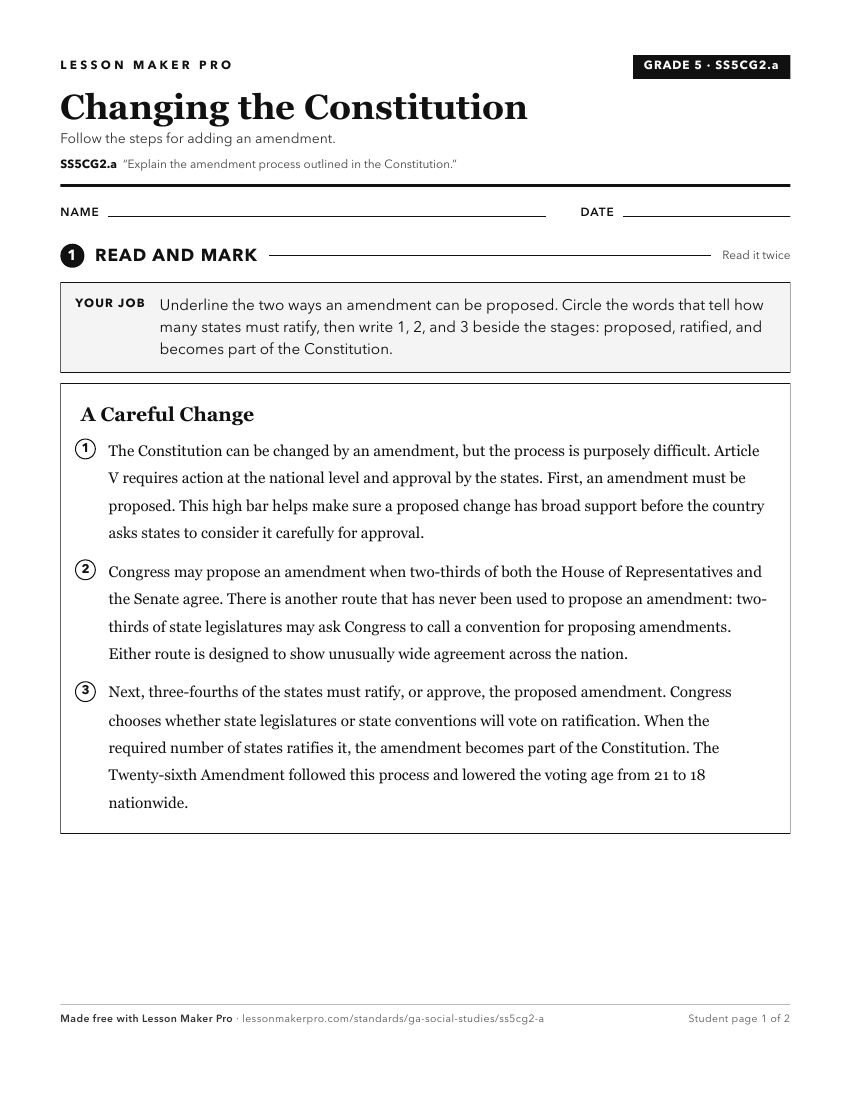
A ready-to-print activity worksheet aligned to SS5CG2.a, with an answer key for the teacher on its own page. No account needed.
PDF, US Letter, prints cleanly in black and white.
Download the worksheetKeep exploring
Related Standards
- SS5CG2
Explain the process by which amendments to the U.S. Constitution are made.
- SS5CG2.b
Describe the purpose for the amendment process.
- SS5CG3.a
Explain how voting rights are protected by the 15th, 19th, 23rd, 24th, and 26th amendments.
- SS5CG3
Explain how amendments to the U. S. Constitution have maintained a representative democracy/republic.
Turn this exact standard into a lesson
Grade, subject, topic, and the complete standard are prefilled. Create one free, no account needed.
Also for this standard:Make a WorksheetMake a QuizMake a Sub Lesson