Georgia S5P1.b
The Standard
- S5P1
- Obtain, evaluate, and communicate information to explain the differences between a physical change and a chemical change.
Construct an argument based on observations to support a claim that the physical changes in the state of water are due to temperature changes, which cause small particles that cannot be seen to move differently.
Georgia Standards of Excellence for Science · Obtain, evaluate, and communicate information to explain the differences between a physical change and a chemical change.
Teacher's field guide
What This Standard Means
What Students Need to Do
- Students observe water as it melts, freezes, evaporates, or condenses. They use evidence to explain how heating and cooling change the motion of water particles.
What Mastery Looks Like
- A student makes a clear claim about why water changed state and supports it with recorded observations. The student explains that particles move faster when heated and slower when cooled.
Common Misconceptions
- Students may think water particles disappear during evaporation or become a new substance. They may also think particles grow larger when heated or that cold is added during freezing.
How to Assess It
- Show a picture of ice melting in a cup. Ask students to write a claim, one observation that supports it, and a particle motion explanation.
Lesson moves
Ways to Teach It
Place an ice cube in a sealed bag, warm it by hand, then cool it over ice and record each visible state change.
Write a claim explaining why droplets form outside a cold cup, using observations and the motion of unseen water particles.
Sort particle diagram cards by solid, liquid, and gas, then match each diagram with heating or cooling.
Observe a puddle over several hours and explain its shrinking using temperature, particle motion, and evidence from the surroundings.
Free download
Printable S5P1.b Worksheet
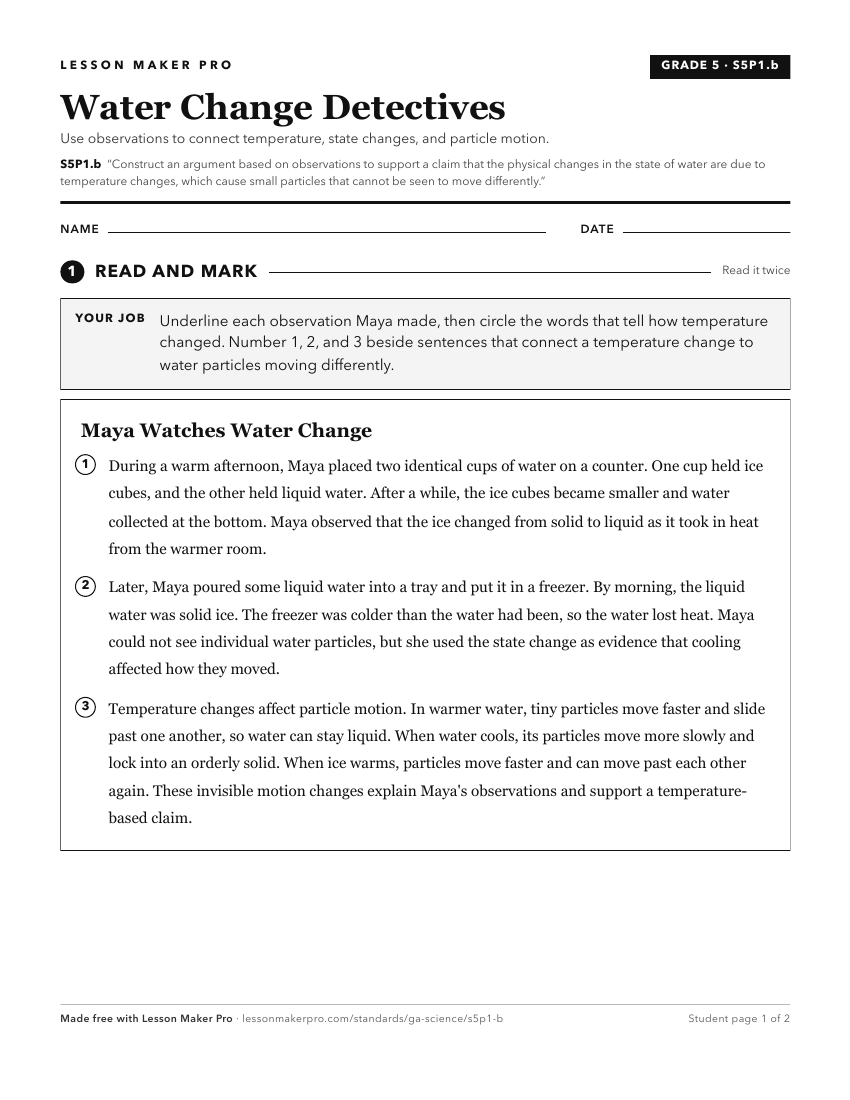
A ready-to-print activity worksheet aligned to S5P1.b, with an answer key for the teacher on its own page. No account needed.
PDF, US Letter, prints cleanly in black and white.
Download the worksheetKeep exploring
Related Standards
- S8P1.d
Construct an argument based on observational evidence to support the claim that when a change in a substance occurs, it can be classified as either chemical or ...
- S2P1.c
Provide evidence from observations to construct an explanation that some changes in matter caused by heating or cooling can be reversed and some changes are irr...
- S4E3.a
Plan and carry out investigations to observe the flow of energy in water as it changes states from solid (ice) to liquid (water) to gas (water vapor) and change...
- S3E1.c
Make observations of the local environment to construct an explanation of how water and/or wind have made changes to soil and/or rocks over time.
Turn this exact standard into a lesson
Grade, subject, topic, and the complete standard are prefilled. Create one free, no account needed.
Also for this standard:Make a WorksheetMake a QuizMake a Sub Lesson