Georgia S4P3.c
The Standard
- S4P3
- Obtain, evaluate, and communicate information about the relationship between balanced and unbalanced forces.
Ask questions to identify and explain the uses of simple machines (lever, pulley, wedge, inclined plane, wheel and axle, and screw) and how forces are changed when simple machines are used to complete tasks.
Georgia Standards of Excellence for Science · Obtain, evaluate, and communicate information about the relationship between balanced and unbalanced forces.
Teacher's field guide
What This Standard Means
What Students Need to Do
- Students examine tools and identify the simple machine involved. They ask questions that can be answered by testing the effort needed. They explain changes in force, direction, or distance.
What Mastery Looks Like
- Students can identify simple machines in familiar and unfamiliar objects. They can compare the effort force with and without the machine. Their explanation names the tradeoff between force and distance.
Common Misconceptions
- Students may think simple machines create energy or remove all work. They may call every slanted object a wedge or every round object a wheel and axle. They often overlook changes in direction or distance.
How to Assess It
- Show pictures of a flagpole pulley, ramp, and doorknob. Students label each, explain how one changes force, and write one question they could test.
Lesson moves
Ways to Teach It
Use a spring scale to pull the same block straight up and up a ramp, then compare force readings and pulling distances.
Write: Why can a longer ramp make lifting a box feel easier, and what tradeoff does it create?
Sort photo cards into the six simple machine types, then justify each choice to a partner.
Survey the classroom for four simple machines, sketch each object, and label the effort, load, and force change.
Free download
Printable S4P3.c Worksheet
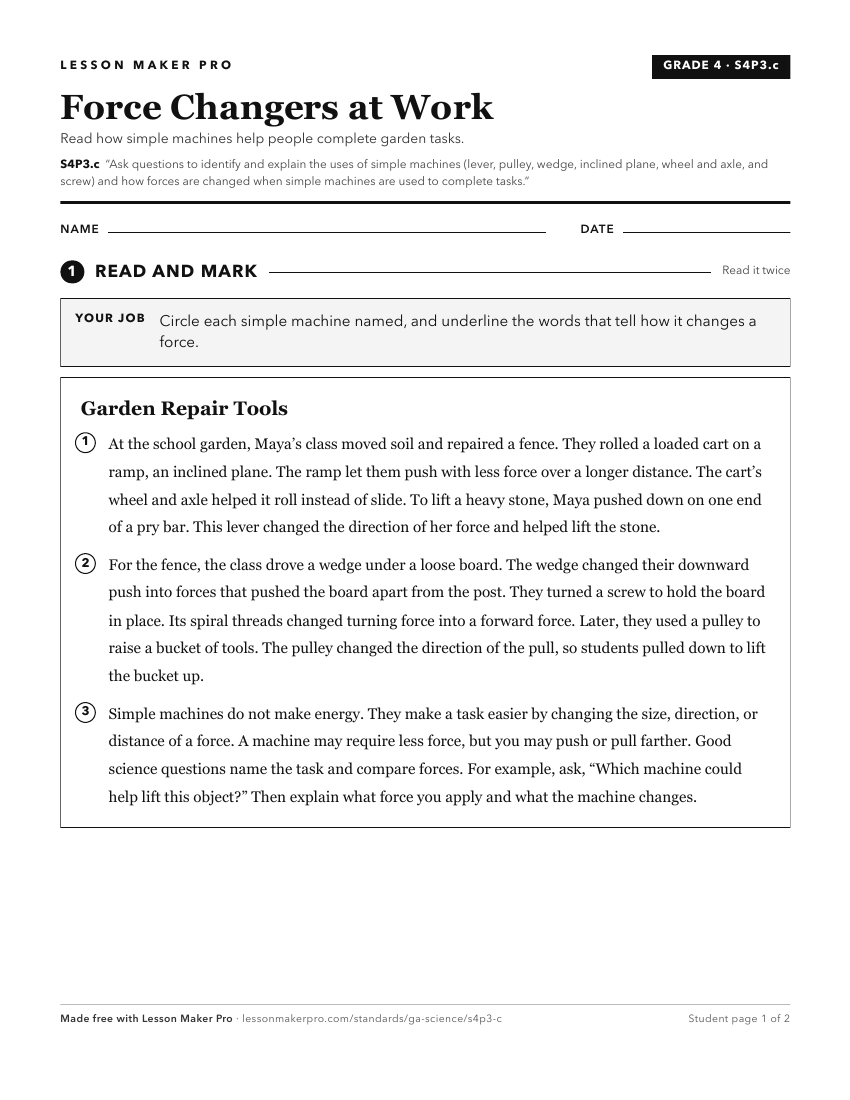
A ready-to-print activity worksheet aligned to S4P3.c, with an answer key for the teacher on its own page. No account needed.
PDF, US Letter, prints cleanly in black and white.
Download the worksheetKeep exploring
Related Standards
- S2P2
Obtain, evaluate, and communicate information to explain the effect of a force (a push or a pull) in the movement of an object (changes in speed and direction).
- S4P3
Obtain, evaluate, and communicate information about the relationship between balanced and unbalanced forces.
- S2P2.a
Plan and carry out an investigation to demonstrate how pushing and pulling on an object affects the motion of the object.
- S2P2.c
Record and analyze data to decide if a design solution works as intended to change the speed or direction of an object with a force (a push or a pull).
Turn this exact standard into a lesson
Grade, subject, topic, and the complete standard are prefilled. Create one free, no account needed.
Also for this standard:Make a WorksheetMake a QuizMake a Sub Lesson