Georgia S4L1.a
The Standard
- S4L1
- Obtain, evaluate, and communicate information about the roles of organisms and the flow of energy within an ecosystem.
Develop a model to describe the roles of producers, consumers, and decomposers in a community.
Georgia Standards of Excellence for Science · Obtain, evaluate, and communicate information about the roles of organisms and the flow of energy within an ecosystem.
Teacher's field guide
What This Standard Means
What Students Need to Do
- Students build a model showing producers, consumers, and decomposers in one community. They label each role and use arrows to show how food and energy move between organisms.
What Mastery Looks Like
- Students correctly classify plants, animals, fungi, and bacteria by their roles. They explain that producers make food, consumers eat organisms, and decomposers break down dead material.
Common Misconceptions
- Students may think all consumers are predators or that fungi are plants. They may also think decomposers create waste instead of returning nutrients to the environment.
How to Assess It
- Give students pictures of grass, a rabbit, a hawk, and a mushroom. Ask them to label each role, add arrows, and explain the mushroom’s job.
Lesson moves
Ways to Teach It
Use organism cards, yarn, and role labels to build a model of a forest community on the classroom floor.
Write a response to this prompt: What would happen in a pond community if all decomposers disappeared?
Play a sorting relay where teams place organism cards under producer, consumer, or decomposer and explain each choice.
Survey the schoolyard for plants, animals, fungi, and decay, then record each organism’s likely role in the community.
Free download
Printable S4L1.a Worksheet
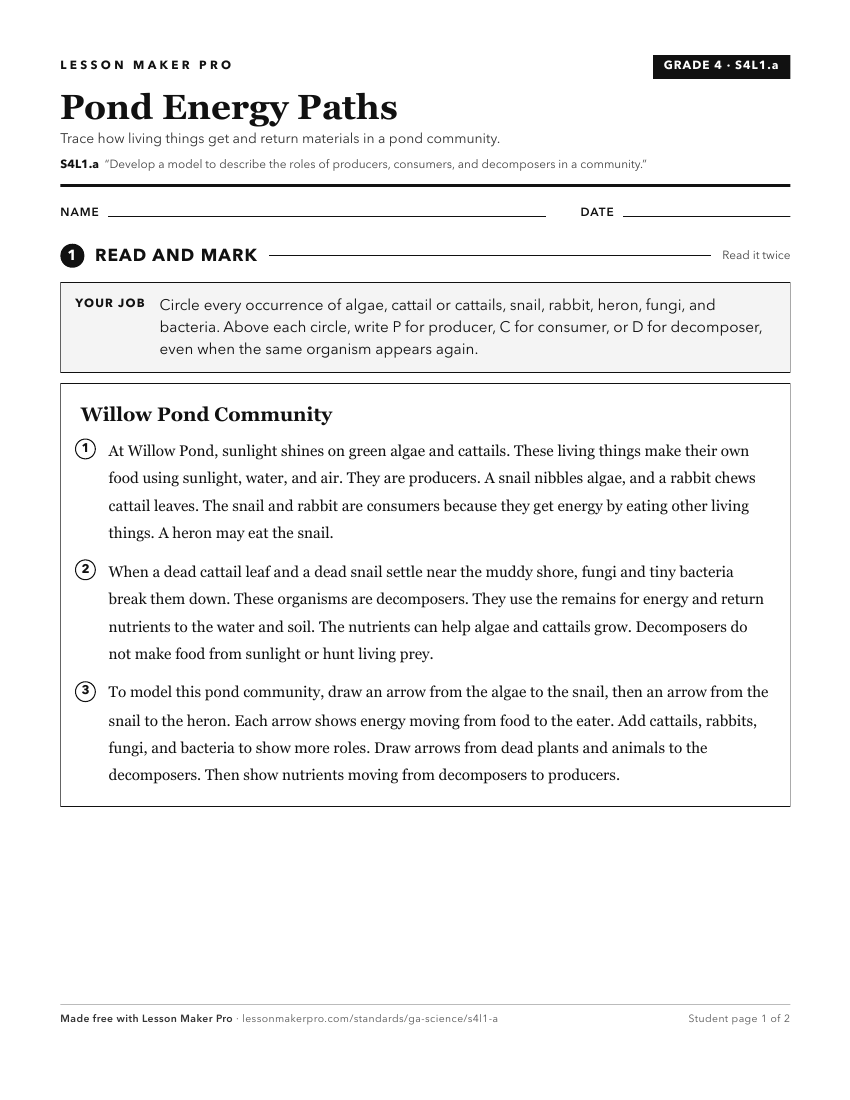
A ready-to-print activity worksheet aligned to S4L1.a, with an answer key for the teacher on its own page. No account needed.
PDF, US Letter, prints cleanly in black and white.
Download the worksheetKeep exploring
Related Standards
- S4L1.b
Develop simple models to illustrate the flow of energy through a food web/food chain beginning with sunlight and including producers, consumers, and decomposers...
- SKL1.b
Develop a model to represent how a set of organisms and non-living objects are sorted into groups based on their attributes.
- S7L4.b
Develop a model to describe the cycling of matter and the flow of energy among biotic and abiotic components of an ecosystem.
- S7L4.a
Construct an explanation for the patterns of interactions observed in different ecosystems in terms of the relationships among and between organisms and abiotic...
Turn this exact standard into a lesson
Grade, subject, topic, and the complete standard are prefilled. Create one free, no account needed.
Also for this standard:Make a WorksheetMake a QuizMake a Sub Lesson