Georgia S1E1.b
The Standard
- S1E1
- Obtain, evaluate, and communicate weather data to identify weather patterns.
Ask questions to identify forms of precipitation such as rain, snow, sleet, and hailstones as either solid (ice) or liquid (water).
Georgia Standards of Excellence for Science · Obtain, evaluate, and communicate weather data to identify weather patterns.
Teacher's field guide
What This Standard Means
What Students Need to Do
- Students ask simple questions about what falls from clouds and use observations or pictures to identify it. They sort each form by whether it is liquid water or solid ice.
What Mastery Looks Like
- A student correctly names rain, snow, sleet, and hail from clear examples. The student classifies rain as liquid and the other three as solid, then explains the choice using visible details.
Common Misconceptions
- Students may think sleet is very cold rain and classify it as liquid. They may confuse hail with snow or think melting changes what the precipitation was when it fell.
How to Assess It
- Show pictures of rain, snow, sleet, and hail. Ask students to label each picture, circle solid or liquid, and write one question about an example.
Lesson moves
Ways to Teach It
Students examine cups of water, shaved ice, ice pellets, and ice balls, then label each model and sort it as solid or liquid.
Show a picture of sleet and ask, "What questions could help us decide whether it is solid or liquid?"
Play Precipitation Four Corners: call out or show a weather clue, and students move to rain, snow, sleet, or hail, then say solid or liquid.
Read a local forecast naming rain, snow, sleet, or hail, and have students mark whether people would see liquid water or ice.
Free download
Printable S1E1.b Worksheet
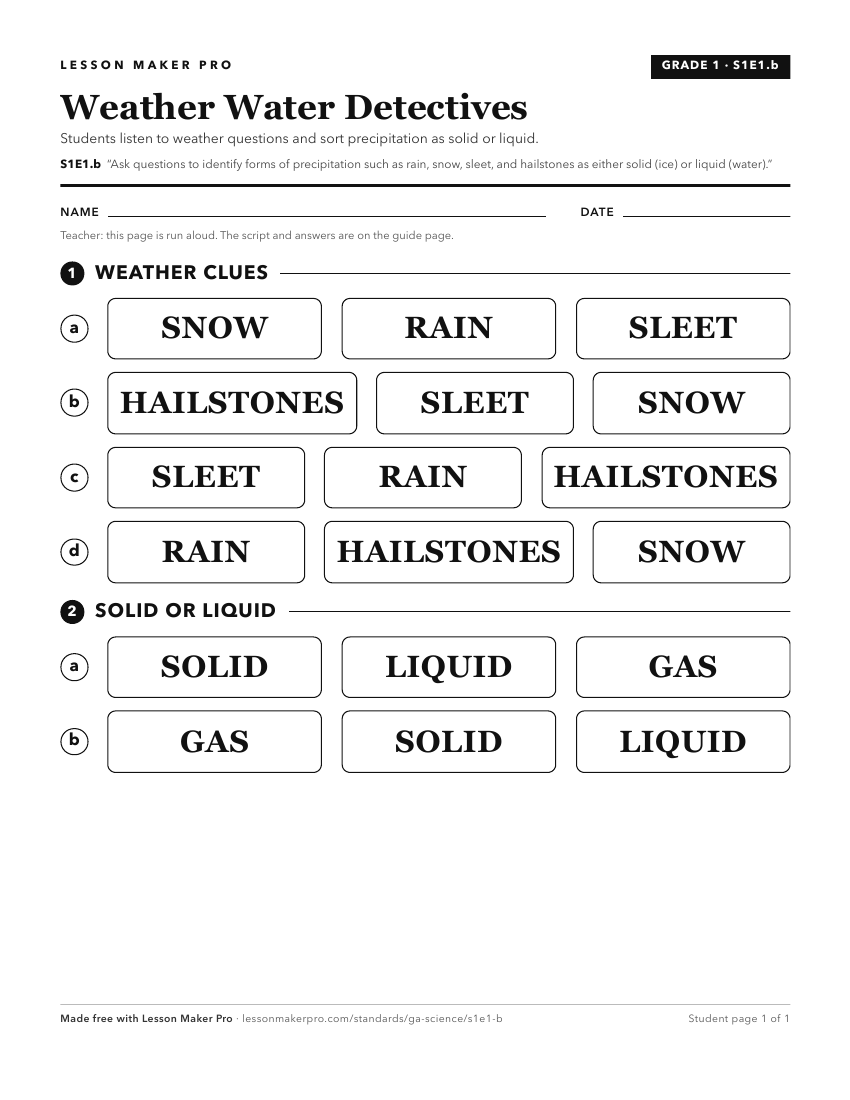
A ready-to-print activity worksheet aligned to S1E1.b, with an answer key for the teacher on its own page. No account needed.
PDF, US Letter, prints cleanly in black and white.
Download the worksheetKeep exploring
Related Standards
- SKE2.a
Ask questions to identify and describe earth materials—soil, rocks, water, and air.
- S4E4.c
Ask questions and use observations of cloud types (cirrus, stratus, and cumulus) and data of weather conditions to predict weather events.
- S2P1.a
Ask questions to describe and classify different objects according to their physical properties.
- S6E3.a
Ask questions to determine where water is located on Earth's surface (oceans, rivers, lakes, swamps, groundwater, aquifers, and ice) and communicate the relativ...
Turn this exact standard into a lesson
Grade, subject, topic, and the complete standard are prefilled. Create one free, no account needed.
Also for this standard:Make a WorksheetMake a QuizMake a Sub Lesson