Georgia 8.NR.1.2
The Standard
Approximate irrational numbers to compare the size of irrational numbers, locate them approximately on a number line, and estimate the value of expressions.
Georgia's K-12 Mathematics Standards · Solve problems involving irrational numbers and rational approximations of irrational numbers to explain realistic applications.
Teacher's field guide
What This Standard Means
What Students Need to Do
- Students estimate irrational values using nearby perfect squares, benchmark decimals, or calculator results. They use those estimates to order values, plot them, and find reasonable values for expressions.
What Mastery Looks Like
- A student can show that √30 lies between 5 and 6, refine it to about 5.5, and place it correctly. The student can compare √50 with 7.1 and estimate an expression such as 2π + √5.
Common Misconceptions
- Students may assume every square root is irrational, including √49. They may compare decimal approximations by digit count, or round each value too early. Some incorrectly write √20 as √16 + √4.
How to Assess It
- Exit ticket: Estimate √27 to the nearest tenth and plot it on a number line from 5 to 6. Then decide whether √27 + π is greater than 8.3, and show your estimates.
Lesson moves
Ways to Teach It
Build a floor number line from 0 to 10, then have students place cards labeled √2, √10, √27, and 2π.
Ask students to write which is closer to 6, √33 or √40, using decimal estimates and each value's distance from 6.
Play a matching game with three card types: irrational expressions, decimal approximations, and number-line intervals.
Calculate the diagonal of a 1-meter square garden bed, then mark a practical approximation on a tape measure.
Free download
Printable 8.NR.1.2 Worksheet
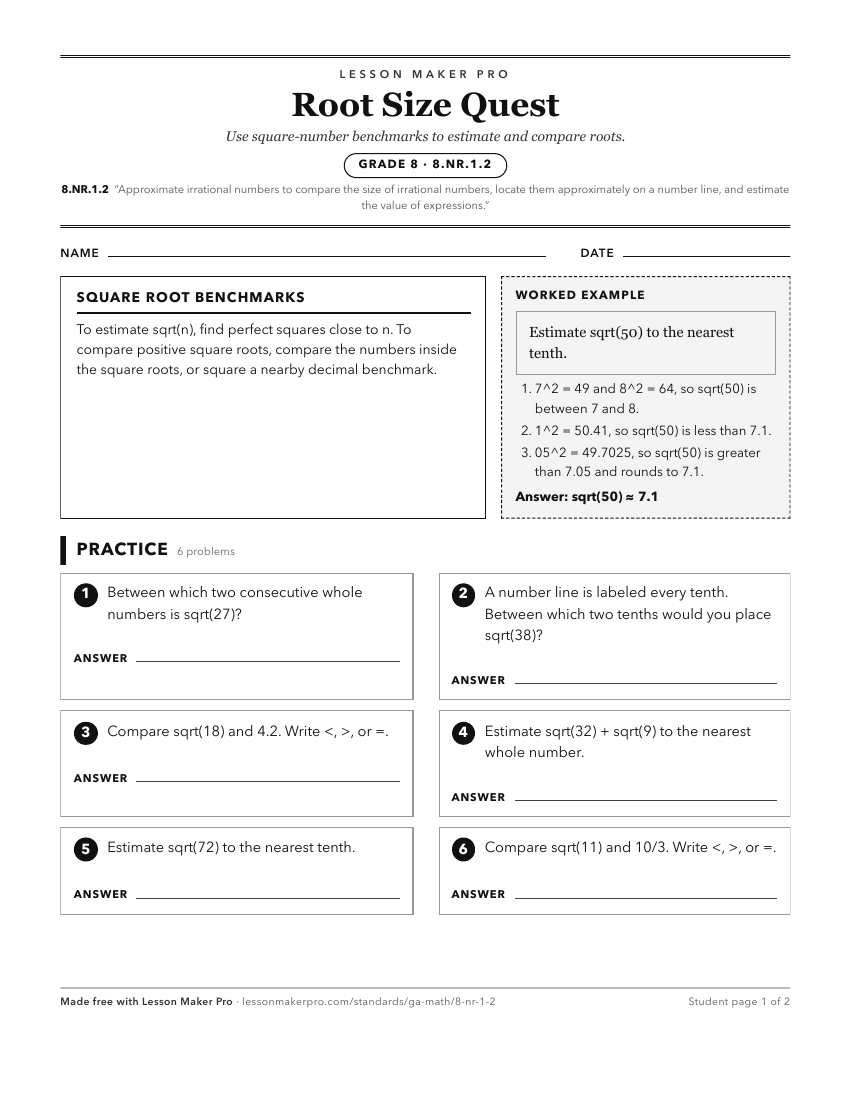
A ready-to-print activity worksheet aligned to 8.NR.1.2, with an answer key for the teacher on its own page. No account needed.
PDF, US Letter, prints cleanly in black and white.
Download the worksheetKeep exploring
Related Standards
- 6.NR.3
Solve a variety of problems involving whole numbers and their opposites; model rational numbers on a number line to describe problems presented in relevant, mat...
- 6.PAR.8.1
Locate and position rational numbers on a horizontal or vertical number line; find and position pairs of integers and other rational numbers on a coordinate pla...
- 8.NR.1.1
Distinguish between rational and irrational numbers using decimal expansion. Convert a decimal expansion which repeats eventually into a rational number.
- 8.NR.1
Solve problems involving irrational numbers and rational approximations of irrational numbers to explain realistic applications.
Turn this exact standard into a lesson
Grade, subject, topic, and the complete standard are prefilled. Create one free, no account needed.
Also for this standard:Make a WorksheetMake a QuizMake a Sub Lesson