Georgia 7.PAR.2.2
The Standard
Rewrite an expression in different forms from a contextual problem to clarify the problem and show how the quantities in it are related.
Georgia's K-12 Mathematics Standards · Use properties of operations, generate equivalent expressions and interpret the expressions to explain relevant contextual situations.
Teacher's field guide
What This Standard Means
What Students Need to Do
- Students represent a situation with an algebraic expression, then rewrite it by distributing, factoring, or combining like terms. They explain how each form shows a different part of the situation.
What Mastery Looks Like
- Given 3(x + 5), a student can write 3x + 15 and explain what each term represents in the situation. The student can verify equivalence by substitution or calculation.
Common Misconceptions
- Students may distribute a factor to only the variable term, such as rewriting 4(x + 3) as 4x + 3. They may combine unlike terms or fail to connect numbers in the rewritten form to the situation.
How to Assess It
- Exit ticket: A school orders 6 boxes, each containing x blue markers and 4 red markers. Write two equivalent expressions for the total and explain what 24 represents.
Lesson moves
Ways to Teach It
Give pairs four sealed bags marked x and 12 loose counters, then have them arrange the materials to model 4(x + 3) and 4x + 12.
Ask students to compare 5(n + 2) and 5n + 10, then write what the 10 represents in a ticket-buying situation.
Create matching cards with short situations, factored expressions, expanded expressions, and interpretations for students to sort into complete sets.
Use a pizza menu to write and rewrite the cost of several identical orders, then explain what each number represents.
Free download
Printable 7.PAR.2.2 Worksheet
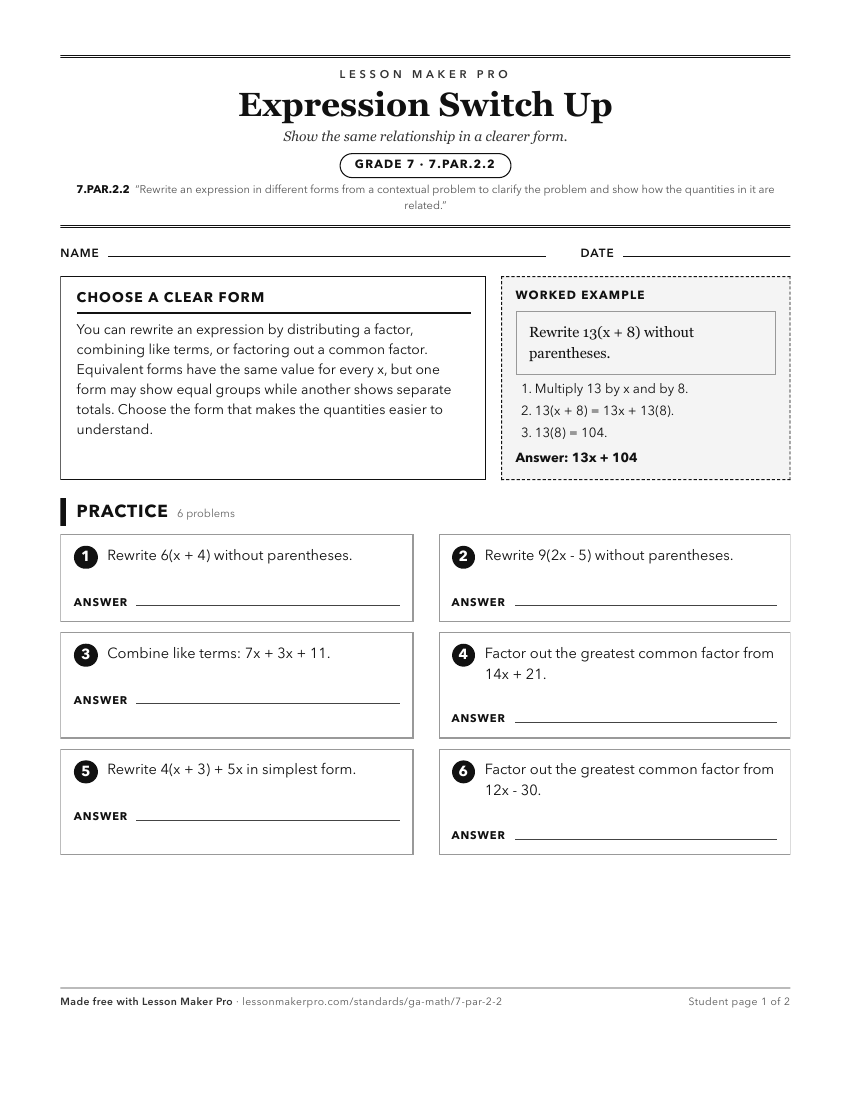
A ready-to-print activity worksheet aligned to 7.PAR.2.2, with an answer key for the teacher on its own page. No account needed.
PDF, US Letter, prints cleanly in black and white.
Download the worksheetKeep exploring
Related Standards
- 8.FGR.5.6
Write a linear function defined by an expression in different but equivalent forms to reveal and explain different properties of the function.
- 6.PAR.6.4
Evaluate expressions when given values for the variables, including expressions that arise in everyday situations.
- 8.PAR.3.1
Interpret expressions and parts of an expression, in context, by utilizing formulas or expressions with multiple terms and/or factors.
- 7.PAR.2
Use properties of operations, generate equivalent expressions and interpret the expressions to explain relevant contextual situations.
Turn this exact standard into a lesson
Grade, subject, topic, and the complete standard are prefilled. Create one free, no account needed.
Also for this standard:Make a WorksheetMake a QuizMake a Sub Lesson