Georgia 5.PAR.6
Georgia Standard (Expectation Cluster)
Solve relevant problems by creating and analyzing numerical patterns using the given rule(s).
Georgia's K-12 Mathematics Standards
Cluster contents
Expectations in This Standard
5.PAR.6 is a Georgia mathematics standard. These are the expectations under it.
Teacher's field guide
What This Cluster Means
What Students Need to Do
- Students use a starting number and a repeated rule to generate terms in a pattern. They organize terms in a table, compare patterns, explain relationships, and solve context problems.
What Mastery Looks Like
- Students correctly extend a pattern, complete missing terms, and state the rule. They compare two patterns and use the relationship to answer a question or predict a later term.
Common Misconceptions
- Students may apply the rule only once instead of repeating it for each new term. They may ignore the starting number or describe a relationship that fits only one pair of terms.
How to Assess It
- Give this exit ticket: “Plan A starts at 5 and adds 3 each week. Plan B starts at 10 and adds 6. List five terms and explain the relationship.”
Lesson moves
Ways to Teach It
Build two cube towers, adding 2 cubes to one and 4 to the other each round, then record and compare five terms.
Ask students to explain in writing how changing the starting number affects a pattern when the repeated rule stays the same.
Play a matching game with cards showing starting numbers, rules, sequences, and descriptions of relationships between two patterns.
Compare two weekly savings plans using a table, then decide when each plan reaches a given amount.
Free download
Printable 5.PAR.6 Worksheet
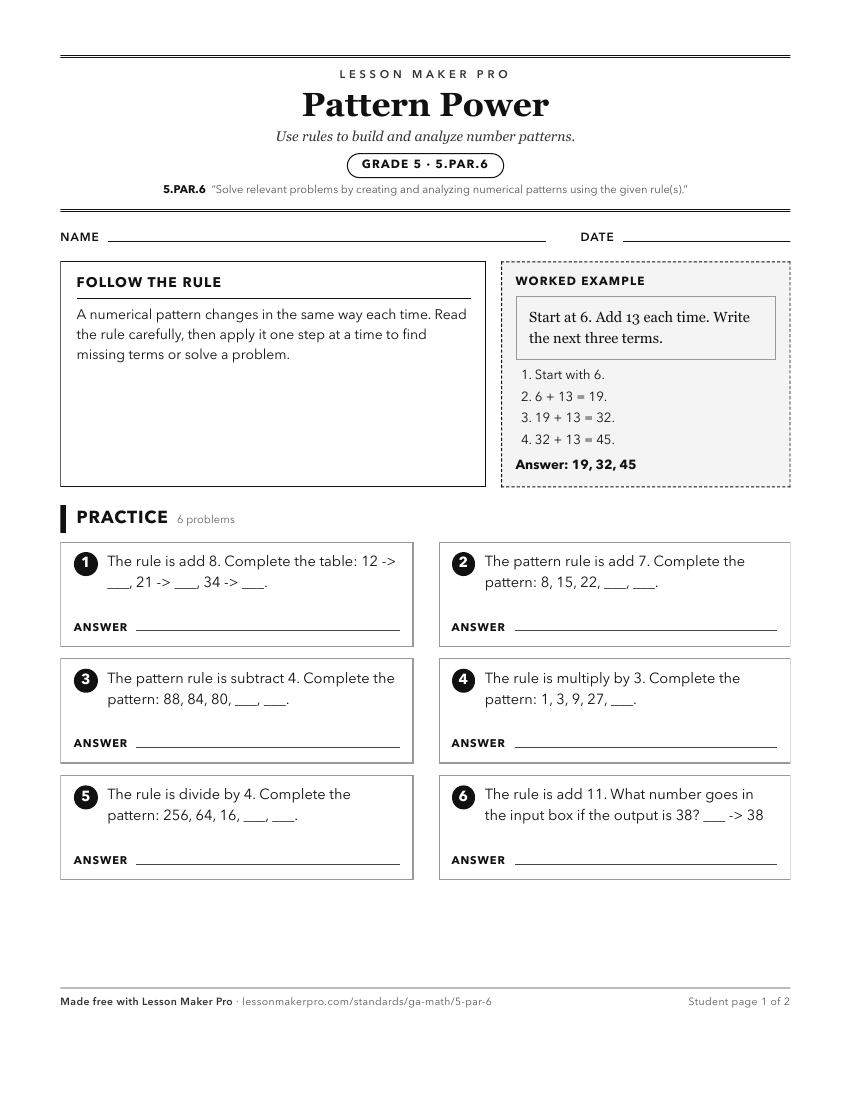
A ready-to-print activity worksheet aligned to 5.PAR.6, with an answer key for the teacher on its own page. No account needed.
PDF, US Letter, prints cleanly in black and white.
Download the worksheetKeep exploring
Related Standards
- K.PAR.6.1
Create, extend, and describe repeating patterns with numbers and shapes, and explain the rationale for the pattern.
- 2.PAR.4.1
Identify, describe, and create a numerical pattern resulting from repeating an operation such as addition and subtraction.
- 4.PAR.3.2
Use input-output rules, tables, and charts to represent and describe patterns, find relationships, and solve problems.
Turn this cluster into a lesson
Grade, subject, topic, and the complete cluster are prefilled. Create one free, no account needed.
Also for this cluster:Make a WorksheetMake a QuizMake a Sub Lesson