Georgia 4.PAR.3.2
The Standard
Use input-output rules, tables, and charts to represent and describe patterns, find relationships, and solve problems.
Georgia's K-12 Mathematics Standards · Generate and analyze patterns, including those involving shapes, input/output diagrams, factors, multiples, prime numbers, and composite numbers.
Teacher's field guide
What This Standard Means
What Students Need to Do
- Students use a given rule to find outputs and missing inputs in a table. They study pairs, identify the rule, and explain how the two quantities are related.
What Mastery Looks Like
- A student can complete a table accurately, name a rule that works for every pair, and test it. The student can use the relationship to solve a short problem and explain the reasoning.
Common Misconceptions
- Students may apply each operation to the previous output instead of returning to the input. They may choose a rule that fits only one pair, reverse input and output, or assume every pattern uses addition.
How to Assess It
- Exit ticket: Complete the table for the rule “multiply by 3, then add 1”: inputs 2, 4, 7; outputs __, __, __. Then find the input for an output of 25 and explain your reasoning.
Lesson moves
Ways to Teach It
Build a cardboard function machine, feed numbered cards through it, and attach output cards using rules such as double then add three.
Show the pairs (1, 5), (2, 8), and (4, 14), then ask students to write and defend one rule that fits all pairs.
Play Rule Detective: one student chooses a rule, classmates request three inputs, record outputs, and earn a point for naming and testing the rule.
Model a taxi fare with a $4 starting fee plus $2 per mile, then complete a table for 0 through 5 miles.
Free download
Printable 4.PAR.3.2 Worksheet
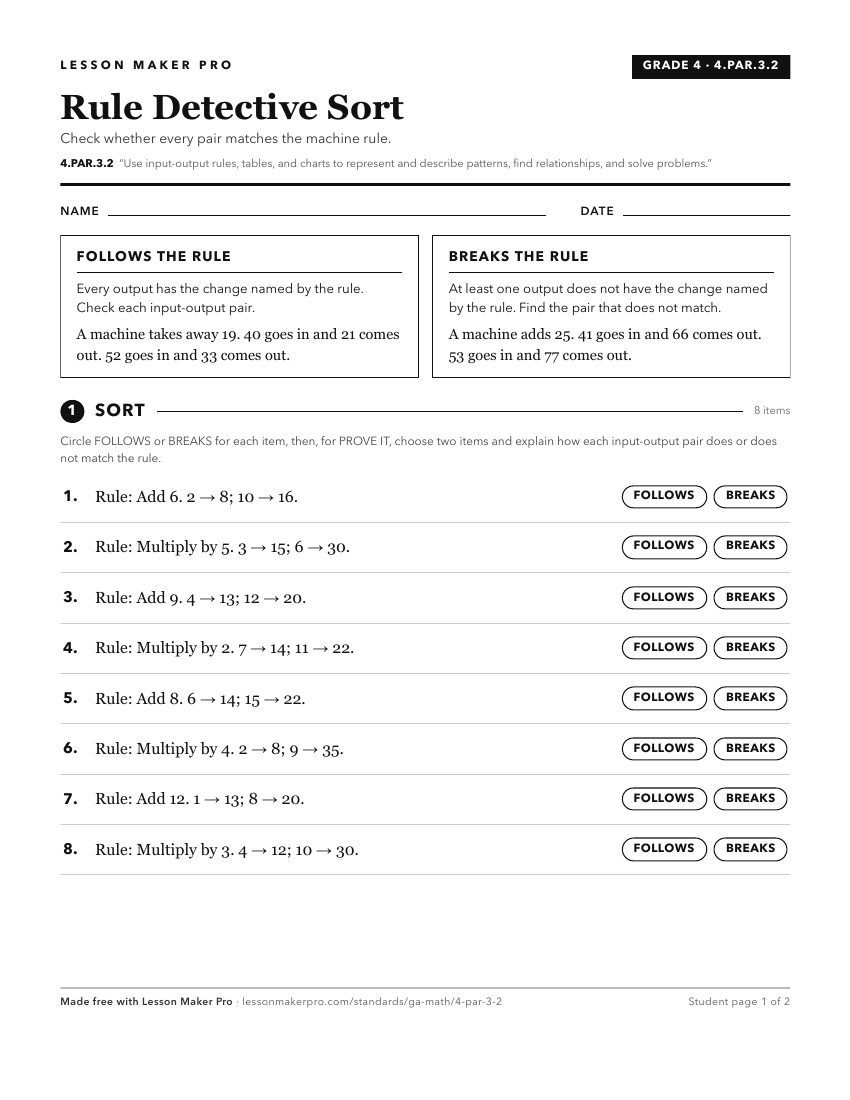
A ready-to-print activity worksheet aligned to 4.PAR.3.2, with an answer key for the teacher on its own page. No account needed.
PDF, US Letter, prints cleanly in black and white.
Download the worksheetKeep exploring
Related Standards
- 5.PAR.6.1
Generate two numerical patterns using two given rules. Identify apparent relationships between corresponding terms by completing a table.
- 7.PAR.4
Recognize proportional relationships in relevant, mathematical problems; represent, solve, and explain these relationships with tables, graphs, and equations.
- 5.PAR.6
Solve relevant problems by creating and analyzing numerical patterns using the given rule(s).
- 4.PAR.3
Generate and analyze patterns, including those involving shapes, input/output diagrams, factors, multiples, prime numbers, and composite numbers.
Turn this exact standard into a lesson
Grade, subject, topic, and the complete standard are prefilled. Create one free, no account needed.
Also for this standard:Make a WorksheetMake a QuizMake a Sub Lesson