Georgia 4.PAR.3.4
The Standard
Identify composite numbers and prime numbers and explain the relationship with the factor pairs.
Georgia's K-12 Mathematics Standards · Generate and analyze patterns, including those involving shapes, input/output diagrams, factors, multiples, prime numbers, and composite numbers.
Teacher's field guide
What This Standard Means
What Students Need to Do
- Students find every factor pair for a whole number. They use those pairs to decide whether the number is prime, composite, or neither, and explain why.
What Mastery Looks Like
- A student can list all factor pairs without repeats or omissions. They can explain why 29 is prime, 36 is composite, and 1 is neither.
Common Misconceptions
- Students may call 1 prime because it has only one factor. They may also assume every odd number is prime or miss factor pairs by checking randomly.
How to Assess It
- Give students 21 and 23. Ask them to list each number’s factor pairs, classify each number, and justify both classifications in one sentence.
Lesson moves
Ways to Teach It
Use square tiles to build every possible rectangular array for numbers 1 through 30, then record each array as a factor pair.
Ask students to compare 17 and 18, then explain how their factor pairs determine each classification.
Play Factor Pair Sort by drawing number cards, listing factor pairs, and placing each card under prime, composite, or neither.
Plan equal rows for 24 garden plants, then explain how the possible row arrangements show that 24 is composite.
Free download
Printable 4.PAR.3.4 Worksheet
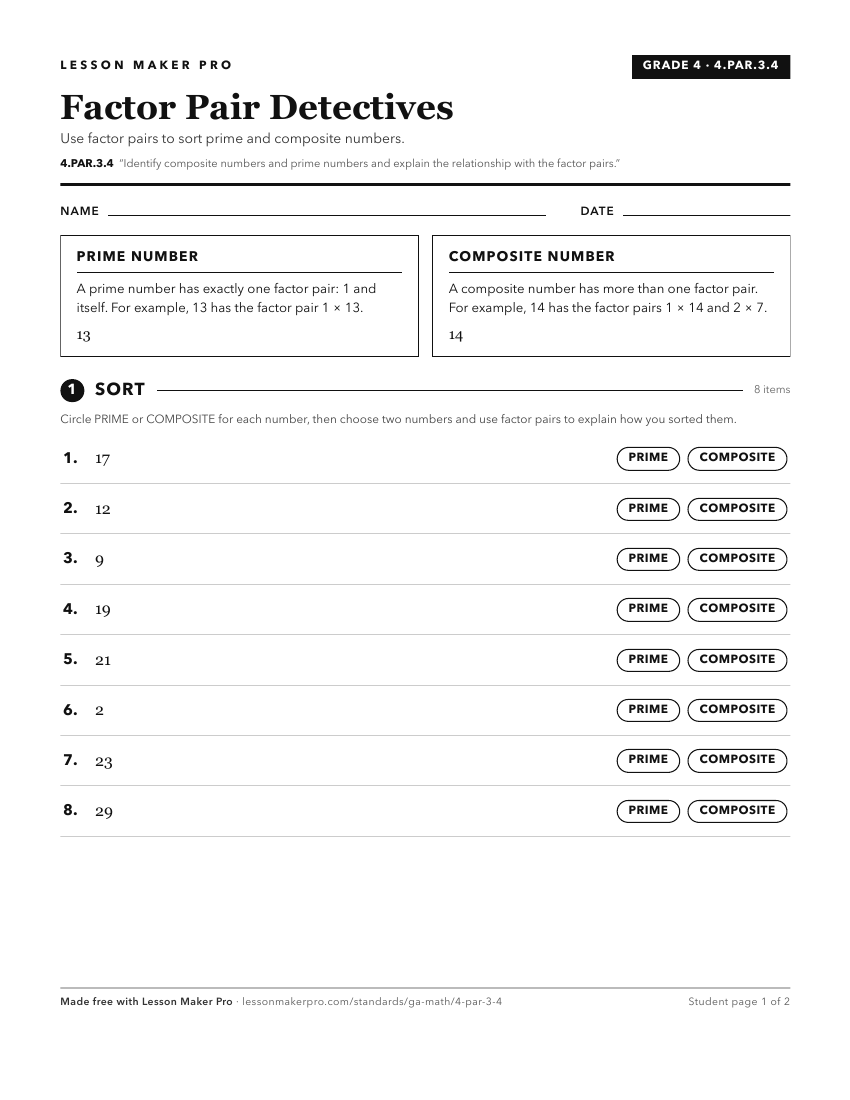
A ready-to-print activity worksheet aligned to 4.PAR.3.4, with an answer key for the teacher on its own page. No account needed.
PDF, US Letter, prints cleanly in black and white.
Download the worksheetKeep exploring
Related Standards
- 3.PAR.3.2
Represent single digit multiplication and division facts using a variety of strategies. Explain the relationship between multiplication and division.
- 4.PAR.3.3
Find factor pairs in the range 1–100 and find multiples of single-digit numbers up to 100.
- 6.PAR.6.2
Determine greatest common factors and least common multiples using a variety of strategies to make sense of applicable problems.
- 4.PAR.3
Generate and analyze patterns, including those involving shapes, input/output diagrams, factors, multiples, prime numbers, and composite numbers.
Turn this exact standard into a lesson
Grade, subject, topic, and the complete standard are prefilled. Create one free, no account needed.
Also for this standard:Make a WorksheetMake a QuizMake a Sub Lesson