Georgia 4.PAR.3.3
The Standard
Find factor pairs in the range 1–100 and find multiples of single-digit numbers up to 100.
Georgia's K-12 Mathematics Standards · Generate and analyze patterns, including those involving shapes, input/output diagrams, factors, multiples, prime numbers, and composite numbers.
Teacher's field guide
What This Standard Means
What Students Need to Do
- Students list whole-number pairs whose product equals a given number. They also generate multiples by skip-counting with a single-digit number, keeping results within 100.
What Mastery Looks Like
- A student can find every factor pair for a number such as 36 without repeats or omissions. The student can list multiples of 7 through 98 and explain the skip-counting rule used.
Common Misconceptions
- Students often confuse factors with multiples, especially when the same number appears in both lists. They may stop after finding one factor pair or count reversed pairs as different pairs.
How to Assess It
- Use this exit ticket: List every factor pair of 48, then list all multiples of 7 between 40 and 100.
Lesson moves
Ways to Teach It
Give students 36 counters to build every possible rectangular array, then record each array's dimensions as a factor pair.
Ask students to explain why 6 is a factor of 42 while 42 is a multiple of 6.
Play Factor or Multiple Bingo using teacher-called clues such as a factor of 24 or a multiple of 8.
Plan equal snack bags for 24 students, then compare possible group sizes and the numbers of bags needed.
Free download
Printable 4.PAR.3.3 Worksheet
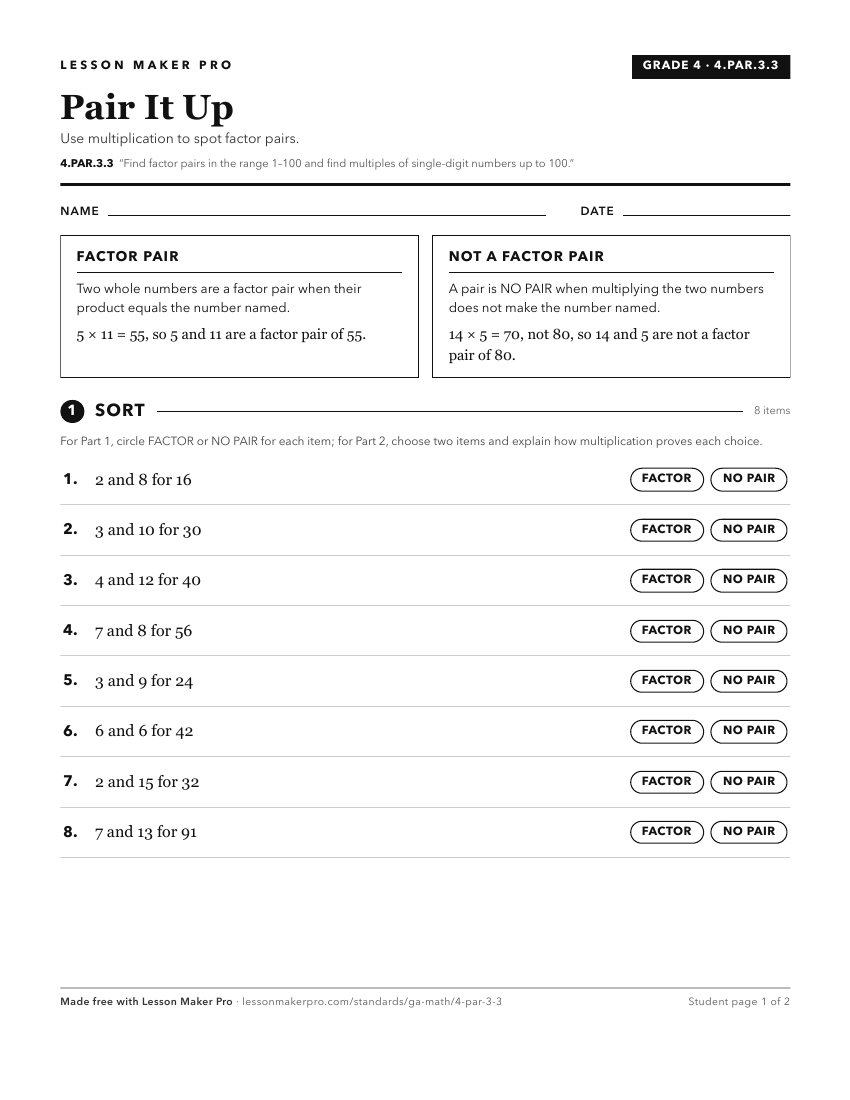
A ready-to-print activity worksheet aligned to 4.PAR.3.3, with an answer key for the teacher on its own page. No account needed.
PDF, US Letter, prints cleanly in black and white.
Download the worksheetKeep exploring
Related Standards
- 2.NR.2.2
Find 10 more or 10 less than a given three-digit number and find 100 more or 100 less than a given three-digit number.
- 3.PAR.3.5
Use place value reasoning and properties of operations to multiply one-digit whole numbers by multiples of 10, in the range 10-90.
- 6.PAR.6.2
Determine greatest common factors and least common multiples using a variety of strategies to make sense of applicable problems.
- 4.PAR.3.4
Identify composite numbers and prime numbers and explain the relationship with the factor pairs.
Turn this exact standard into a lesson
Grade, subject, topic, and the complete standard are prefilled. Create one free, no account needed.
Also for this standard:Make a WorksheetMake a QuizMake a Sub Lesson