Georgia 2.NR.2.2
The Standard
Find 10 more or 10 less than a given three-digit number and find 100 more or 100 less than a given three-digit number.
Georgia's K-12 Mathematics Standards · Apply multiple part-whole strategies, properties of operations and place value understanding to solve real-life, mathematical problems involving addition and subtraction within 1,000.
Teacher's field guide
What This Standard Means
What Students Need to Do
- Students use place value to increase or decrease a three-digit number by one ten or one hundred. They track changes across place-value boundaries, such as moving from 395 to 405.
What Mastery Looks Like
- Students quickly find each new number, including cases that cross a hundred. They explain which place changed and use counting, place value, or an equation to check.
Common Misconceptions
- Students may change the ones digit instead of the tens or hundreds value. They may also miss regrouping across a hundred, such as saying 10 more than 395 is 305.
How to Assess It
- Give this exit ticket: Find 10 more than 395, 10 less than 402, 100 more than 568, and 100 less than 700. Explain one answer using place value.
Lesson moves
Ways to Teach It
Build 364 with base-ten blocks, then add or remove one ten and one hundred, recording each new number.
Ask students to explain why 10 more than 395 is 405, not 305, using a drawing or place-value chart.
Play More or Less: draw a three-digit number card and a change card, then race to write the correct result.
Use a library book count, then ask how many books there would be after adding or removing 10 or 100 books.
Free download
Printable 2.NR.2.2 Worksheet
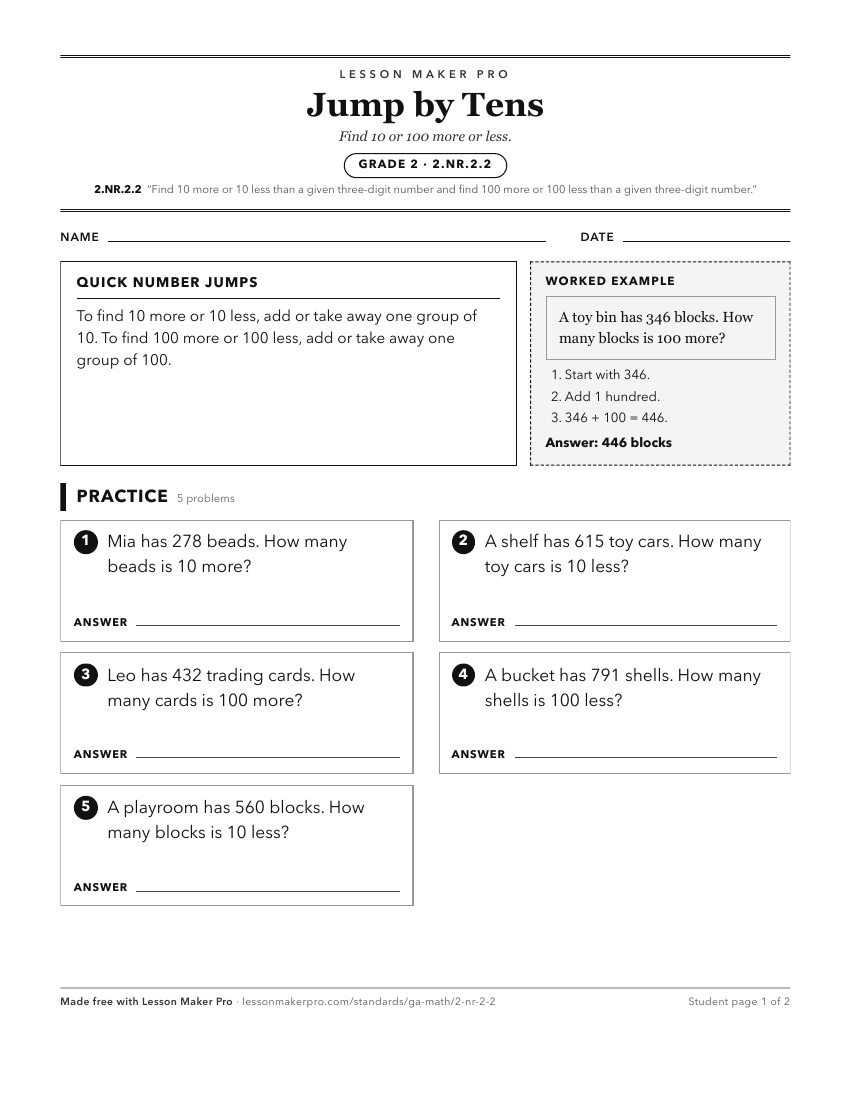
A ready-to-print activity worksheet aligned to 2.NR.2.2, with an answer key for the teacher on its own page. No account needed.
PDF, US Letter, prints cleanly in black and white.
Download the worksheetKeep exploring
Related Standards
- 1.NR.5.3
Add and subtract multiples of 10 within 100.
- 1.NR.5.2
Given a two-digit number, mentally find 10 more or 10 less than the number, without having to count; explain the reasoning used.
- 4.PAR.3.3
Find factor pairs in the range 1–100 and find multiples of single-digit numbers up to 100.
- K.NR.1.3
Given a number from 1-20, identify the number that is one more or one less.
Turn this exact standard into a lesson
Grade, subject, topic, and the complete standard are prefilled. Create one free, no account needed.
Also for this standard:Make a WorksheetMake a QuizMake a Sub Lesson