Georgia 8.P.ST.1.b
The Standard
Consider how context impacts the purposes of the author and the audience. (I/C)
Georgia's K-12 English Language Arts Standards · Practices (P) · Situating Texts
Teacher's field guide
What This Standard Means
What Students Need to Do
- Students identify why an author created a text and why an audience might read, hear, or view it. They explain how time, place, events, and social conditions shape those purposes.
What Mastery Looks Like
- Given a text and background information, students make a clear claim about the author’s goal and the audience’s likely goal. They support both claims with details from the text and context.
Common Misconceptions
- Students may name a purpose from the genre alone or treat every audience as passive. They may summarize the background without linking it to specific author or audience goals.
How to Assess It
- Give students a short wartime poster and a two-sentence context note. Ask: “How did the situation shape the creator’s goal and the audience’s reason for viewing it? Cite one detail.”
Lesson moves
Ways to Teach It
Give groups context cards and matching excerpts; students pair them, then label how each context changes the author’s and audience’s purposes.
Discuss: “Why might an eighth grader and a factory worker in 1943 read the same speech for different reasons?”
Play Purpose Match: teams connect text clues, context clues, author goals, and audience goals, then defend each completed set.
Compare a school emergency alert with a local news post, noting how the same event creates different goals for writers and readers.
Free download
Printable 8.P.ST.1.b Worksheet
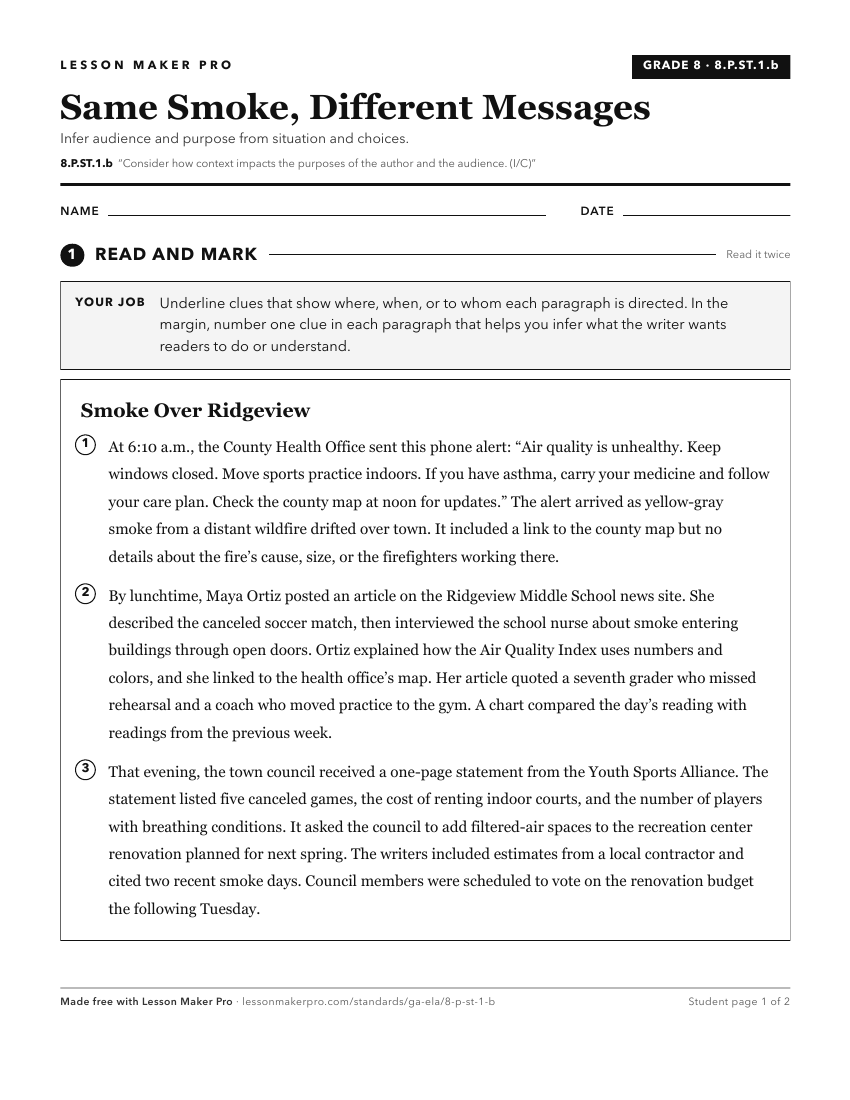
A ready-to-print activity worksheet aligned to 8.P.ST.1.b, with an answer key for the teacher on its own page. No account needed.
PDF, US Letter, prints cleanly in black and white.
Download the worksheetKeep exploring
Related Standards
Turn this exact standard into a lesson
Grade, subject, topic, and the complete standard are prefilled. Create one free, no account needed.
Also for this standard:Make a WorksheetMake a QuizMake a Sub Lesson