Georgia 6.T.T.1.b
The Standard
Analyze how setting, events, conflict, and characterization influence plot pacing. (I)
Georgia's K-12 English Language Arts Standards · Texts (T) · Techniques
Teacher's field guide
What This Standard Means
What Students Need to Do
- Students track how quickly or slowly a story unfolds. They explain how specific details about place, events, problems, and characters speed up or slow down the plot.
What Mastery Looks Like
- Students can identify where a plot speeds up, slows down, or pauses. They use details from the text to explain how a character, conflict, event, or place causes that shift.
Common Misconceptions
- Students may treat pacing as the order of events rather than the speed or rhythm of the plot. They may label a scene fast or slow without explaining which details create that effect.
How to Assess It
- Give students a short action scene and ask: “Which detail affects the pace most, and how would removing it change the scene?”
Lesson moves
Ways to Teach It
Give groups scene details on cards, then have them remove or add cards to change the pace and explain the result.
Ask students to write: “Which plot element controls the pace most in this scene, and what evidence supports your answer?”
Play Pace Detective by reading short passages while teams identify the pace shift, its cause, and supporting words.
Compare a slow-motion sports replay with live footage, then connect each version’s pace to the details viewers notice.
Free download
Printable 6.T.T.1.b Worksheet
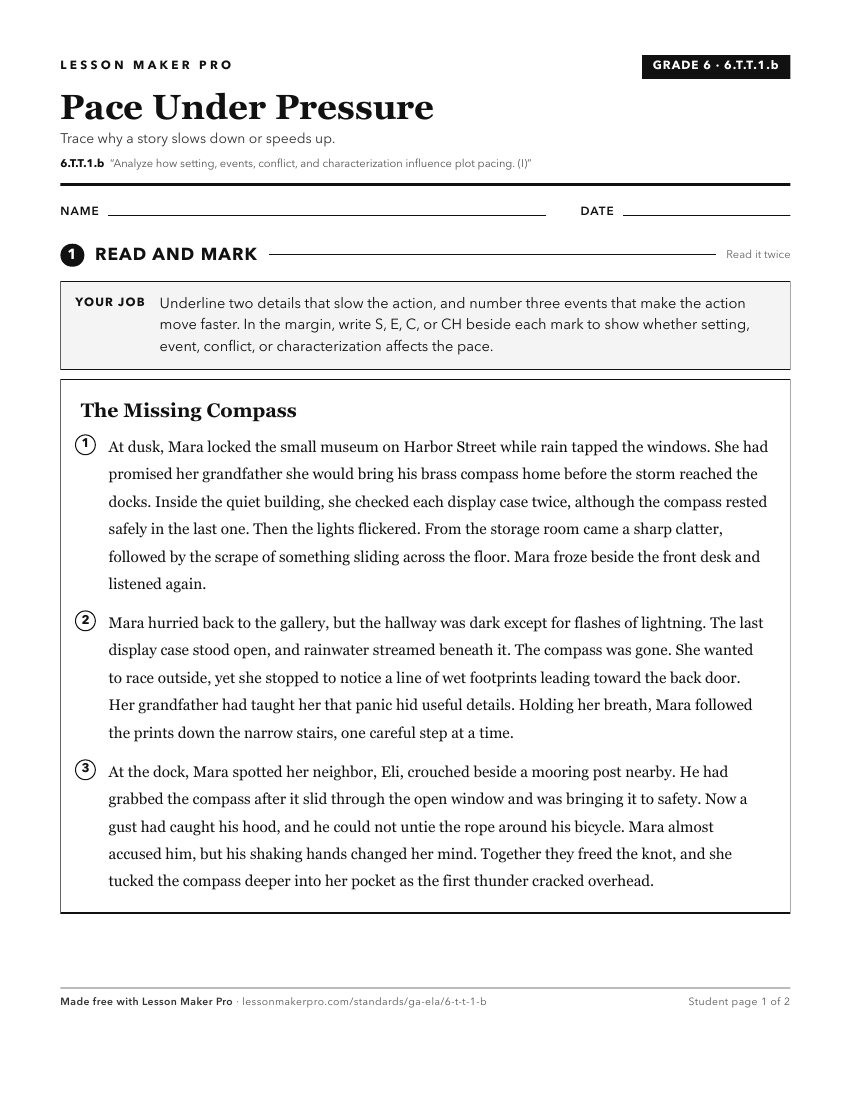
A ready-to-print activity worksheet aligned to 6.T.T.1.b, with an answer key for the teacher on its own page. No account needed.
PDF, US Letter, prints cleanly in black and white.
Download the worksheetKeep exploring
Related Standards
- 7.T.T.1.a
Analyze how narrative techniques are used across the text to develop plot, characters, and setting. (I)
- 7.T.T.1.b
Analyze the use of plot structures, conflict, and narrative devices (e.g., flashback, foreshadowing) within a text. (I)
- 5.T.T.1.b
Analyze how setting, events, conflict, and characterization contribute to the plot. (I)
- 8.T.T.1.a
Analyze how narrative techniques are used across the text to develop plot, characters, and setting. (I)
Turn this exact standard into a lesson
Grade, subject, topic, and the complete standard are prefilled. Create one free, no account needed.
Also for this standard:Make a WorksheetMake a QuizMake a Sub Lesson