Georgia 4.T.SS.2.a
The Standard
Identify and explain how figurative language, such as hyperboles and personification, shapes how ideas and information in texts are understood. (I)
Georgia's K-12 English Language Arts Standards · Texts (T) · Structure & Style
Teacher's field guide
What This Standard Means
What Students Need to Do
- Students locate personification and hyperbole in stories, poems, and informational texts. They explain how the wording affects the picture, feeling, emphasis, or information a reader takes away.
What Mastery Looks Like
- Students correctly distinguish personification from hyperbole in a passage. They explain how each phrase adds emphasis, creates an image, or clarifies a feeling or idea.
Common Misconceptions
- Students may treat exaggerated statements as literal facts. They may label any nonliteral phrase as personification, or identify a phrase without explaining its effect on meaning.
How to Assess It
- Give students: “The alarm clock yelled at me” and “My backpack weighs a ton.” Ask them to label each phrase and explain what it helps readers understand.
Lesson moves
Ways to Teach It
Give pairs phrase cards to sort under personification, hyperbole, or literal language, then require a spoken reason for each choice.
Ask students to rewrite “The storm was strong” using personification, then explain how their version changes the reader’s picture.
Play Figurative Language Match by having teams pair example cards with effect cards such as emphasizes size, shows emotion, or creates motion.
Collect exaggerated ads or slogans, then have students explain what each claim suggests and why a reader should not take it literally.
Free download
Printable 4.T.SS.2.a Worksheet
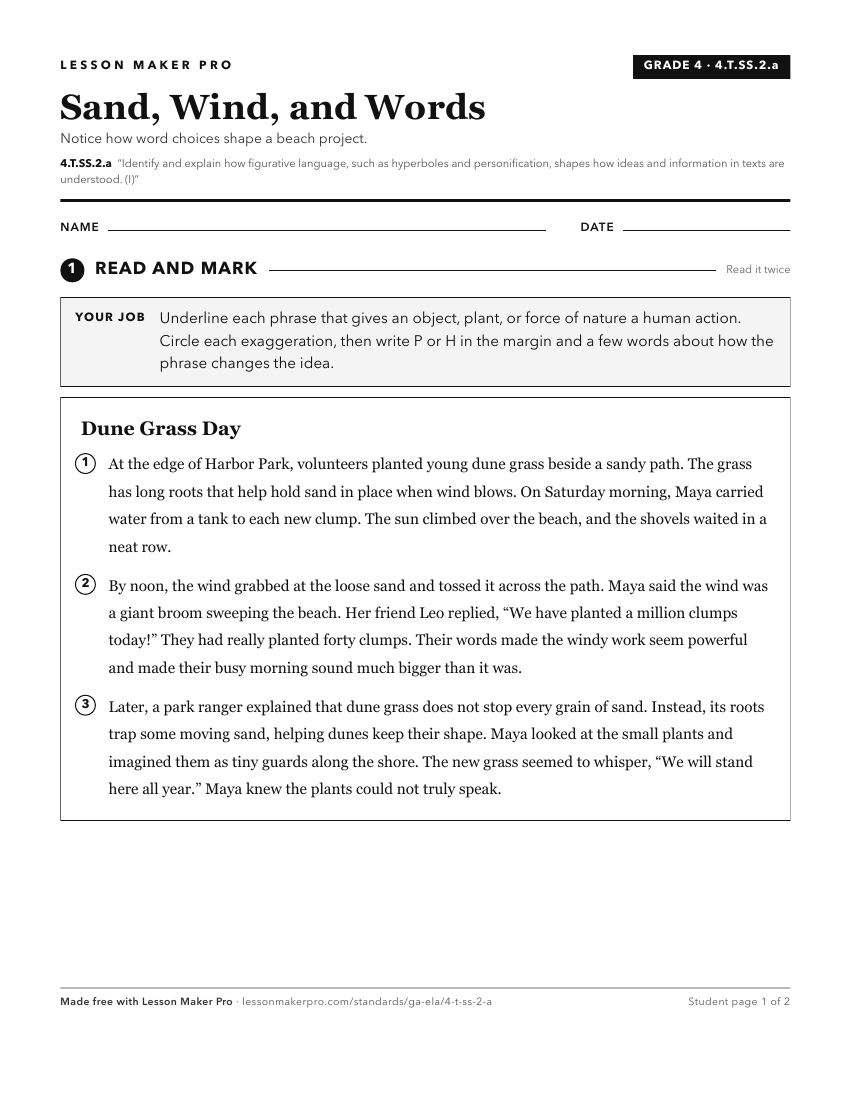
A ready-to-print activity worksheet aligned to 4.T.SS.2.a, with an answer key for the teacher on its own page. No account needed.
PDF, US Letter, prints cleanly in black and white.
Download the worksheetKeep exploring
Related Standards
- 6.T.SS.2.a
Determine how figurative and connotative language choices contribute to meaning, mood, or tone in a wide variety of texts. (I)
- 5.T.SS.2.a
Describe the impact of the use of figurative language such as similes, metaphors, idioms, hyperboles, and personification in response to audience and purpose, i...
- 3.T.SS.2.a
Identify and describe the use of figurative language, such as similes, metaphors, and idioms in a wide variety of texts. (I)
- 10.T.SS.2.a
Analyze how the use of figurative, connotative, and/or rhetorical language contributes to the development of meaning, tone, or mood in a wide variety of texts. ...
Turn this exact standard into a lesson
Grade, subject, topic, and the complete standard are prefilled. Create one free, no account needed.
Also for this standard:Make a WorksheetMake a QuizMake a Sub Lesson