Georgia 3.T.C.2.a
The Standard
Describe different perspectives of the narrator or speakers and distinguish them from their own. (I)
Georgia's K-12 English Language Arts Standards · Texts (T) · Context
Teacher's field guide
What This Standard Means
What Students Need to Do
- Students figure out what a narrator or speaker thinks, feels, or believes about events and topics. They compare that viewpoint with their own ideas and support both with clear reasons.
What Mastery Looks Like
- Students explain a narrator’s or speaker’s viewpoint using words and actions from the text. They clearly state whether their own view is similar or different and why.
Common Misconceptions
- Students may assume the narrator is the author or confuse a character’s opinion with their own. They may name a feeling without using text details to explain the speaker’s viewpoint.
How to Assess It
- Give students a short first-person paragraph. Ask: “What does the narrator think about the event, and how is that view different from yours?”
Lesson moves
Ways to Teach It
Give pairs two colored sticky notes to mark the narrator’s view and their own view in a short story.
After reading a poem, ask students to write: “The speaker believes ___, but I believe ___ because ___.”
Play Perspective Match by pairing text-detail cards with narrator-viewpoint cards, then have students explain each match.
Read two reviews of the same playground, then compare each reviewer’s view with students’ own playground preferences.
Free download
Printable 3.T.C.2.a Worksheet
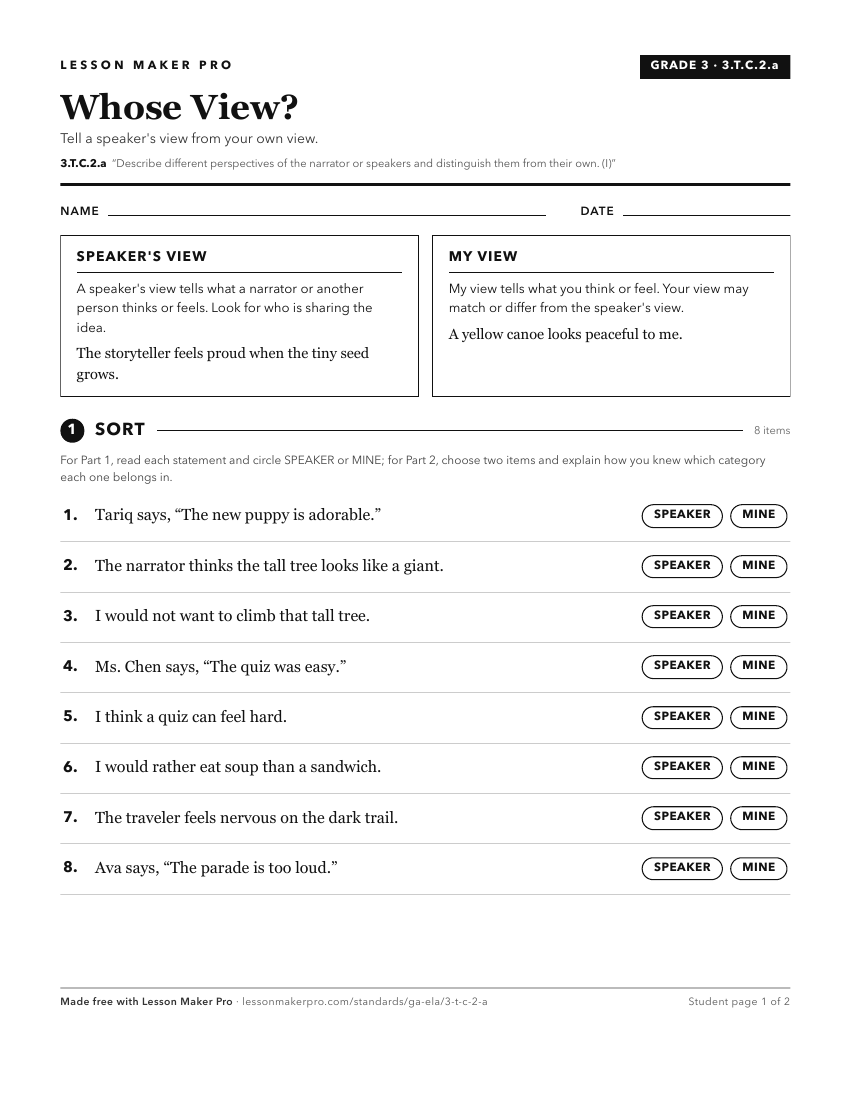
A ready-to-print activity worksheet aligned to 3.T.C.2.a, with an answer key for the teacher on its own page. No account needed.
PDF, US Letter, prints cleanly in black and white.
Download the worksheetKeep exploring
Related Standards
- 5.T.C.2.a
Describe how a narrator or speaker’s perspective influences the text. (I)
- 2.T.C.2.a
Use examples of language from the text to identify various points of view (e.g., first person, third person). (I)
- 4.T.C.2.a
Compare and contrast the perspectives of different narrators or speakers in a text. (I)
- 1.T.C.2.a
Identify who is speaking or telling the story at various points in a text. (I)
Turn this exact standard into a lesson
Grade, subject, topic, and the complete standard are prefilled. Create one free, no account needed.
Also for this standard:Make a WorksheetMake a QuizMake a Sub Lesson