Georgia 1.T.C.2.a
The Standard
Identify who is speaking or telling the story at various points in a text. (I)
Georgia's K-12 English Language Arts Standards · Texts (T) · Context
Teacher's field guide
What This Standard Means
What Students Need to Do
- Students track whose voice is heard in each part of a story. They use dialogue tags, speech bubbles, pictures, and events to notice voice changes. They distinguish the author from the narrator and characters.
What Mastery Looks Like
- Given a page or short passage, a student can label each line as narrator or a named character. The student can point to a dialogue tag, speech bubble, quotation marks, or picture as evidence.
Common Misconceptions
- Students may name the author when asked whose voice they hear. They may assume the main character says every line or miss changes between characters. They may also confuse narration with dialogue.
How to Assess It
- Give students three lines: Ava said, “My kite is stuck”; Dad answered, “I will help”; the wind shook the tree. Ask them to label each line Ava, Dad, or narrator, then circle the clue.
Lesson moves
Ways to Teach It
Give pairs character puppets and a three-line dialogue; students raise the matching puppet whenever that character speaks.
Read a picture-book page and ask, “Who is talking now, and which words or picture prove it?”
Play Speaker Switch: read narration and dialogue cards aloud while students point to labeled narrator and character cards.
Play a short school announcement and classroom conversation, then have students name each voice and explain how they knew.
Free download
Printable 1.T.C.2.a Worksheet
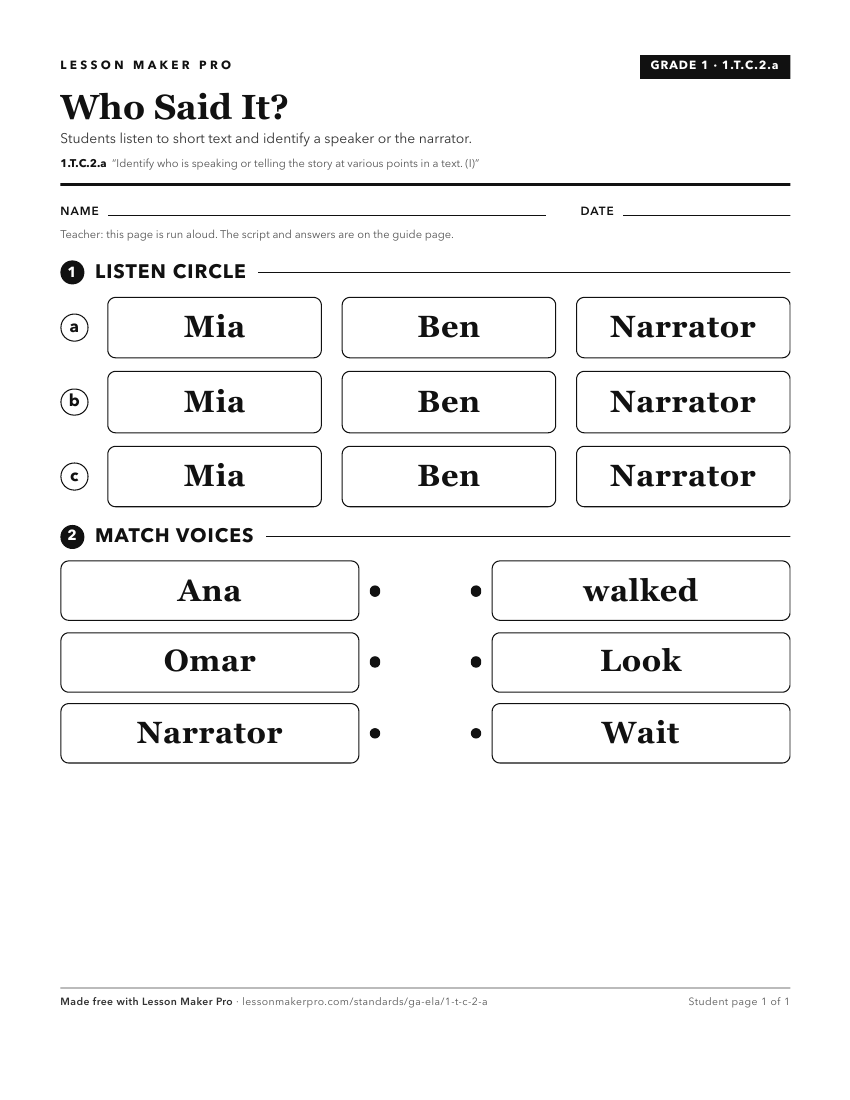
A ready-to-print activity worksheet aligned to 1.T.C.2.a, with an answer key for the teacher on its own page. No account needed.
PDF, US Letter, prints cleanly in black and white.
Download the worksheetKeep exploring
Related Standards
- 5.T.C.2.a
Describe how a narrator or speaker’s perspective influences the text. (I)
- 2.T.C.2.a
Use examples of language from the text to identify various points of view (e.g., first person, third person). (I)
- 4.T.C.2.a
Compare and contrast the perspectives of different narrators or speakers in a text. (I)
- 1.T.RA.2.a
Refer to parts of texts when supporting an idea, answer, or opinion. (I)
Turn this exact standard into a lesson
Grade, subject, topic, and the complete standard are prefilled. Create one free, no account needed.
Also for this standard:Make a WorksheetMake a QuizMake a Sub Lesson