Florida SS.8.FL.4.3
The Standard
- SS.8.FL.4
- Identify and analyze the benefits, risks, associated fees, and laws that consumers should consider when choosing to buy on credit.
Examine the fact that borrowers who use credit cards for purchases and who do not pay the full balance when it is due pay much higher costs for their purchases because interest is charged monthly. Explain how a credit card user can avoid interest charges by paying the entire balance within the grace period specified by the financial institution.
Florida Next Generation Sunshine State Standards for Social Studies
Teacher's field guide
What This Standard Means
What Students Need to Do
- Students calculate how monthly interest raises the cost of a purchase when part of the credit card balance remains unpaid. They explain how paying the full statement balance by the due date avoids interest during the grace period.
What Mastery Looks Like
- Given a purchase amount, payment, and monthly interest rate, students can find the remaining balance and interest charge. They can identify the payment amount and date needed to avoid interest.
Common Misconceptions
- Students may think paying the minimum amount due prevents interest. They may treat interest as a one-time fee instead of a monthly charge. Some confuse the statement balance with the minimum payment.
How to Assess It
- Exit ticket: A $240 statement is due June 20. If $40 is paid and 2% monthly interest applies to the remaining $200, find the interest and state how to avoid it.
Lesson moves
Ways to Teach It
Give pairs a receipt, mock credit card statement, and calculator; have them compare full and minimum payments after one month of interest.
Write a short response to: Why can a $60 purchase cost more than $60, and what payment choice prevents that?
Run a card-sort race matching purchase amounts, unpaid balances, monthly rates, interest charges, and payment choices that avoid interest.
Use a sample credit card disclosure to locate the grace period, then choose a payment date that would prevent purchase interest.
Free download
Printable SS.8.FL.4.3 Worksheet
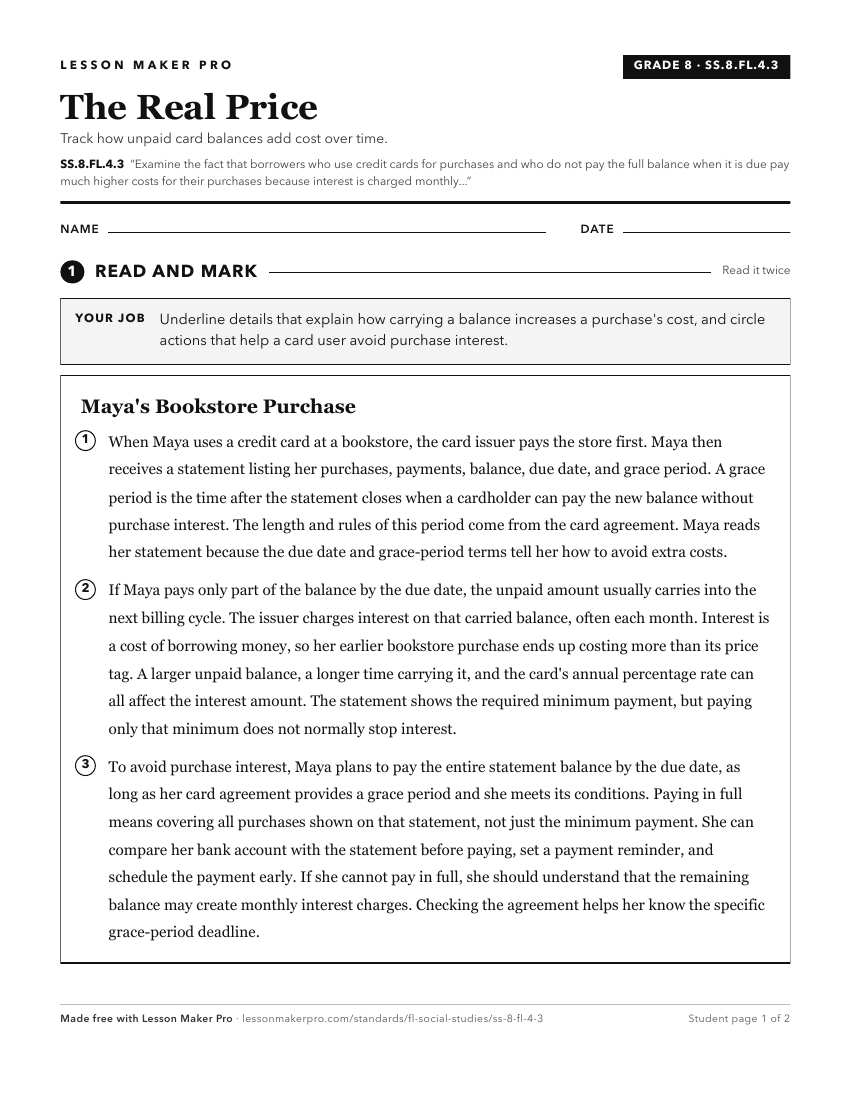
A ready-to-print activity worksheet aligned to SS.8.FL.4.3, with an answer key for the teacher on its own page. No account needed.
PDF, US Letter, prints cleanly in black and white.
Download the worksheetKeep exploring
Related Standards
- SS.8.FL.4.4
Explain that lenders charge different interest rates based on the risk of nonpayment by borrowers. Describe why the higher the risk of nonpayment, the higher th...
- SS.8.FL.4.2
Identify a credit card purchase as a loan from the financial institution that issued the card. Explain that credit card interest rates tend to be higher than ra...
- SS.8.FL.4
Identify and analyze the benefits, risks, associated fees, and laws that consumers should consider when choosing to buy on credit.
- SS.4.FL.4.2
Identify instances when people use credit, that they receive something of value now and agree to repay the lender over time, or at some date in the future, with...
Turn this exact standard into a lesson
Grade, subject, topic, and the complete standard are prefilled. Create one free, no account needed.
Also for this standard:Make a WorksheetMake a QuizMake a Sub Lesson