Florida SS.8.A.4.13
The Standard
- SS.8.A.4
- Demonstrate an understanding of the domestic and international causes, course, and consequences of westward expansion.
Explain the consequences of landmark Supreme Court decisions (McCulloch v. Maryland [1819], Gibbons v. Ogden [1824], Cherokee Nation v. Georgia [1831], and Worcester v. Georgia [1832]) significant to this era of American history.
Florida Next Generation Sunshine State Standards for Social Studies
Teacher's field guide
What This Standard Means
What Students Need to Do
- Students explain what each ruling changed about federal power, state power, or Cherokee sovereignty. They connect the rulings to events such as the fight over steamboat routes and Cherokee removal.
What Mastery Looks Like
- A student can explain why Maryland could not tax the national bank and why New York could not control interstate steamboat travel. They can also explain how the two Cherokee cases differed and why the later ruling did not stop removal.
Common Misconceptions
- Students may think the Cherokee cases had the same outcome. They may also assume that a Supreme Court ruling was always enforced, or that these cases gave the federal government unlimited power.
How to Assess It
- Give students four case names and ask them to write one consequence of each ruling. Have them circle the ruling that said Georgia law did not apply in Cherokee territory and explain why removal still continued.
Lesson moves
Ways to Teach It
Give pairs bank tax, steamboat license, and Cherokee land cards, then have them place each under state or federal authority and defend their choices.
Ask students to write: Why did the ruling about Georgia law not end Cherokee removal?
Play a case match game using four ruling cards and four consequence cards, then have students explain each match aloud.
Show a map of an interstate river route and ask who could set steamboat rules for boats crossing state lines.
Free download
Printable SS.8.A.4.13 Worksheet
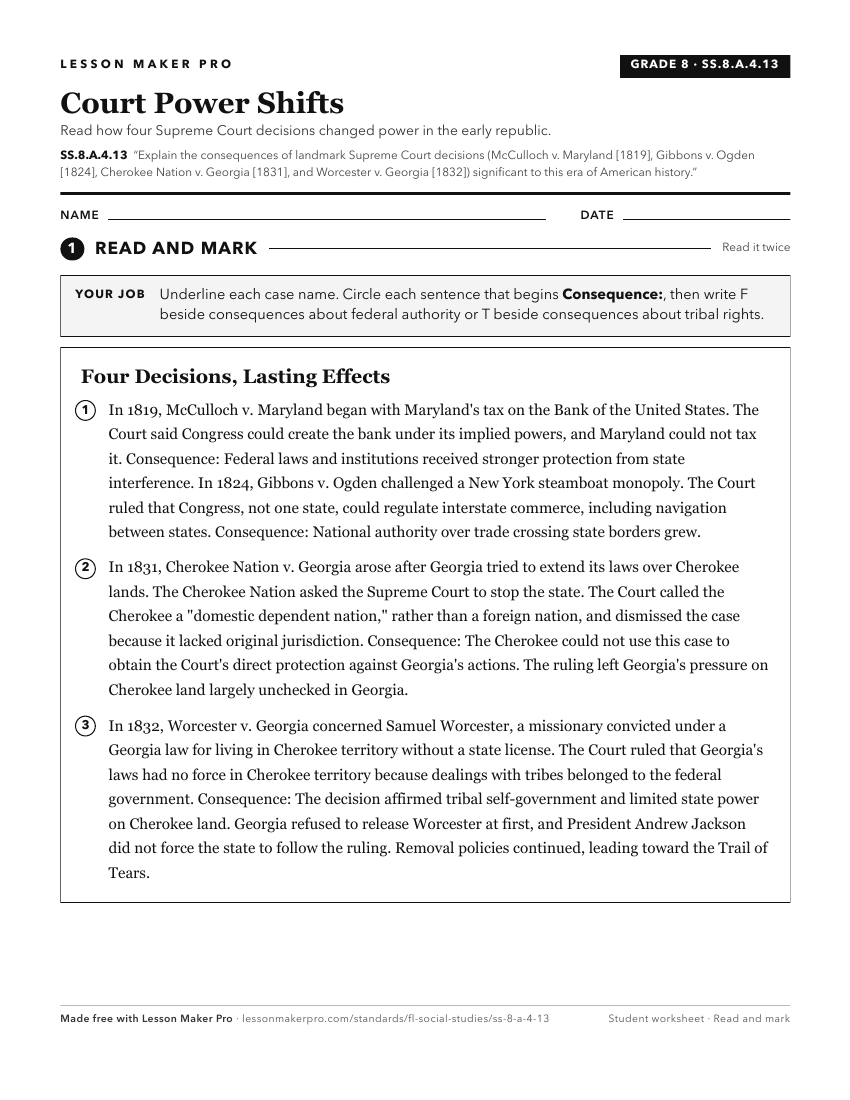
A ready-to-print activity worksheet aligned to SS.8.A.4.13, with an answer key for the teacher on its own page. No account needed.
PDF, US Letter, prints cleanly in black and white.
Download the worksheetKeep exploring
Related Standards
- SS.7.CG.3.11
Analyze the effects of landmark Supreme Court decisions on law, liberty, and the interpretation of the U.S. Constitution.
- SS.7.CG.1.3
Trace the impact that the Magna Carta, Mayflower Compact, English Bill of Rights and Thomas Paine's Common Sense had on colonists' views of government.
- SS.7.CG.1.2
Trace the principles underlying America's founding ideas on law and government.
- SS.5.A.5.9
Discuss the impact and significance of land policies developed under the Confederation Congress (Northwest Ordinance of 1787).
Turn this exact standard into a lesson
Grade, subject, topic, and the complete standard are prefilled. Create one free, no account needed.
Also for this standard:Make a WorksheetMake a QuizMake a Sub Lesson