Florida SS.6.W.1.3
The Standard
- SS.6.W.1
- Utilize historical inquiry skills and analytical processes.
Interpret primary and secondary sources.
Florida Next Generation Sunshine State Standards for Social Studies
Teacher's field guide
What This Standard Means
What Students Need to Do
- Students decide whether a source is primary or secondary. They use details about the creator, time, purpose, and audience to explain its meaning and perspective.
What Mastery Looks Like
- Given a diary entry and a textbook passage, students correctly classify each source and cite clues that support their choices. They explain what each source reveals and what it cannot prove.
Common Misconceptions
- Students may think every old document is a primary source or that primary sources are always accurate. They may treat secondary sources as unreliable instead of checking evidence, perspective, and purpose.
How to Assess It
- Give students a historical photograph and a textbook paragraph. Ask: Which is primary, which is secondary, and what can each source help historians understand?
Lesson moves
Ways to Teach It
Set up four source stations with a letter, photograph, textbook excerpt, and biography for students to classify and annotate.
Ask students to write which source they would trust for a specific question and explain their choice with two details.
Play Source Detective by revealing creator, date, and purpose clues while teams identify each source as primary or secondary.
Compare an eyewitness social media post with a news report about the same event, then identify differences in perspective and evidence.
Free download
Printable SS.6.W.1.3 Worksheet
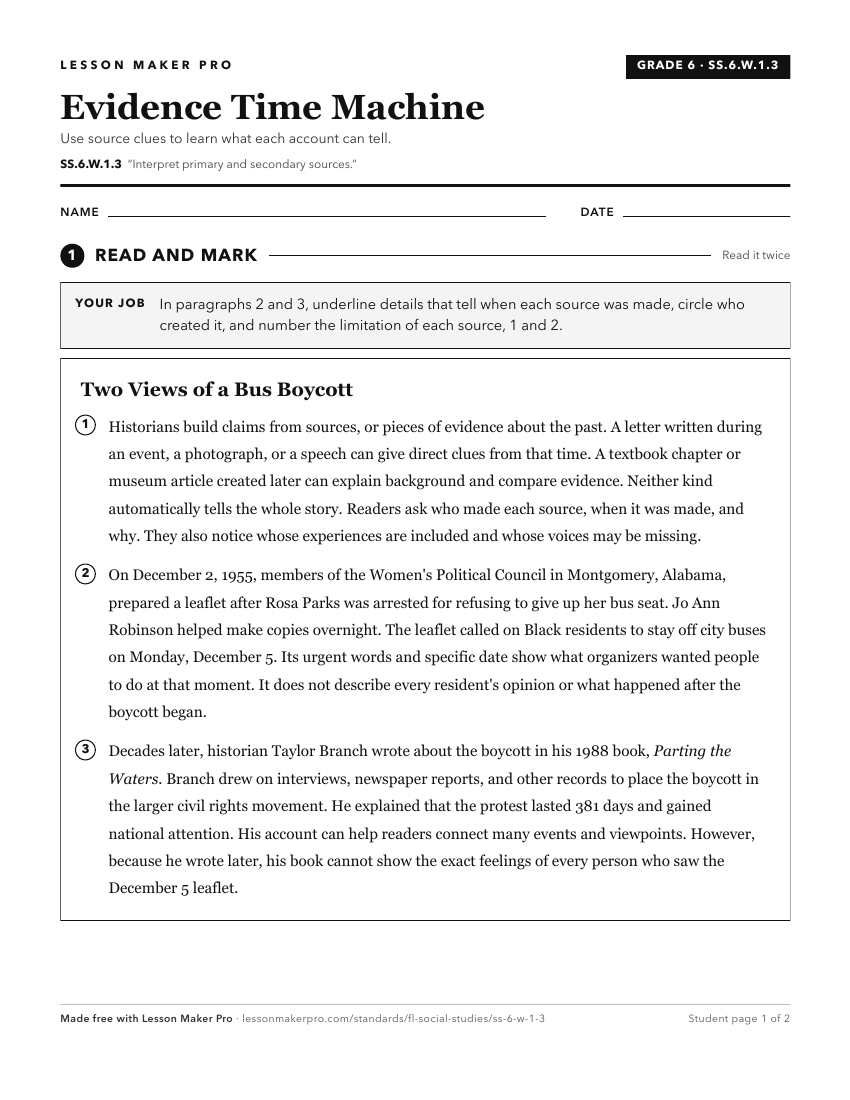
A ready-to-print activity worksheet aligned to SS.6.W.1.3, with an answer key for the teacher on its own page. No account needed.
PDF, US Letter, prints cleanly in black and white.
Download the worksheetKeep exploring
Related Standards
Turn this exact standard into a lesson
Grade, subject, topic, and the complete standard are prefilled. Create one free, no account needed.
Also for this standard:Make a WorksheetMake a QuizMake a Sub Lesson