Florida SC.8.N.3.2
The Standard
Explain why theories may be modified but are rarely discarded.
Florida Next Generation Sunshine State Standards for Science
Teacher's field guide
What This Standard Means
What Students Need to Do
- Students examine new evidence and explain how it can change parts of a scientific theory. They explain why repeated testing and supporting evidence keep the larger explanation in use.
What Mastery Looks Like
- Given a historical example, students identify what changed, what evidence caused the change, and what remained supported. They distinguish revising an explanation from rejecting it completely.
Common Misconceptions
- Students may think theories are guesses or that theories become laws after enough testing. They may also think one unusual result automatically disproves an entire theory.
How to Assess It
- Exit ticket: Explain how Rutherford’s evidence changed atomic theory without causing scientists to discard every earlier idea about atoms.
Lesson moves
Ways to Teach It
Give groups clay atom models and evidence cards from Dalton, Thomson, Rutherford, and Bohr, then have them revise each model.
Ask students to write why new evidence can strengthen a theory even when it causes scientists to change part of it.
Play an evidence card game where teams label each result revise, reject, or investigate further, then defend their choice.
Use a live GPS plate motion map to show how new measurements refine plate tectonic theory while supporting its main explanation.
Free download
Printable SC.8.N.3.2 Worksheet
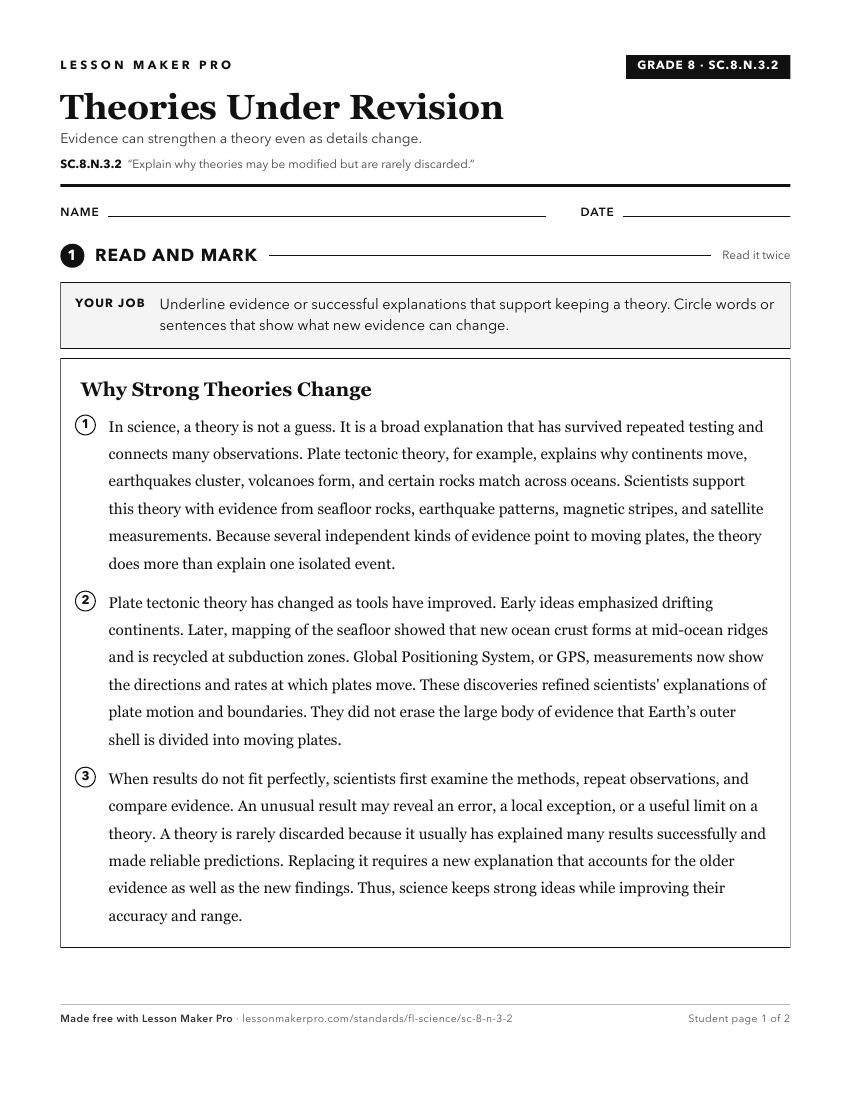
A ready-to-print activity worksheet aligned to SC.8.N.3.2, with an answer key for the teacher on its own page. No account needed.
PDF, US Letter, prints cleanly in black and white.
Download the worksheetKeep exploring
Related Standards
- SC.7.N.2.1
Identify an instance from the history of science in which scientific knowledge has changed when new evidence or new interpretations are encountered.
- SC.8.N.1.4
Explain how hypotheses are valuable if they lead to further investigations, even if they turn out not to be supported by the data.
- SC.6.N.2.2
Explain that scientific knowledge is durable because it is open to change as new evidence or interpretations are encountered.
- SC.6.N.3.1
Recognize and explain that a scientific theory is a well-supported and widely accepted explanation of nature and is not simply a claim posed by an individual. T...
Turn this exact standard into a lesson
Grade, subject, topic, and the complete standard are prefilled. Create one free, no account needed.
Also for this standard:Make a WorksheetMake a QuizMake a Sub Lesson