Florida SC.8.N.1.4
The Standard
Explain how hypotheses are valuable if they lead to further investigations, even if they turn out not to be supported by the data.
Florida Next Generation Sunshine State Standards for Science
Teacher's field guide
What This Standard Means
What Students Need to Do
- Students explain what can be learned when data do not support a hypothesis. They use the results to identify new questions, revise explanations, or improve the investigation.
What Mastery Looks Like
- Given an investigation and its data, students decide whether the hypothesis was supported and explain what the results revealed. They propose a logical, testable follow-up question based on the evidence.
Common Misconceptions
- Students may think an unsupported hypothesis makes an experiment useless or incorrect. They may change the original hypothesis after seeing results, or confuse unsupported results with flawed methods.
How to Assess It
- Exit ticket: A plant given extra light did not grow taller than the control plant. State one useful conclusion and one testable follow-up question.
Lesson moves
Ways to Teach It
Test paper airplanes with two wing lengths, record flight distances, then use unexpected results to design a new test.
Write a response to: What can scientists learn when evidence does not match their prediction? Use one data example.
Sort experiment cards into supported, unsupported, or inconclusive, then earn a point by proposing a testable follow-up for each card.
Read a short report about an ineffective medicine, then identify how the result could guide a new dose or patient-group study.
Free download
Printable SC.8.N.1.4 Worksheet
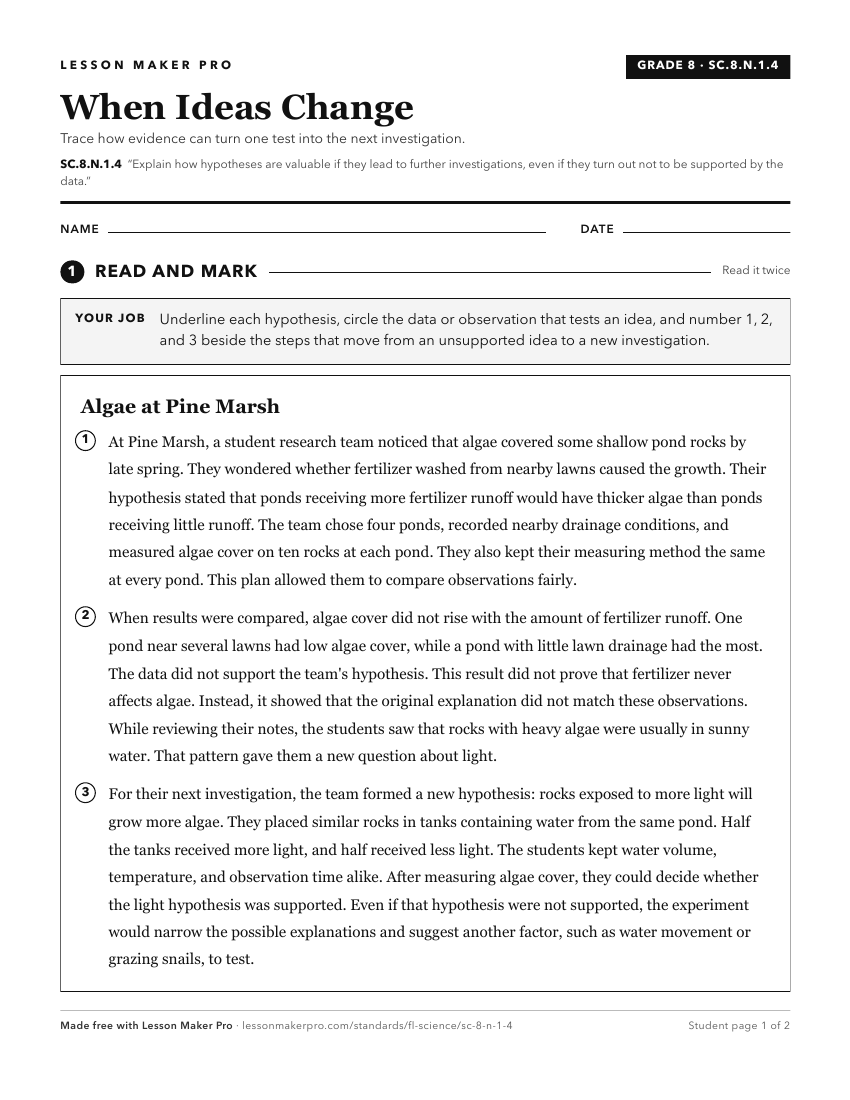
A ready-to-print activity worksheet aligned to SC.8.N.1.4, with an answer key for the teacher on its own page. No account needed.
PDF, US Letter, prints cleanly in black and white.
Download the worksheetKeep exploring
Related Standards
- SC.2.N.1.4
Explain how particular scientific investigations should yield similar conclusions when repeated.
- SC.8.N.1.6
Understand that scientific investigations involve the collection of relevant empirical evidence, the use of logical reasoning, and the application of imaginatio...
- SC.5.N.1.5
Recognize and explain that authentic scientific investigation frequently does not parallel the steps of "the scientific method."
- SC.8.N.3.1
Select models useful in relating the results of their own investigations.
Turn this exact standard into a lesson
Grade, subject, topic, and the complete standard are prefilled. Create one free, no account needed.
Also for this standard:Make a WorksheetMake a QuizMake a Sub Lesson