Florida SC.2.N.1.4
The Standard
Explain how particular scientific investigations should yield similar conclusions when repeated.
Florida Next Generation Sunshine State Standards for Science
Teacher's field guide
What This Standard Means
What Students Need to Do
- Students repeat the same investigation and compare the results. They explain why similar methods and conditions should lead to similar conclusions, even when measurements differ slightly.
What Mastery Looks Like
- Students identify a shared pattern across repeated trials and state a conclusion supported by the results. They can spot when a changed condition makes comparisons unfair.
Common Misconceptions
- Students may expect every measurement to be exactly the same. They may think one trial is enough or call an investigation repeated even when materials or steps change.
How to Assess It
- Give students ice-melting times of 8, 9, and 8 minutes from three matching trials. Ask them to write one conclusion and explain the small difference.
Lesson moves
Ways to Teach It
Teams release the same toy car down the same ramp three times, measure each distance, and compare conclusions.
Ask students to write why two groups following the same seed-growing steps should reach similar conclusions.
Students sort investigation cards into fair repeats and changed tests, then explain each choice to a partner.
Test three pieces of the same paper towel for absorbency, then use the repeated results to recommend it for cleaning spills.
Free download
Printable SC.2.N.1.4 Worksheet
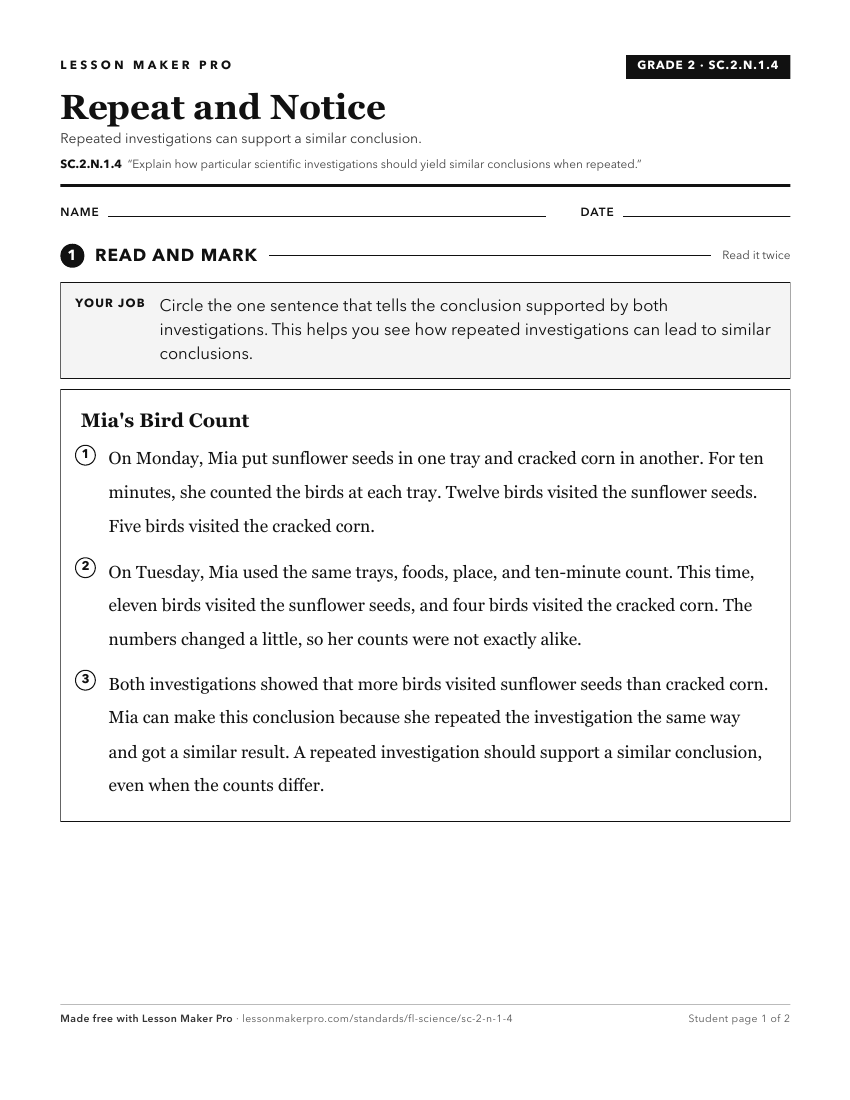
A ready-to-print activity worksheet aligned to SC.2.N.1.4, with an answer key for the teacher on its own page. No account needed.
PDF, US Letter, prints cleanly in black and white.
Download the worksheetKeep exploring
Related Standards
- SC.5.N.1.5
Recognize and explain that authentic scientific investigation frequently does not parallel the steps of "the scientific method."
- SC.5.N.1.3
Recognize and explain the need for repeated experimental trials.
- SC.6.N.1.2
Explain why scientific investigations should be replicable.
- SC.5.N.2.2
Recognize and explain that when scientific investigations are carried out, the evidence produced by those investigations should be replicable by others.
Turn this exact standard into a lesson
Grade, subject, topic, and the complete standard are prefilled. Create one free, no account needed.
Also for this standard:Make a WorksheetMake a QuizMake a Sub Lesson