Florida SC.5.P.13.4
The Standard
Investigate and explain that when a force is applied to an object but it does not move, it is because another opposing force is being applied by something in the environment so that the forces are balanced.
Florida Next Generation Sunshine State Standards for Science
Teacher's field guide
What This Standard Means
What Students Need to Do
- Students identify the pushes and pulls acting on an object that stays still. They use observations or a simple force diagram to explain why its motion does not change.
What Mastery Looks Like
- Given a book resting on a table, students identify gravity pulling down and the table pushing up. They explain that equal forces in opposite directions keep the book still.
Common Misconceptions
- Students may think a still object has no forces acting on it. They may overlook support forces from tables, floors, walls, or ropes. They may also think any two forces are balanced, even when their strengths differ.
How to Assess It
- Place a book on a desk. Ask students to draw and label the forces, then write one sentence explaining why the book stays still.
Lesson moves
Ways to Teach It
Attach a toy cart between two spring scales, pull in opposite directions until it stays still, and compare the readings.
Students answer the prompt, "If gravity pulls a book down, why does it not fall through the table?" using two labeled forces.
Give pairs cards showing stationary objects and force arrows, then have students match each scene to balanced arrows and explain one match.
Examine a photo of a parked car on a hill, then identify gravity, road support, and friction keeping it still.
Free download
Printable SC.5.P.13.4 Worksheet
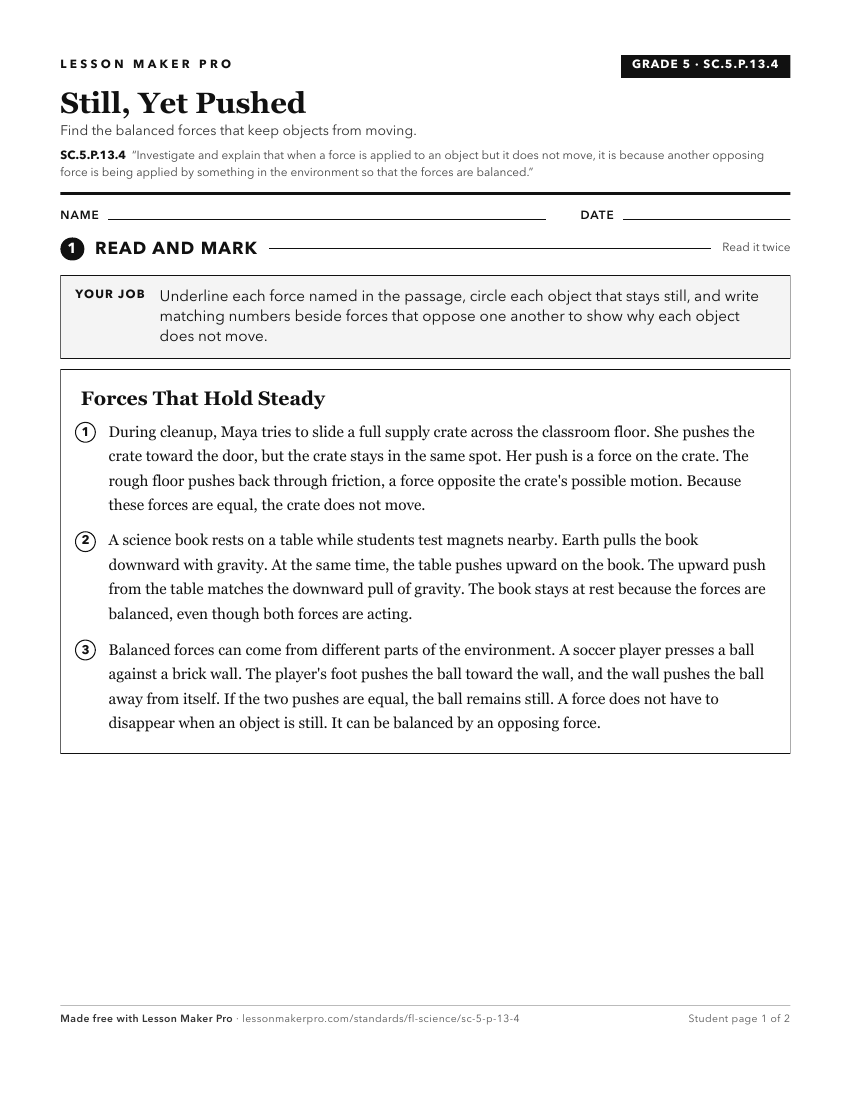
A ready-to-print activity worksheet aligned to SC.5.P.13.4, with an answer key for the teacher on its own page. No account needed.
PDF, US Letter, prints cleanly in black and white.
Download the worksheetKeep exploring
Related Standards
- SC.5.P.13.2
Investigate and describe that the greater the force applied to it, the greater the change in motion of a given object.
- SC.6.P.13.1
Investigate and describe types of forces including contact forces and forces acting at a distance, such as electrical, magnetic, and gravitational.
- SC.6.P.13.3
Investigate and describe that an unbalanced force acting on an object changes its speed, or direction of motion, or both.
- SC.5.P.10.3
Investigate and explain that an electrically-charged object can attract an uncharged object and can either attract or repel another charged object without any c...
Turn this exact standard into a lesson
Grade, subject, topic, and the complete standard are prefilled. Create one free, no account needed.
Also for this standard:Make a WorksheetMake a QuizMake a Sub Lesson