Florida SC.4.E.5.3
The Standard
Recognize that Earth revolves around the Sun in a year and rotates on its axis in a 24-hour day.
Florida Next Generation Sunshine State Standards for Science
Teacher's field guide
What This Standard Means
What Students Need to Do
- Students distinguish Earth’s spin from its path around the Sun. They connect one complete spin with a day and one complete orbit with a year.
What Mastery Looks Like
- A student can use a globe and lamp to model both motions correctly. The student names each motion and gives its correct time period.
Common Misconceptions
- Students may think the Sun travels around Earth each day. They may confuse rotation with revolution or switch their time periods. Some think Earth completes one orbit in 24 hours.
How to Assess It
- Ask students to draw Earth beside the Sun, add arrows for both motions, and label each arrow with rotation or revolution and its duration.
Lesson moves
Ways to Teach It
Use a lamp and globe to model Earth spinning while moving around the lamp, then attach labels for rotation and revolution.
Ask students to explain why a birthday marks one trip around the Sun, while bedtime marks part of one spin.
Give pairs motion, time, and diagram cards to match, then have them correct one deliberately mismatched set.
Compare a clock and calendar, linking the clock’s daily cycle to rotation and the calendar year to revolution.
Free download
Printable SC.4.E.5.3 Worksheet
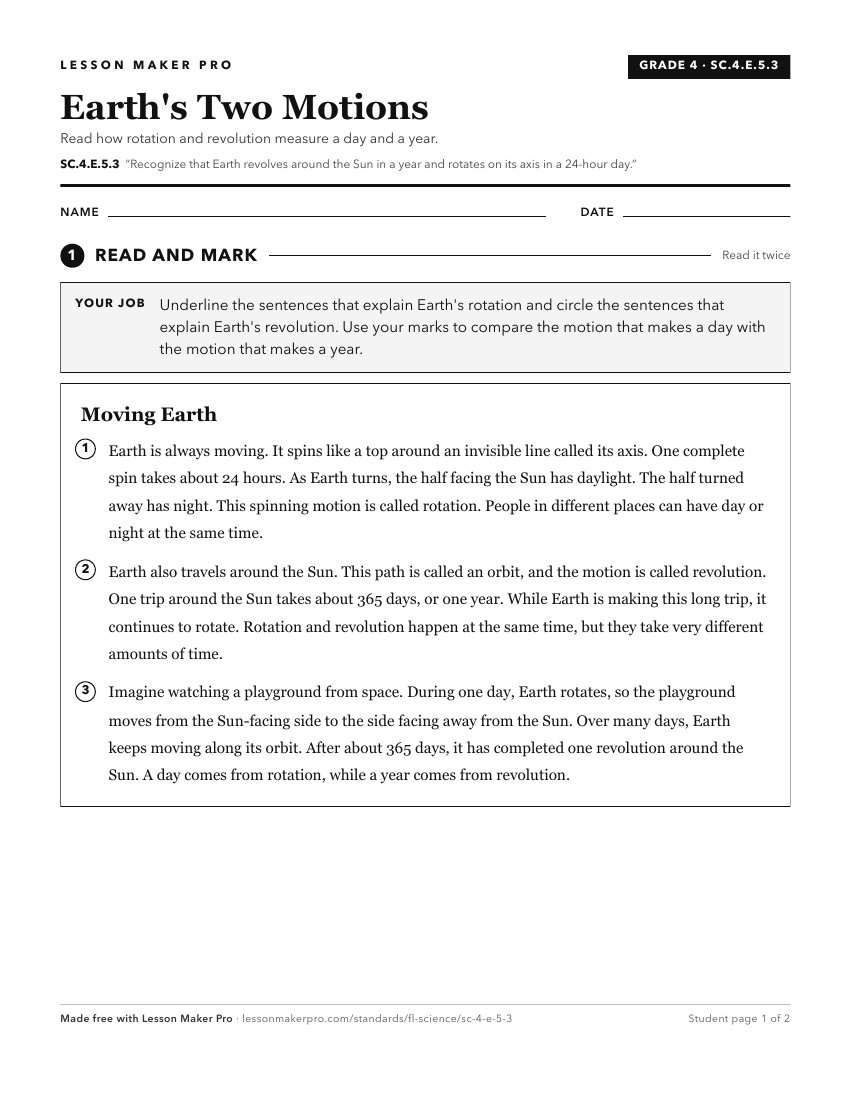
A ready-to-print activity worksheet aligned to SC.4.E.5.3, with an answer key for the teacher on its own page. No account needed.
PDF, US Letter, prints cleanly in black and white.
Download the worksheetKeep exploring
Related Standards
- SC.4.E.5.4
Relate that the rotation of Earth (day and night) and apparent movements of the Sun, Moon, and stars are connected.
- SC.3.E.5.3
Recognize that the Sun appears large and bright because it is the closest star to Earth.
- SC.K.E.5.2
Recognize the repeating pattern of day and night.
- SC.K.E.5.3
Recognize that the Sun can only be seen in the daytime.
Turn this exact standard into a lesson
Grade, subject, topic, and the complete standard are prefilled. Create one free, no account needed.
Also for this standard:Make a WorksheetMake a QuizMake a Sub Lesson