Florida SC.2.N.1.6
The Standard
Explain how scientists alone or in groups are always investigating new ways to solve problems.
Florida Next Generation Sunshine State Standards for Science
Teacher's field guide
What This Standard Means
What Students Need to Do
- Students describe how scientists ask questions, test ideas, and change their approach when a problem remains. They explain how working alone or with others can lead to new ideas.
What Mastery Looks Like
- Given a science problem, students can name another test a scientist might try. They can explain how a teammate could add ideas, observations, or skills.
Common Misconceptions
- Students may think scientists already know the answer or stop after one test. They may believe scientists only work in laboratories or that working alone means never sharing results.
How to Assess It
- Give this exit prompt: “A scientist’s water filter still lets dirt through. What could the scientist test next, and how could a teammate help?”
Lesson moves
Ways to Teach It
Give pairs coffee filters, cotton, gravel, and muddy water; have them test one filter, compare results, and revise the design.
Write about a scientist whose first idea failed: What could the scientist try next, and how might a partner help?
Use scientist scenario cards; students sort them into working alone or together, then name one useful next step for each.
Show weather maps from two days, then ask how meteorologists use new data and teamwork to improve their predictions.
Free download
Printable SC.2.N.1.6 Worksheet
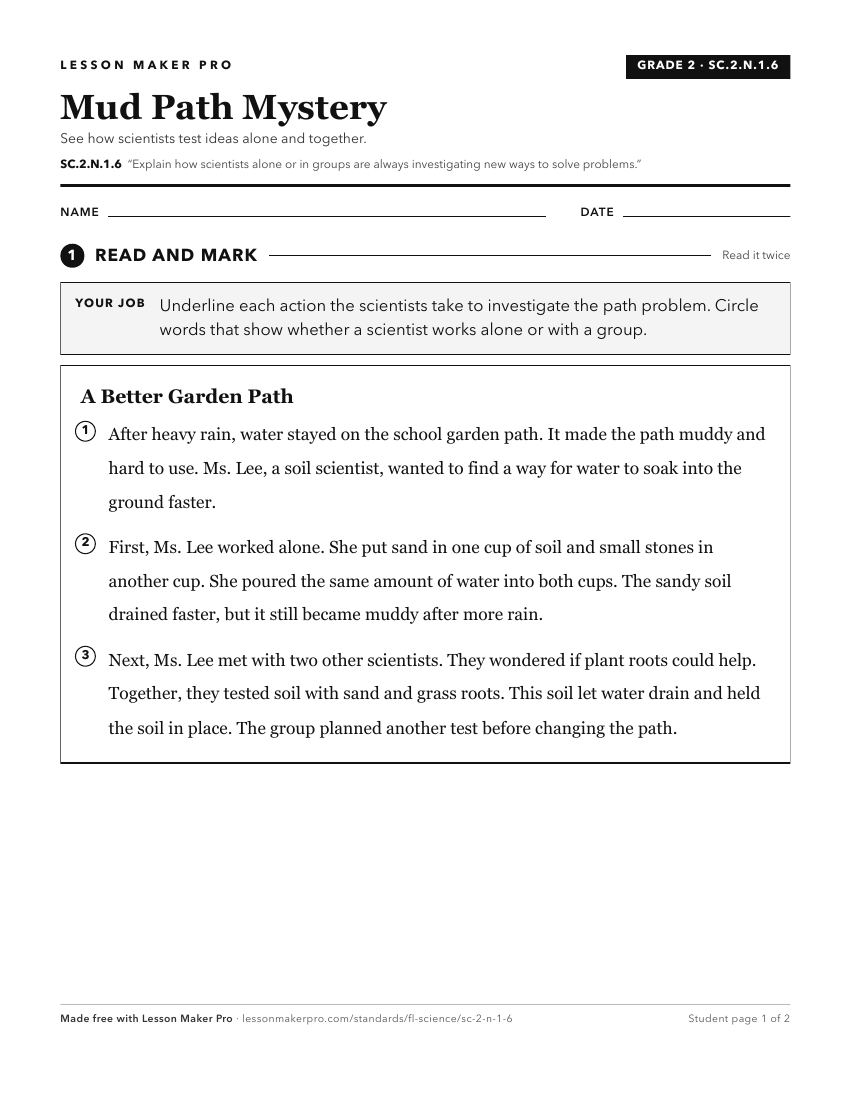
A ready-to-print activity worksheet aligned to SC.2.N.1.6, with an answer key for the teacher on its own page. No account needed.
PDF, US Letter, prints cleanly in black and white.
Download the worksheetKeep exploring
Related Standards
- SC.5.N.1.5
Recognize and explain that authentic scientific investigation frequently does not parallel the steps of "the scientific method."
- SC.3.N.1.5
Recognize that scientists question, discuss, and check each other's evidence and explanations.
- SC.5.N.1.1
Define a problem, use appropriate reference materials to support scientific understanding, plan and carry out scientific investigations of various types such as...
- SC.3.N.1.1
Raise questions about the natural world, investigate them individually and in teams through free exploration and systematic investigations, and generate appropr...
Turn this exact standard into a lesson
Grade, subject, topic, and the complete standard are prefilled. Create one free, no account needed.
Also for this standard:Make a WorksheetMake a QuizMake a Sub Lesson