Florida B.E.S.T. MA.K12.MTR.5.1
B.E.S.T. Standard (Benchmark Cluster)
Use patterns and structure to help understand and connect mathematical concepts. Mathematicians who use patterns and structure to help understand and connect mathematical concepts: Focus on relevant details within a problem. Create plans and procedures to logically order events, steps or ideas to solve problems. Decompose a complex problem into manageable parts. Relate previously learned concepts to new concepts. Look for similarities among problems. Connect solutions of problems to more complicated large-scale situations.
Florida B.E.S.T. Standards for Mathematics
Cluster contents
Benchmarks in This Standard
MA.K12.MTR.5.1 is a B.E.S.T. standard. These are the benchmarks under it.
- MA.K12.MTR.5.1.Connect solutions of problems to more complicated large-scale situations.
- MA.K12.MTR.5.1.aFocus on relevant details within a problem.
- MA.K12.MTR.5.1.bCreate plans and procedures to logically order events, steps or ideas to solve problems.
- MA.K12.MTR.5.1.cDecompose a complex problem into manageable parts.
- MA.K12.MTR.5.1.dRelate previously learned concepts to new concepts.
- MA.K12.MTR.5.1.eLook for similarities among problems.
Teacher's field guide
What This Cluster Means
What Students Need to Do
- Students identify the details that control a problem, organize a solution, and break difficult work into smaller parts. They use familiar relationships and similar problems to make sense of new ones.
What Mastery Looks Like
- A student can identify useful information, show an ordered plan, and solve smaller parts while keeping track of the whole problem. The student can connect a familiar method to a new case and explain why it applies.
Common Misconceptions
- Students often match problems because they share numbers or words, even when the mathematical relationships differ. They may split a problem into unrelated pieces or assume a noticed pattern will continue without checking.
How to Assess It
- Exit ticket: Revisit today’s hardest problem. Circle the useful details, list the solution steps, and explain how it matches an earlier problem.
Lesson moves
Ways to Teach It
Give pairs colored tiles to build a growing pattern, record each stage, and mark the part that stays the same.
Ask, "How is this problem like one we solved before?" Students write two similarities and one useful difference.
Run a card sort where students match problems with shared structures, then explain one match to a partner.
Plan a class event by splitting the budget, schedule, and supplies into smaller tasks, then combine the results.
Free download
Printable MA.K12.MTR.5.1 Worksheet
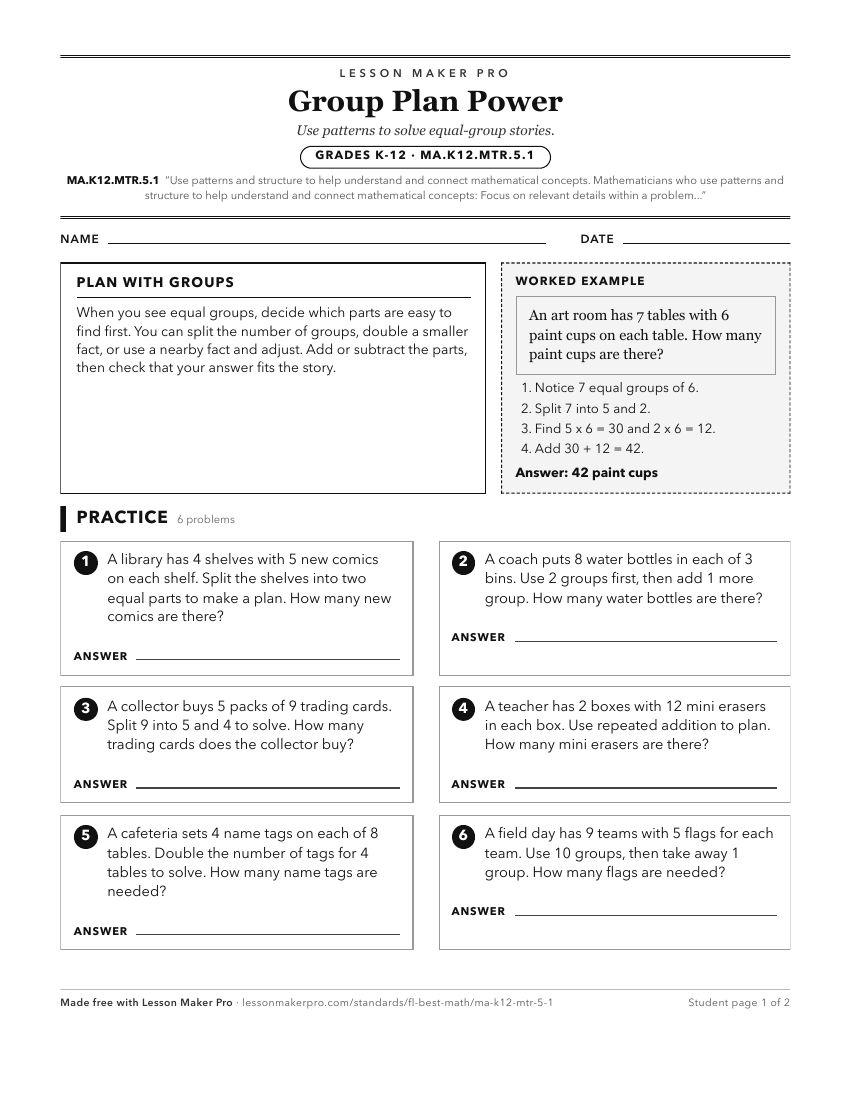
A ready-to-print activity worksheet aligned to MA.K12.MTR.5.1, with an answer key for the teacher on its own page. No account needed.
PDF, US Letter, prints cleanly in black and white.
Download the worksheetKeep exploring
Related Standards
- MA.K12.MTR.5
Use patterns and structure to help understand and connect mathematical concepts.
- MA.K12.MTR.2.1
Demonstrate understanding by representing problems in multiple ways. Mathematicians who demonstrate understanding by representing problems in multiple ways: Bui...
- MA.K12.MTR.7.1
Apply mathematics to real-world contexts. Mathematicians who apply mathematics to real-world contexts: Connect mathematical concepts to everyday experiences. Us...
- MA.3.AR.3.3
Identify, create and extend numerical patterns.
Turn this cluster into a lesson
Grade, subject, topic, and the complete cluster are prefilled. Create one free, no account needed.
Also for this cluster:Make a WorksheetMake a QuizMake a Sub Lesson