Florida B.E.S.T. MA.8.DP.2.3
The Standard
Solve real-world problems involving probabilities related to single or repeated experiments, including making predictions based on theoretical probability.
Florida B.E.S.T. Standards for Mathematics
Teacher's field guide
What This Standard Means
What Students Need to Do
- Students calculate probabilities for one trial and for repeated trials, then use those probabilities to predict counts over many trials. They interpret predictions as expected results, not guarantees.
What Mastery Looks Like
- A student can choose the correct probabilities, combine them for repeated trials, and show the work clearly. The student can multiply a probability by the number of trials to make a reasonable prediction.
Common Misconceptions
- Students may add probabilities when repeated independent events require multiplication. They may treat a predicted count as an exact result. They may also ignore whether an item is replaced between draws.
How to Assess It
- Give this exit ticket: A bag has 3 red and 2 blue counters, with replacement after each draw. Find the probability of two reds and predict how often that result should occur in 100 experiments.
Lesson moves
Ways to Teach It
Pairs roll two dice 40 times, record sums in a tally chart, and compare experimental frequencies with theoretical probabilities.
Ask, “A spinner lands red with probability 1/4. How many reds should 80 spins produce, and why might results differ?”
Play Probability Match: students pair event cards, probability expressions, and predicted counts, then justify each match to a partner.
Have students estimate how many defective bulbs appear in 500 bulbs when the defect probability is 0.02, then discuss reasonable variation.
Free download
Printable MA.8.DP.2.3 Worksheet
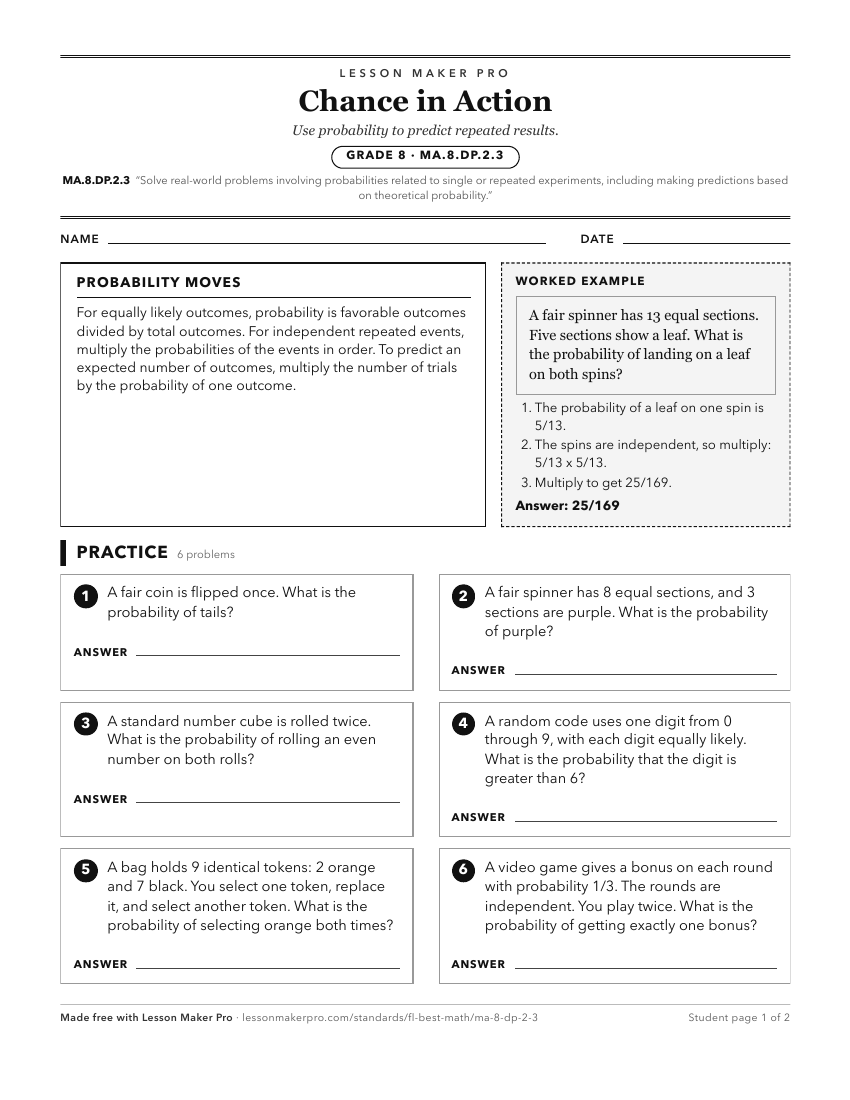
A ready-to-print activity worksheet aligned to MA.8.DP.2.3, with an answer key for the teacher on its own page. No account needed.
PDF, US Letter, prints cleanly in black and white.
Download the worksheetKeep exploring
Related Standards
- MA.7.DP.2.4
Use a simulation of a simple experiment to find experimental probabilities and compare them to theoretical probabilities.
- MA.8.DP.2.2
Find the theoretical probability of an event related to a repeated experiment.
- MA.7.DP.2
Develop an understanding of probability. Find and compare experimental and theoretical probabilities.
- MA.8.DP.2
Represent and find probabilities of repeated experiments.
Turn this exact standard into a lesson
Grade, subject, topic, and the complete standard are prefilled. Create one free, no account needed.
Also for this standard:Make a WorksheetMake a QuizMake a Sub Lesson