Florida B.E.S.T. MA.7.DP.2.4
The Standard
Use a simulation of a simple experiment to find experimental probabilities and compare them to theoretical probabilities.
Florida B.E.S.T. Standards for Mathematics
Teacher's field guide
What This Standard Means
What Students Need to Do
- Students model a chance event with coins, dice, spinners, cubes, or random numbers. They calculate the observed relative frequency and compare it with the expected probability.
What Mastery Looks Like
- Students choose a suitable random tool and run enough trials. They calculate both probabilities correctly and explain why results may differ, especially with fewer trials.
Common Misconceptions
- Students may use the number of successes instead of dividing by total trials. They may expect observed results to match the expected probability exactly. They may also think a short run is as reliable as a long run.
How to Assess It
- Give students this exit ticket: A fair die simulation produced 14 fives in 60 trials. Find the observed and expected probabilities, then explain the difference.
Lesson moves
Ways to Teach It
Use a bag with three blue and two yellow cubes to simulate 50 prize draws, replacing each cube after every draw.
Ask students why two groups can get observed probabilities of 0.38 and 0.52 when the expected probability is 0.40.
Play Probability Match by pairing event cards with expected probabilities and sample trial results, then defending each match.
Analyze a carnival spinner with eight equal sections, simulate 100 plays, and compare expected and observed prize rates.
Free download
Printable MA.7.DP.2.4 Worksheet
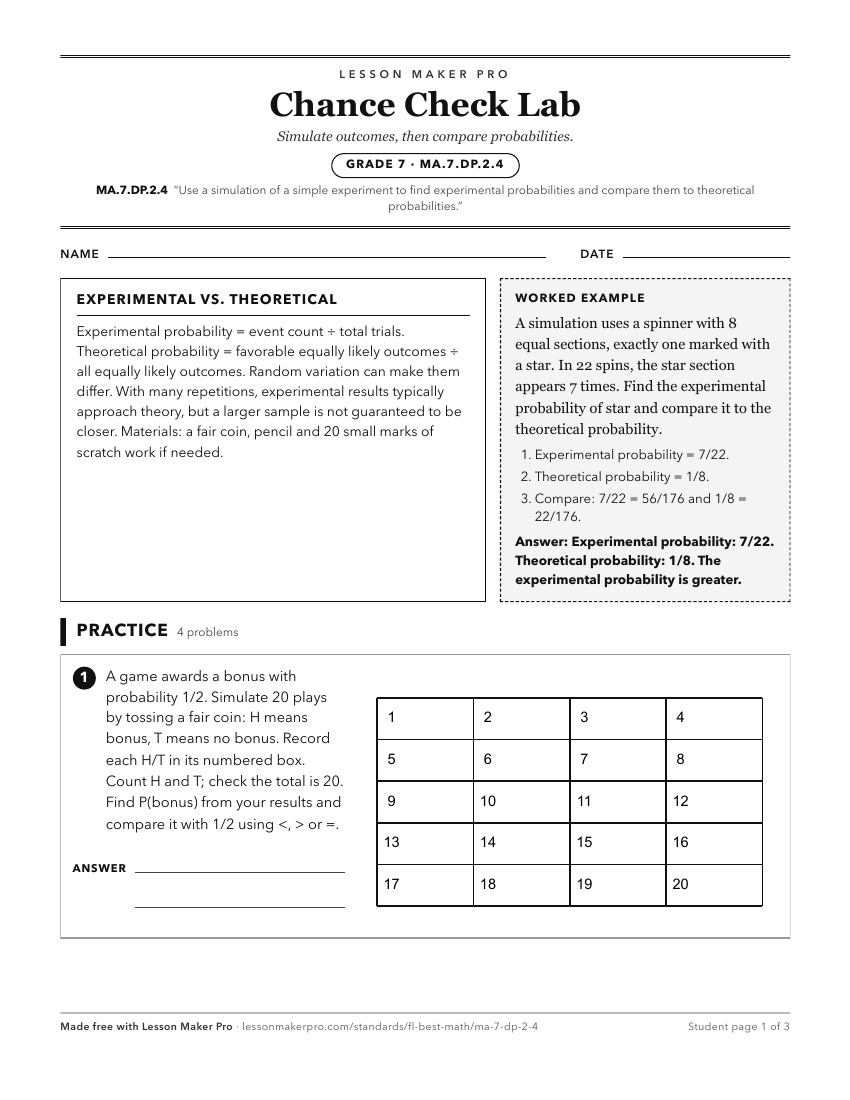
A ready-to-print activity worksheet aligned to MA.7.DP.2.4, with an answer key for the teacher on its own page. No account needed.
PDF, US Letter, prints cleanly in black and white.
Download the worksheetKeep exploring
Related Standards
- MA.7.DP.2.3
Find the theoretical probability of an event related to a simple experiment.
- MA.8.DP.2.2
Find the theoretical probability of an event related to a repeated experiment.
- MA.7.DP.2
Develop an understanding of probability. Find and compare experimental and theoretical probabilities.
- MA.8.DP.2
Represent and find probabilities of repeated experiments.
Turn this exact standard into a lesson
Grade, subject, topic, and the complete standard are prefilled. Create one free, no account needed.
Also for this standard:Make a WorksheetMake a QuizMake a Sub Lesson