Florida B.E.S.T. MA.8.AR.4.2
The Standard
Given a system of two linear equations represented graphically on the same coordinate plane, determine whether there is one solution, no solution or infinitely many solutions.
Florida B.E.S.T. Standards for Mathematics
Teacher's field guide
What This Standard Means
What Students Need to Do
- Students inspect two lines on one coordinate plane and decide how many points the lines share. They connect crossing lines, distinct parallel lines, and overlapping lines to different solution counts.
What Mastery Looks Like
- Students correctly classify crossing, parallel, and overlapping line pairs. For crossing lines, they name the intersection as an ordered pair and explain why it satisfies both equations.
Common Misconceptions
- Students may treat either line’s intercept as a shared solution. They may think distinct parallel lines eventually meet, or that overlapping lines have only one solution. Some identify an intersection but read its coordinates in the wrong order.
How to Assess It
- Show three small graphs: lines crossing at (2, -1), distinct parallel lines, and overlapping lines. Ask students to state the solution count for each and give the intersection coordinates when possible.
Lesson moves
Ways to Teach It
Use transparent coordinate grids to draw one line per sheet, then overlay them and classify the intersection pattern.
Display three graph pairs and ask, “How does the picture prove the number of shared solutions?”
Run a card sort matching graph pairs with labels for one, none, or infinitely many solutions and written reasons.
Graph two taxi fare plans, then interpret crossing, parallel, or overlapping lines as comparisons between costs.
Free download
Printable MA.8.AR.4.2 Worksheet
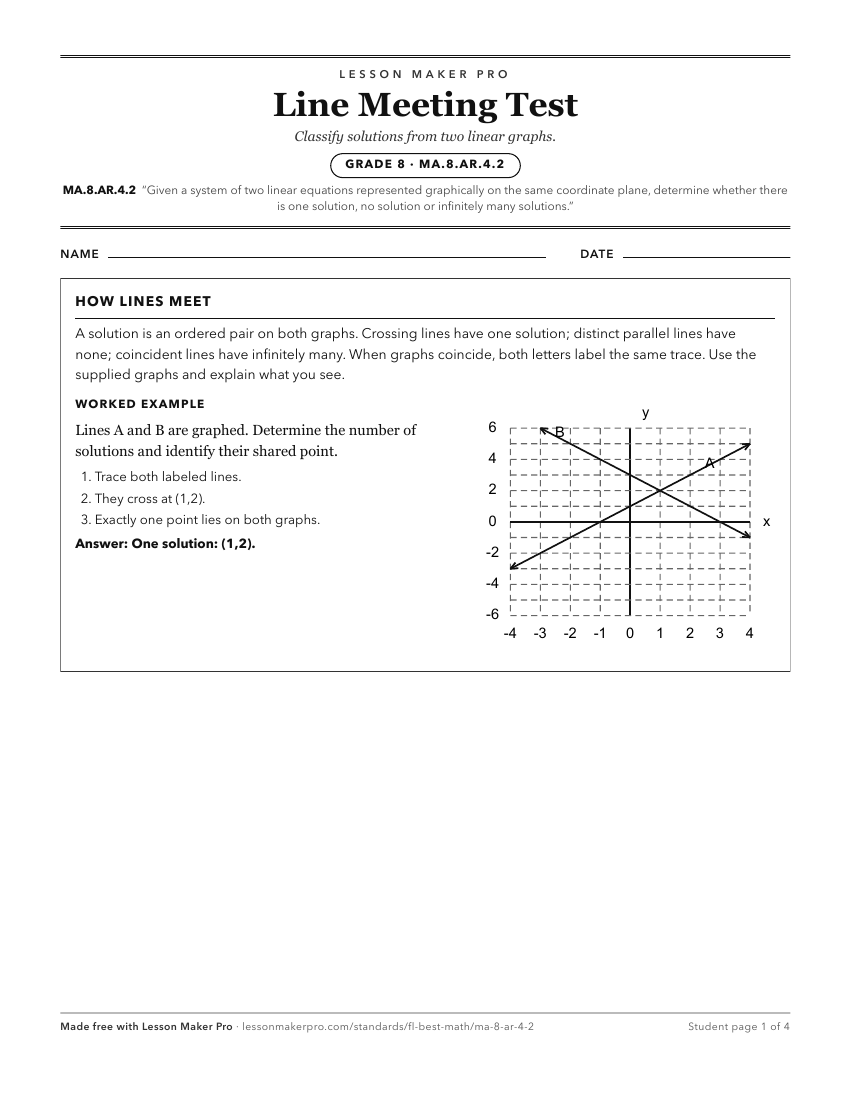
A ready-to-print activity worksheet aligned to MA.8.AR.4.2, with an answer key for the teacher on its own page. No account needed.
PDF, US Letter, prints cleanly in black and white.
Download the worksheetKeep exploring
Related Standards
- MA.8.AR.4.1
Given a system of two linear equations and a specified set of possible solutions, determine which ordered pairs satisfy the system of linear equations.
- MA.912.AR.9.1
Given a mathematical or real-world context, write and solve a system of two-variable linear equations algebraically or graphically.
- MA.8.AR.4.3
Given a mathematical or real-world context, solve systems of two linear equations by graphing.
- MA.912.AR.9.3
Given a mathematical or real-world context, solve a system consisting of two-variable linear or non-linear equations algebraically or graphically.
Turn this exact standard into a lesson
Grade, subject, topic, and the complete standard are prefilled. Create one free, no account needed.
Also for this standard:Make a WorksheetMake a QuizMake a Sub Lesson