Florida B.E.S.T. ELA.K.R.1.4
The Standard
Identify rhyme in a poem.
Florida B.E.S.T. Standards for English Language Arts
Teacher's field guide
What This Standard Means
What Students Need to Do
- Students listen for words with the same ending sound in a short poem. They name the rhyming words and tell which words form a pair.
What Mastery Looks Like
- After hearing a short poem, a student correctly names words that share an ending sound. The student can distinguish a rhyming pair from a nonrhyming pair.
Common Misconceptions
- Students may match words with the same beginning sound, such as cat and cup. They may pair related words, such as dog and bone, or treat repeated words as rhymes.
How to Assess It
- Read aloud: “I see a cat. It wears a hat. I see a dog. It sits on a log.” Ask, “Tell me the two rhyming pairs.”
Lesson moves
Ways to Teach It
Give students picture cards for cat, hat, dog, log, sun, and run, then have them build matching rhyme pairs.
Read a short nursery rhyme and ask, “Which two words sounded alike at the end?”
Play Rhyme Corners by labeling corners with pictures, saying a word, and having students move to its rhyming match.
Play a familiar playground chant and have students clap each time they hear two words that rhyme.
Free download
Printable ELA.K.R.1.4 Worksheet
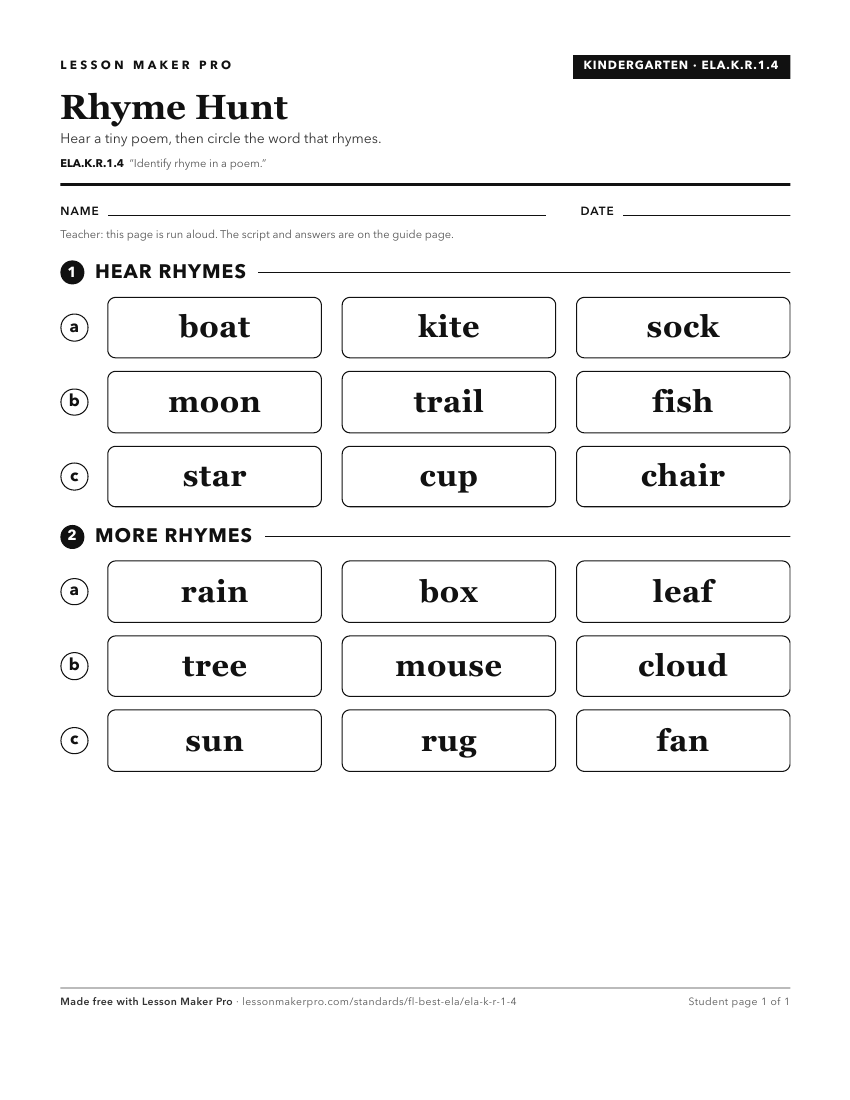
A ready-to-print activity worksheet aligned to ELA.K.R.1.4, with an answer key for the teacher on its own page. No account needed.
PDF, US Letter, prints cleanly in black and white.
Download the worksheetKeep exploring
Related Standards
Turn this exact standard into a lesson
Grade, subject, topic, and the complete standard are prefilled. Create one free, no account needed.
Also for this standard:Make a WorksheetMake a QuizMake a Sub Lesson