Florida B.E.S.T. ELA.3.R.1.4
The Standard
Identify types of poems: free verse, rhymed verse, haiku, and limerick.
Florida B.E.S.T. Standards for English Language Arts
Teacher's field guide
What This Standard Means
What Students Need to Do
- Students examine a poem's lines, rhyme, rhythm, and syllable pattern. They use those features to name the poem type and explain their choice.
What Mastery Looks Like
- Students correctly label unfamiliar examples and point to evidence such as line count, rhyme scheme, syllables, or lack of a fixed pattern. They can explain why a poem fits one type better than another.
Common Misconceptions
- Students may call any poem with rhyme a limerick. They may identify haiku only by topic, rather than checking its three lines and syllable pattern. They may think free verse cannot use any rhyme.
How to Assess It
- Give students four short poems, one of each type. Ask them to label each poem and circle or note one structural clue.
Lesson moves
Ways to Teach It
Give pairs poem cards and feature labels, then have them sort the cards and underline evidence for each choice.
Ask students to compare two poems and write which structural clues reveal each poem's type.
Play Poem Type Four Corners by reading a poem aloud while students move to the matching labeled corner and explain their choice.
Collect poems from greeting cards, songs, or children's books, then classify each one using line, rhyme, and syllable clues.
Free download
Printable ELA.3.R.1.4 Worksheet
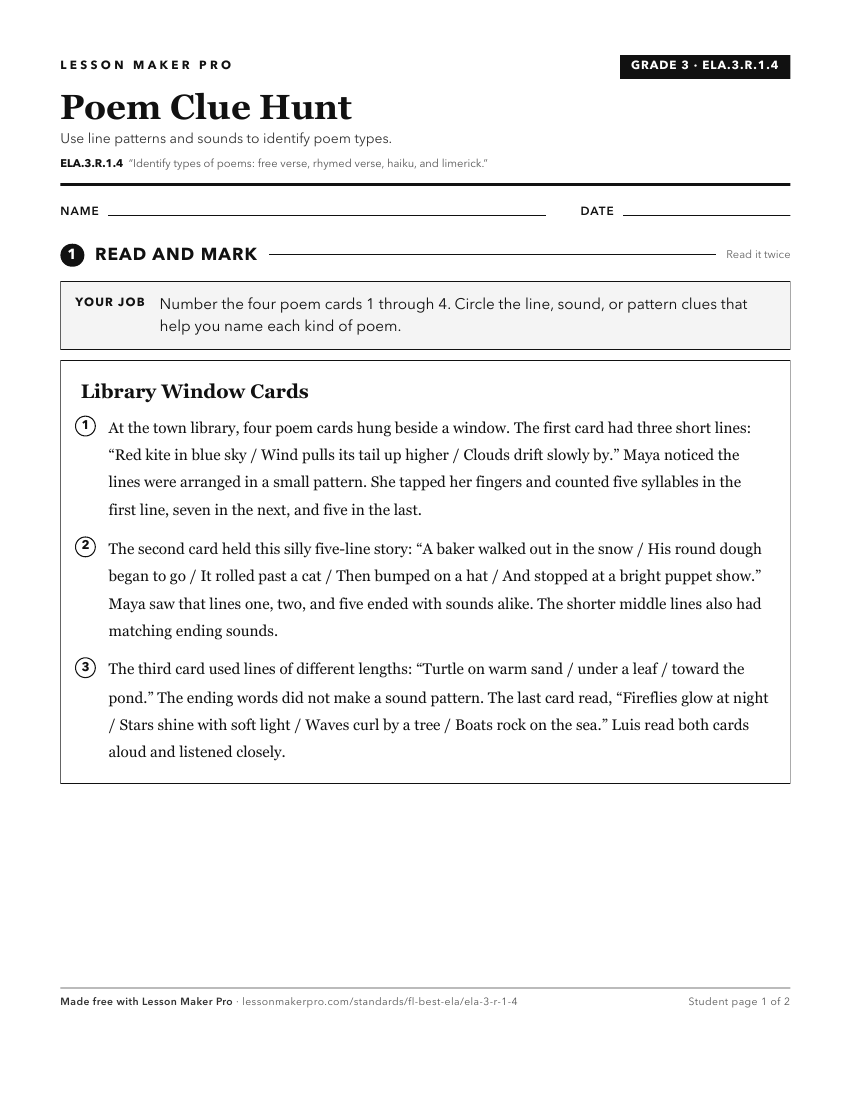
A ready-to-print activity worksheet aligned to ELA.3.R.1.4, with an answer key for the teacher on its own page. No account needed.
PDF, US Letter, prints cleanly in black and white.
Download the worksheetKeep exploring
Related Standards
Turn this exact standard into a lesson
Grade, subject, topic, and the complete standard are prefilled. Create one free, no account needed.
Also for this standard:Make a WorksheetMake a QuizMake a Sub Lesson