Florida B.E.S.T. ELA.4.R.1.3
The Standard
Identify the narrator's point of view and explain the difference between a narrator's point of view and character perspective in a literary text.
Florida B.E.S.T. Standards for English Language Arts
Teacher's field guide
What This Standard Means
What Students Need to Do
- Students determine who tells a story and whether that narrator participates in events or observes from outside. They compare the narrator’s knowledge and attitudes with a character’s thoughts, feelings, and experiences.
What Mastery Looks Like
- Students correctly identify first-person or third-person narration using pronouns and story details. They explain how a character’s feelings, beliefs, or knowledge differ from the narrator’s, using text evidence.
Common Misconceptions
- Students may mistake first-person dialogue for first-person narration. They may also assume the narrator and main character share the same thoughts, feelings, and knowledge.
How to Assess It
- Display: “I watched Maya hide the cracked vase. She smiled when Dad entered, but I knew she was worried.” Ask students to name the narrator’s point of view and explain how it differs from Maya’s perspective.
Lesson moves
Ways to Teach It
Give pairs colored sticky notes to mark narrator clues in blue and character thoughts or feelings in yellow within a short story.
Ask students to write: “What does the narrator know that one character does not know, and how does that shape the story?”
Have teams sort evidence cards under three headings: narrator’s words, character’s thoughts, and character’s actions.
Retell a playground disagreement as an observer and then as one participant, comparing what each person notices and believes.
Free download
Printable ELA.4.R.1.3 Worksheet
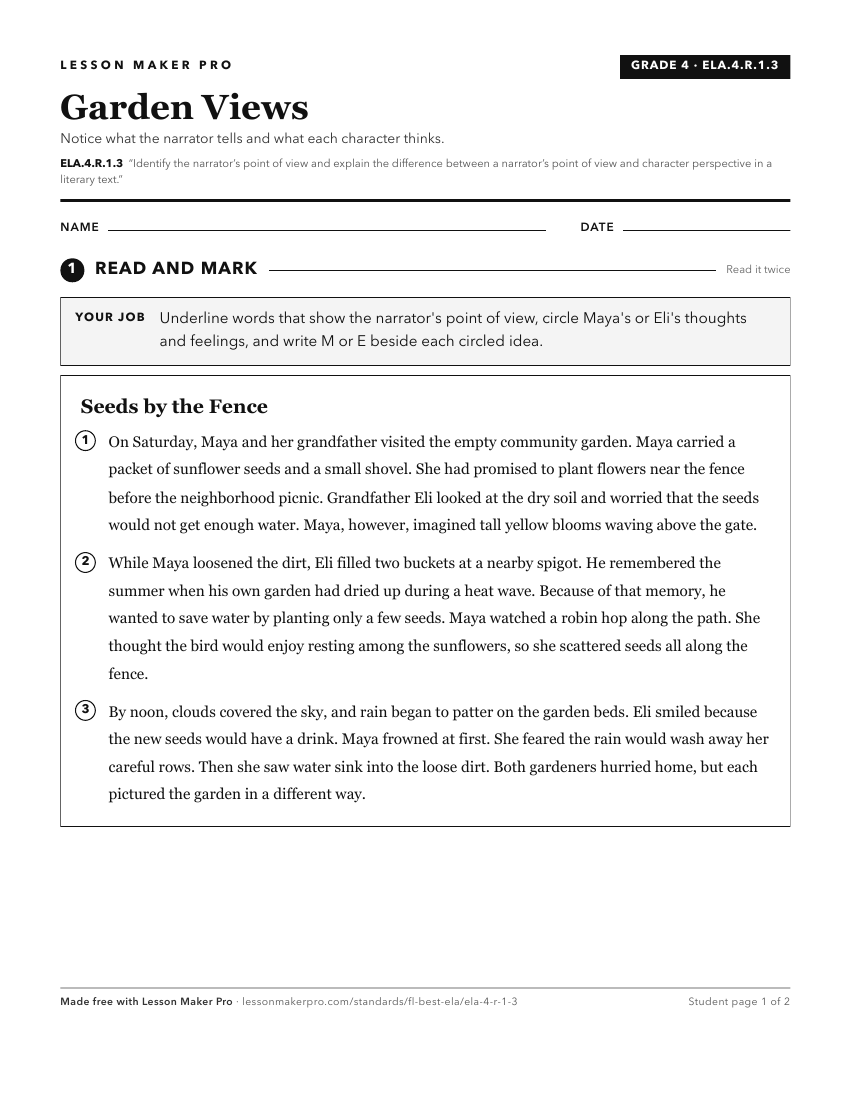
A ready-to-print activity worksheet aligned to ELA.4.R.1.3, with an answer key for the teacher on its own page. No account needed.
PDF, US Letter, prints cleanly in black and white.
Download the worksheetKeep exploring
Related Standards
- ELA.5.R.1.3
Describe how an author develops a character's perspective in a literary text.
- ELA.7.R.1.3
Explain the influence of narrator(s), including unreliable narrator(s), and/or shifts in point of view in a literary text.
- ELA.2.R.1.3
Identify different characters’ perspectives in a literary text.
- ELA.3.R.1.3
Explain different characters' perspectives in a literary text
Turn this exact standard into a lesson
Grade, subject, topic, and the complete standard are prefilled. Create one free, no account needed.
Also for this standard:Make a WorksheetMake a QuizMake a Sub Lesson