Florida B.E.S.T. ELA.3.R.1.3
The Standard
Explain different characters' perspectives in a literary text
Florida B.E.S.T. Standards for English Language Arts
Teacher's field guide
What This Standard Means
What Students Need to Do
- Students explain what different characters think, feel, or believe about events in a story or poem. They use dialogue, actions, and thoughts to show how the perspectives differ.
What Mastery Looks Like
- Students clearly compare how two characters understand or react to the same event. They support each perspective with relevant dialogue, thoughts, feelings, or actions from the text.
Common Misconceptions
- Students may list character traits or retell events instead of explaining each character’s perspective. They may confuse the narrator’s perspective with a character’s perspective or make claims without text evidence.
How to Assess It
- Exit ticket: Choose two characters from today’s story. Explain how they view the same event differently, and give one supporting detail for each character.
Lesson moves
Ways to Teach It
Give pairs character cards and dialogue strips, then have them sort each strip by the perspective it shows.
Ask, “Which character sees the problem differently, and what words or actions show that?”
Play Perspective Match by pairing event cards with character reaction cards, then explaining each match.
Present a missed-recess situation and have students write how a student, teacher, and principal might each view it.
Free download
Printable ELA.3.R.1.3 Worksheet
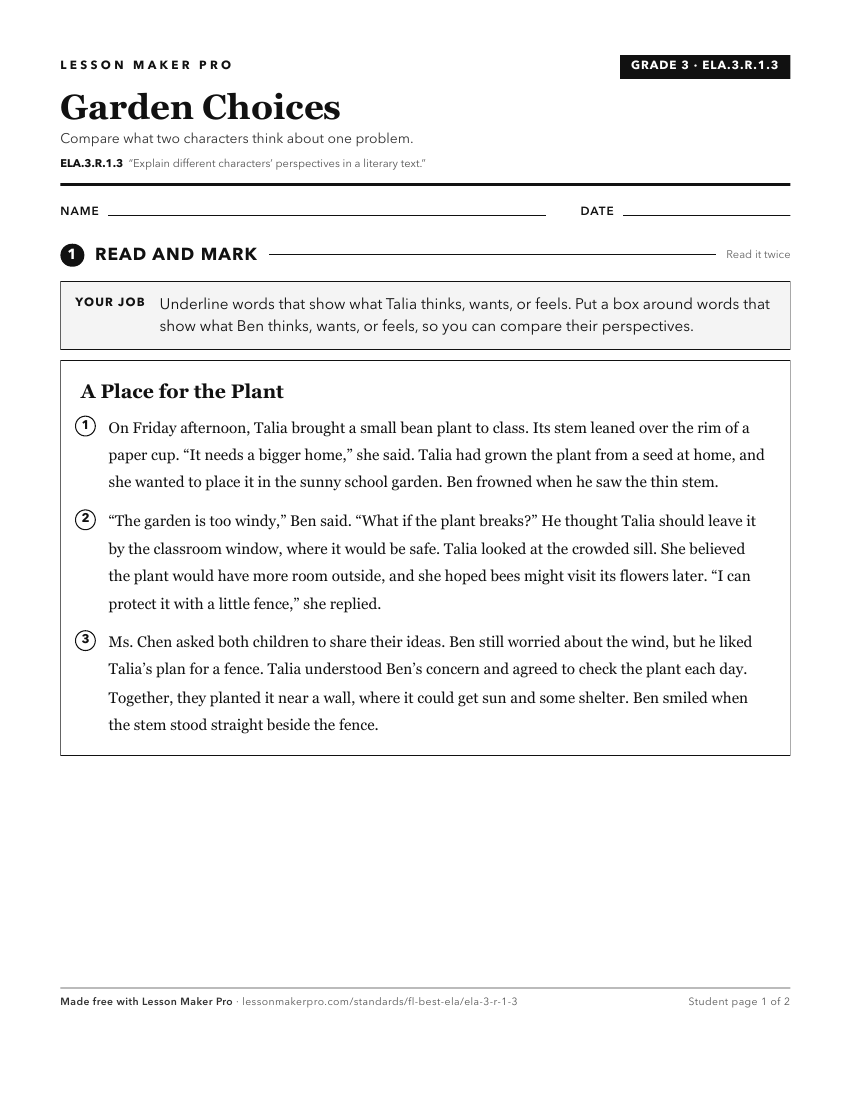
A ready-to-print activity worksheet aligned to ELA.3.R.1.3, with an answer key for the teacher on its own page. No account needed.
PDF, US Letter, prints cleanly in black and white.
Download the worksheetKeep exploring
Related Standards
- ELA.5.R.1.3
Describe how an author develops a character's perspective in a literary text.
- ELA.8.R.1.3
Analyze how an author develops and individualizes the perspectives of different characters.
- ELA.4.R.1.3
Identify the narrator's point of view and explain the difference between a narrator's point of view and character perspective in a literary text.
- ELA.2.R.1.3
Identify different characters’ perspectives in a literary text.
Turn this exact standard into a lesson
Grade, subject, topic, and the complete standard are prefilled. Create one free, no account needed.
Also for this standard:Make a WorksheetMake a QuizMake a Sub Lesson