Florida B.E.S.T. ELA.7.R.1.3
The Standard
Explain the influence of narrator(s), including unreliable narrator(s), and/or shifts in point of view in a literary text.
Florida B.E.S.T. Standards for English Language Arts
Teacher's field guide
What This Standard Means
What Students Need to Do
- Students track who tells each part and what that person knows, believes, or hides. They explain how bias, limited knowledge, credibility, or a viewpoint change shapes the reader’s understanding.
What Mastery Looks Like
- A student can cite details that reveal limited knowledge, bias, or contradictions. The student can explain how a narrator or viewpoint change affects suspense, sympathy, surprise, or meaning.
Common Misconceptions
- Students often confuse the narrator with the author or assume every first-person narrator is unreliable. They may mistake dialogue changes for viewpoint shifts or claim unreliability without citing a contradiction, bias, or knowledge gap.
How to Assess It
- Use this exit ticket: “I never entered the office,” Maya narrates, but Leo later describes seeing her leave it. How does the change in narrator affect whom you trust? Cite one detail.
Lesson moves
Ways to Teach It
Give pairs a printed excerpt. Students highlight facts blue, opinions yellow, and contradictions pink, then rate the narrator’s reliability.
Read two accounts of one event, then ask: Which narrator earns your trust, and what exact wording shapes your choice?
Run a narrator detective game where teams sort clue cards into limited knowledge, bias, contradiction, and viewpoint shift, then justify one choice.
Compare two eyewitness posts about a school game, then write how each writer’s location and goal shape the account.
Free download
Printable ELA.7.R.1.3 Worksheet
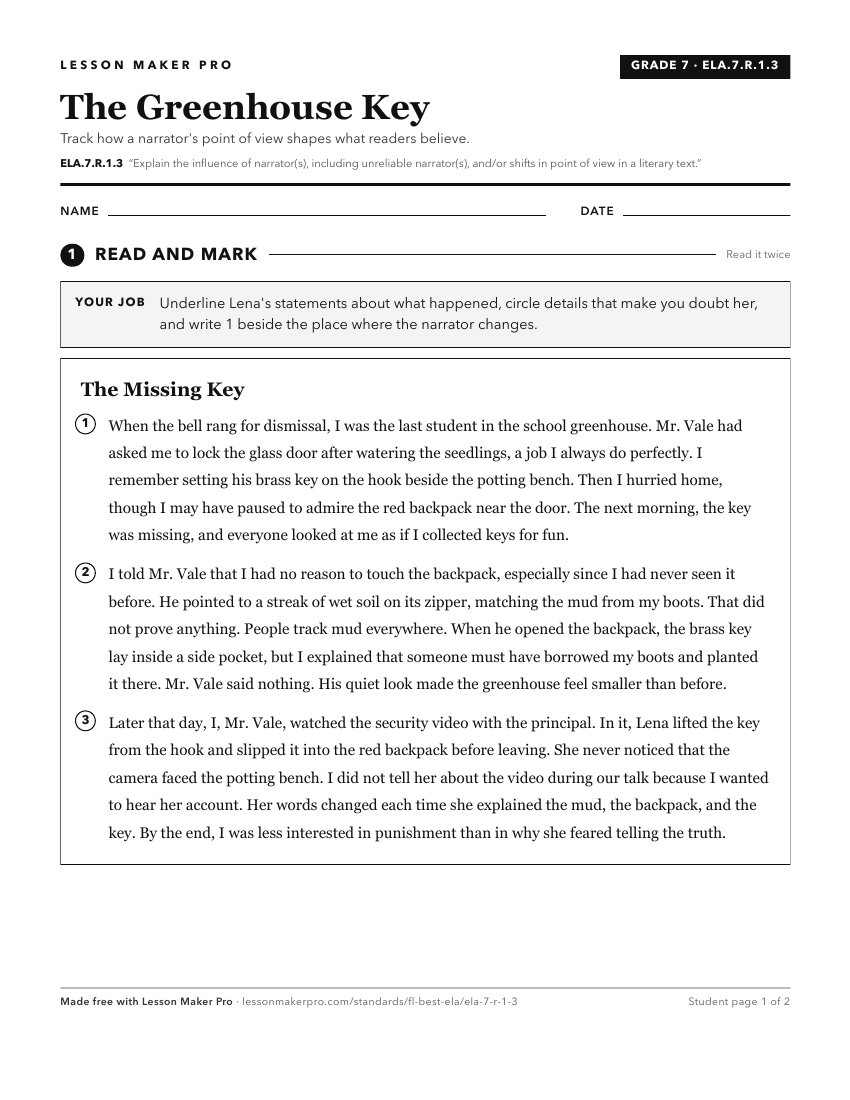
A ready-to-print activity worksheet aligned to ELA.7.R.1.3, with an answer key for the teacher on its own page. No account needed.
PDF, US Letter, prints cleanly in black and white.
Download the worksheetKeep exploring
Related Standards
- ELA.6.R.1.3
Explain the influence of multiple narrators and/or shifts in point of view in a literary text.
- ELA.4.R.1.3
Identify the narrator's point of view and explain the difference between a narrator's point of view and character perspective in a literary text.
- ELA.2.R.1.3
Identify different characters’ perspectives in a literary text.
- ELA.3.R.1.3
Explain different characters' perspectives in a literary text
Turn this exact standard into a lesson
Grade, subject, topic, and the complete standard are prefilled. Create one free, no account needed.
Also for this standard:Make a WorksheetMake a QuizMake a Sub Lesson