Florida B.E.S.T. ELA.2.R.1.1
The Standard
Identify plot structure and describe main story elements in a literary text.
Florida B.E.S.T. Standards for English Language Arts
Teacher's field guide
What This Standard Means
What Students Need to Do
- Students name the main characters and setting, then explain what happens at the beginning, middle, and end. They identify the main problem, key events, and solution.
What Mastery Looks Like
- Students accurately name the main characters and setting. They retell key events in order and explain how the problem develops and is resolved.
Common Misconceptions
- Students may list events without putting them in order. They may confuse the main problem with a small event or name the final event as the solution without explaining how it fixes the problem.
How to Assess It
- Give students a short story and ask them to write the character, setting, problem, one key event, and solution. Then have them label the beginning, middle, and end.
Lesson moves
Ways to Teach It
Give pairs six event cards from a familiar tale to sort into beginning, middle, and end, then label the problem and solution.
After reading, ask, "Which event changes the story most, and how does it lead to the ending?"
Play Plot Match: students match character, setting, problem, event, and solution cards to short story summaries.
Students turn a real classroom problem, such as a missing pencil, into a three-part story with characters, setting, and resolution.
Free download
Printable ELA.2.R.1.1 Worksheet
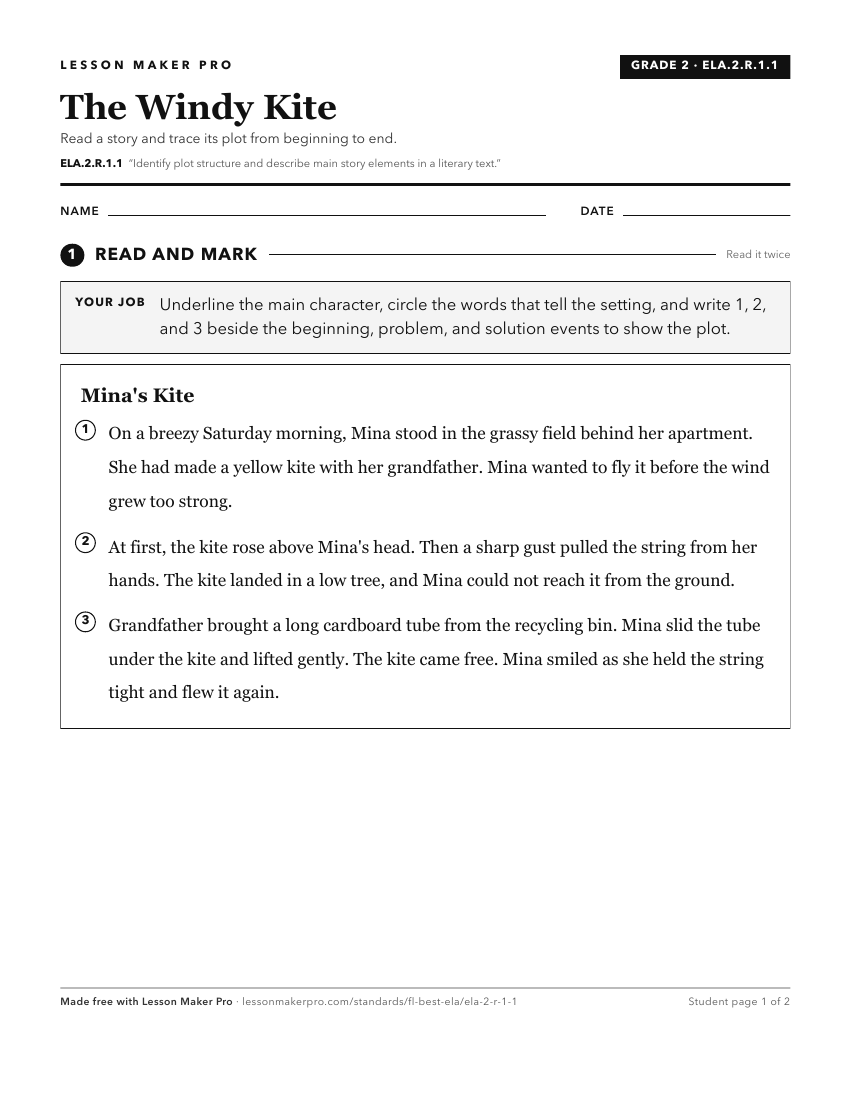
A ready-to-print activity worksheet aligned to ELA.2.R.1.1, with an answer key for the teacher on its own page. No account needed.
PDF, US Letter, prints cleanly in black and white.
Download the worksheetKeep exploring
Related Standards
- ELA.4.R.1.1
Explain how setting, events, conflict, and character development contribute to the plot in a literary text.
- ELA.1.R.1.1
Identify and describe the main story elements in a story.
- ELA.2.R.1.2
Identify and explain a theme of a literary text.
- ELA.5.R.1.1
Analyze how setting, events, conflict, and characterization contribute to the plot in a literary text.
Turn this exact standard into a lesson
Grade, subject, topic, and the complete standard are prefilled. Create one free, no account needed.
Also for this standard:Make a WorksheetMake a QuizMake a Sub Lesson