CCSS.
The Standard
Construct viable arguments and critique the reasoning of others. Mathematically proficient students understand and use stated assumptions, definitions, and previously established results in constructing arguments. They make conjectures and build a logical progression of statements to explore the truth of their conjectures. They are able to analyze situations by breaking them into cases, and can recognize and use counterexamples. They justify their conclusions, communicate them to others, and respond to the arguments of others. They reason inductively about data, making plausible arguments that take into account the context from which the data arose. Mathematically proficient students are also able to compare the effectiveness of two plausible arguments, distinguish correct logic or reasoning from that which is flawed, and—if there is a flaw in an argument—explain what it is. Elementary students can construct arguments using concrete referents such as objects, drawings, diagrams, and actions. Such arguments can make sense and be correct, even though they are not generalized or made formal until later grades. Later, students learn to determine domains to which an argument applies. Students at all grades can listen or read the arguments of others, decide whether they make sense, and ask useful questions to clarify or improve the arguments.
Common Core State Standards for Mathematics
Teacher's field guide
What This Standard Means
What Students Need to Do
- Students make a mathematical claim and support it with objects, diagrams, examples, definitions, calculations, or known results. They examine another person’s reasoning, ask questions, identify gaps or counterexamples, and suggest corrections.
What Mastery Looks Like
- Students connect each claim to a definition, model, calculation, or known result. They can find gaps or counterexamples in another argument, ask a useful question, and revise their own reasoning.
Common Misconceptions
- Students may think several examples prove a claim for every case. They may focus only on the final answer, reject unfamiliar methods, or name an error without explaining why it fails.
How to Assess It
- Display a solution from today’s lesson with one deliberate reasoning error. Ask students to identify the first flawed step, explain why it fails, and correct it.
Lesson moves
Ways to Teach It
Give pairs counters, tiles, or algebra cards to build two models, then use each model to defend the same mathematical claim.
Have students write, “I agree or disagree because,” after reading a two-step solution, then cite the exact step supporting their view.
Run an Error Hunt with solution cards, awarding points for finding the first flawed step and giving a valid correction.
Use class survey data to test a claim about students, then discuss whether the sample supports the conclusion and what limits remain.
Free download
Printable CCSS.Math.Practice.MP3 Worksheet
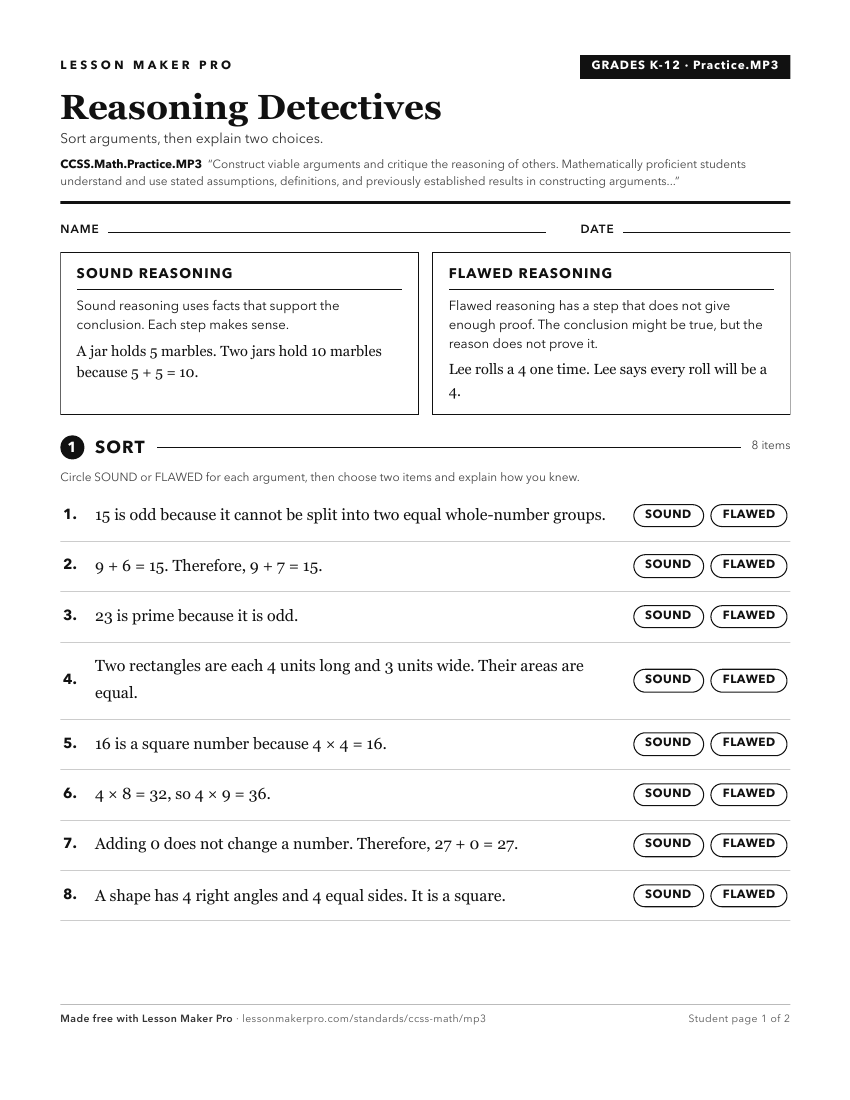
A ready-to-print activity worksheet aligned to CCSS.Math.Practice.MP3, with an answer key for the teacher on its own page. No account needed.
PDF, US Letter, prints cleanly in black and white.
Download the worksheetKeep exploring
Related Standards
- CCSS.Math.Content.HSA-REI.A
Understand solving equations as a process of reasoning and explain the reasoning
- CCSS.Math.Content.6.EE.B
Reason about and solve one-variable equations and inequalities.
- CCSS.Math.Practice.MP8
Look for and express regularity in repeated reasoning.
- CCSS.Math.Content.6.RP.A
Understand ratio concepts and use ratio reasoning to solve problems.
Turn this exact standard into a lesson
Grade, subject, topic, and the complete standard are prefilled. Create one free, no account needed.
Also for this standard:Make a WorksheetMake a QuizMake a Sub Lesson