CCSS.
The Standard
Explain each step in solving a simple equation as following from the equality of numbers asserted at the previous step, starting from the assumption that the original equation has a solution. Construct a viable argument to justify a solution method.
Common Core State Standards for Mathematics
Teacher's field guide
What This Standard Means
What Students Need to Do
- Students solve simple equations and give a reason for every transformation. They explain why each operation or simplification keeps the two sides equal and supports the final solution.
What Mastery Looks Like
- A student writes a correct sequence of steps and identifies the property that supports each one. The student can also spot an invalid step and explain why it changes the solution set.
Common Misconceptions
- Students may change only one side of an equation or lose a negative sign when distributing. They may name an inverse operation without explaining why it preserves equality. Some confuse simplifying an expression with performing the same operation on both sides.
How to Assess It
- Exit ticket: Solve 3(x - 2) = 15, and write a reason beside every line. Explain why each step preserves equality.
Lesson moves
Ways to Teach It
Use a balance scale and algebra tiles to model 2x + 3 = 11, recording the matching change made to both sides.
Ask students to explain why subtracting 3 from only one side changes the solution set, then revise the incorrect work.
Run a card sort matching equation steps with reasons such as subtraction property of equality, distributive property, and combining like terms.
Model a phone plan bill with an equation, then have students justify each step used to find the number of gigabytes.
Free download
Printable HSA-REI.A.1 Worksheet
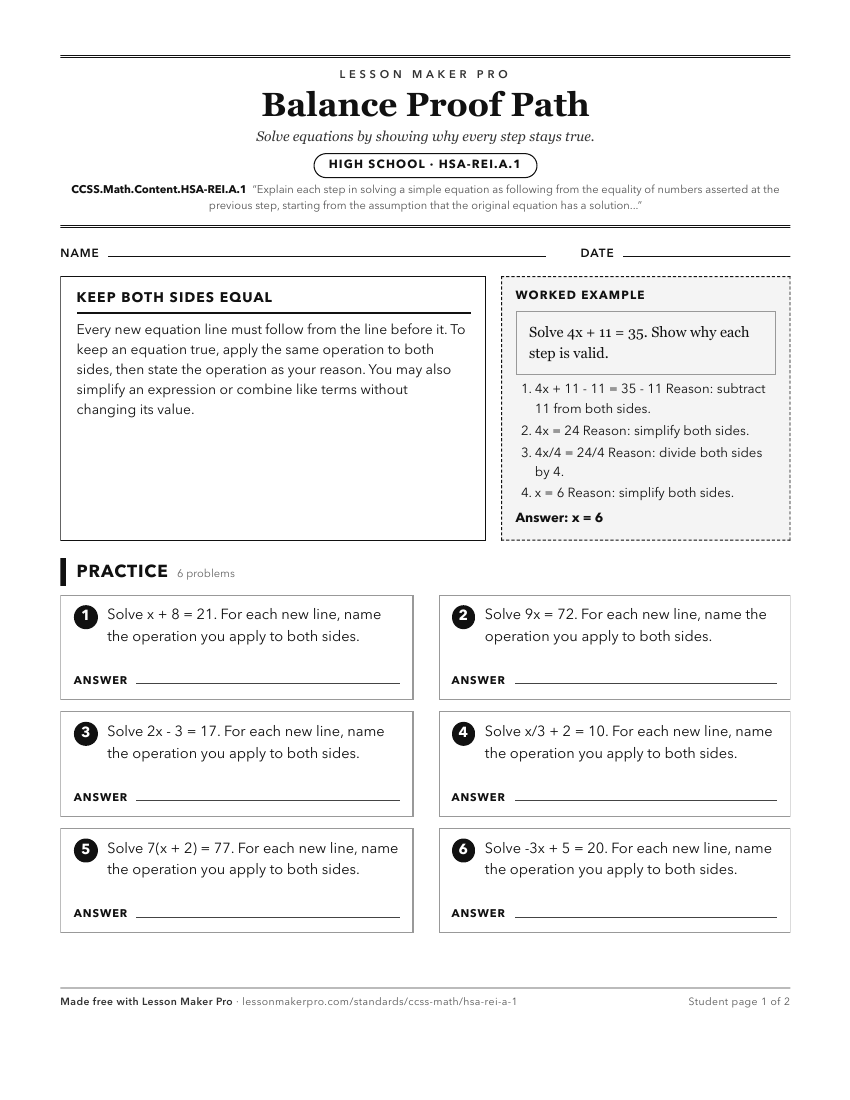
A ready-to-print activity worksheet aligned to CCSS.Math.Content.HSA-REI.A.1, with an answer key for the teacher on its own page. No account needed.
PDF, US Letter, prints cleanly in black and white.
Download the worksheetLearning progression
Where This Standard Sits
Before This Standard
If students are struggling here, check these first.
- CCSS.Math.Content.7.EE.A.1
Using properties of operations on linear expressions supports justifying equivalent equation steps and solution methods.
- CCSS.Math.Content.8.EE.C.7
Students must understand inverse operations and preserving equality while solving one-variable equations before they can justify each solution step.
- CCSS.Math.Content.7.NS.A.3
Fluent rational number operations support accurate equation steps, but the target mainly requires justifying equality-preserving moves.
What This Unlocks
Mastery here sets students up for these next.
- CCSS.Math.Content.HSA-REI.C.5
Justifying equation steps supports proving that adding a multiple of one equation preserves exactly the same solution pairs.
- CCSS.Math.Content.HSA-CED.A.4
Justifying equation steps with equality properties supports rearranging formulas by applying the same operations to isolate a chosen variable.
- CCSS.Math.Content.HSA-REI.A.2
Justifying equation steps supports recognizing when multiplying or squaring can change the solution set and create extraneous answers.
Keep exploring
Related Standards
- CCSS.Math.Content.HSA-REI.A
Understand solving equations as a process of reasoning and explain the reasoning
- CCSS.Math.Content.6.EE.B
Reason about and solve one-variable equations and inequalities.
- CCSS.Math.Content.6.EE.B.5
Understand solving an equation or inequality as a process of answering a question: which values from a specified set, if any, make the equation or inequality tr...
Turn this exact standard into a lesson
Grade, subject, topic, and the complete standard are prefilled. Create one free, no account needed.
Also for this standard:Make a WorksheetMake a QuizMake a Sub Lesson