CCSS.
The Standard
Solve linear equations in one variable.
Common Core State Standards for Mathematics · Expressions and Equations
Teacher's field guide
What This Standard Means
What Students Need to Do
- Students use inverse operations, the distributive property, and combining like terms to isolate a variable. They solve equations with variables on both sides and rational coefficients. They also decide whether an equation has one solution, no solution, or infinitely many solutions.
What Mastery Looks Like
- A student keeps both sides balanced and shows valid steps from the original equation to the solution. The student checks by substitution and recognizes when simplification produces a true statement or a contradiction.
Common Misconceptions
- Students may move a term across the equals sign without applying the same operation to both sides. They may distribute incorrectly, combine unlike terms, or treat 0 = 0 as x = 0. They often mistake a contradiction such as 4 = 9 for a calculation error instead of no solution.
How to Assess It
- Exit ticket: solve and classify 4(x - 2) = 2x + 6, 3(x + 2) = 3x + 1, and 2(x + 4) = 2x + 8.
Lesson moves
Ways to Teach It
Use algebra tiles on balance mats to model 2(x + 3) = x + 8, recording each matching move symbolically.
Show two worked solutions to 5x - 7 = 2x + 8; students identify the first invalid step and explain why.
Run a card sort where students group equations as one solution, no solution, or infinitely many solutions, then solve to verify.
Compare two taxi fare rules, write an equation for equal costs, and solve for the trip distance.
Free download
Printable 8.EE.C.7 Worksheet
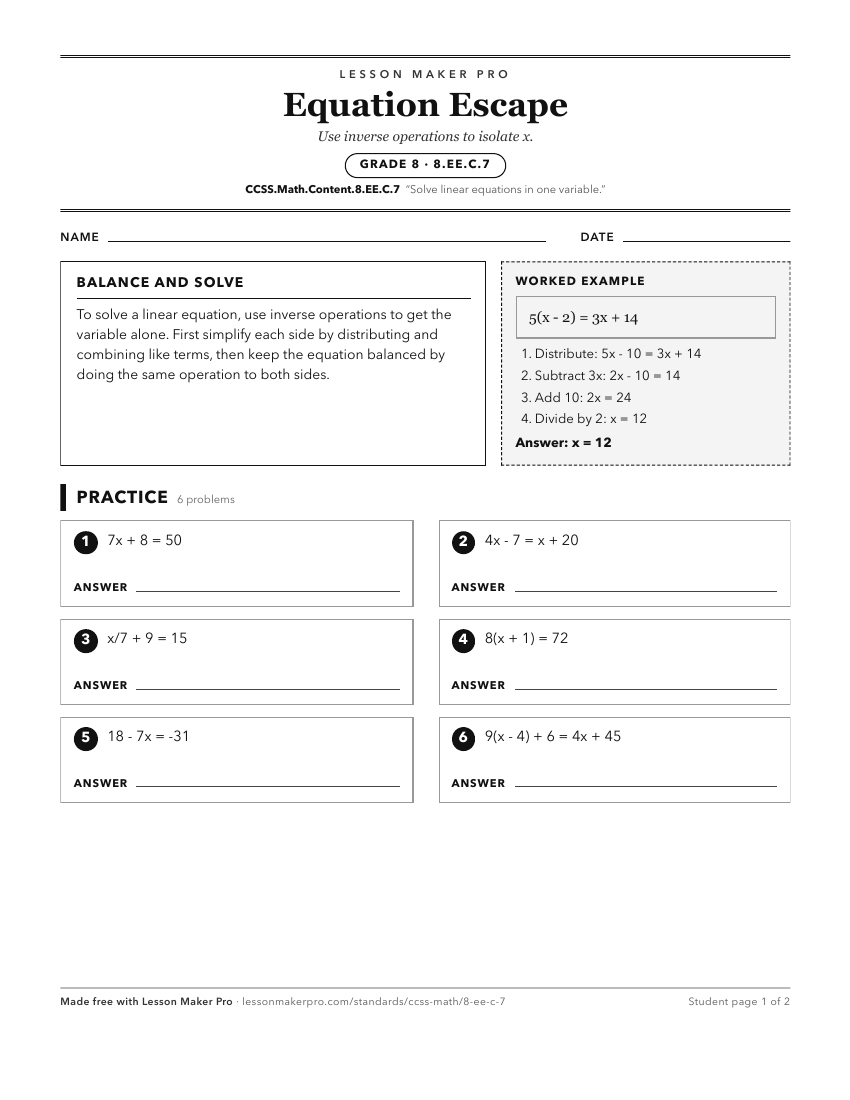
A ready-to-print activity worksheet aligned to CCSS.Math.Content.8.EE.C.7, with an answer key for the teacher on its own page. No account needed.
PDF, US Letter, prints cleanly in black and white.
Download the worksheetLearning progression
Where This Standard Sits
See the whole path on the Expressions & Equations progression map.
Before This Standard
If students are struggling here, check these first.
- CCSS.Math.Content.7.NS.A.3
Solving linear equations requires adding, subtracting, multiplying, and dividing rational numbers while isolating the variable.
- CCSS.Math.Content.7.EE.B.4a
Solving one-step and two-step rational equations prepares students for the broader linear equation methods required in grade 8.
- CCSS.Math.Content.7.EE.A.1
Solving linear equations often requires distributing, factoring, and combining rational linear expressions from both sides of the equation.
What This Unlocks
Mastery here sets students up for these next.
- CCSS.Math.Content.8.EE.C.8
Solving a system by substitution or elimination usually reduces to solving a linear equation in one variable.
- CCSS.Math.Content.HSA-REI.C.6
Solving one-variable linear equations carries into substitution or elimination after a system is reduced to a single equation.
- CCSS.Math.Content.HSA-CED.A.1
Solving one-variable linear equations supports using created equations to find unknowns before extending to quadratic, rational, and exponential cases.
- CCSS.Math.Content.HSA-CED.A.4
Solving one-variable linear equations provides the inverse-operation reasoning needed to isolate a chosen variable in a formula.
- CCSS.Math.Content.HSA-REI.B.3
Students extend one-variable equation solving to inequalities and literal coefficients, using the same inverse operations and solution reasoning.
- CCSS.Math.Content.HSA-REI.A.1
Students must understand inverse operations and preserving equality while solving one-variable equations before they can justify each solution step.
Keep exploring
Related Standards
Turn this exact standard into a lesson
Grade, subject, topic, and the complete standard are prefilled. Create one free, no account needed.
Also for this standard:Make a WorksheetMake a QuizMake a Sub Lesson