CCSS.
The Standard
Prove that, given a system of two equations in two variables, replacing one equation by the sum of that equation and a multiple of the other produces a system with the same solutions.
Common Core State Standards for Mathematics
Teacher's field guide
What This Standard Means
What Students Need to Do
- Students replace one equation in a two-variable system by adding a multiple of the other equation. They use algebra to show that this move keeps exactly the same solution pairs.
What Mastery Looks Like
- Students create the replacement equation without changing the other equation. They prove equivalence by adding a multiple in one direction and subtracting that same multiple to recover the original equation.
Common Misconceptions
- Students may multiply only one term instead of the entire equation, or change both equations at once. Some show that an original solution works in the new system but do not prove the reverse direction.
How to Assess It
- Give 2x + y = 7 and x - y = 2. Ask students to replace the first equation with the first plus three times the second, then explain why both systems have the same solutions.
Lesson moves
Ways to Teach It
Give pairs equation strips and coefficient cards; students build a replacement equation, then undo it by subtracting the same multiple.
Ask students to write: Why must the unchanged equation remain available when we reverse the replacement step?
Run a card sort matching original systems, valid replacement systems, and reverse steps that recover the removed equation.
Model two ticket-package equations, combine them to remove one price, and explain why the possible price pair does not change.
Free download
Printable HSA-REI.C.5 Worksheet
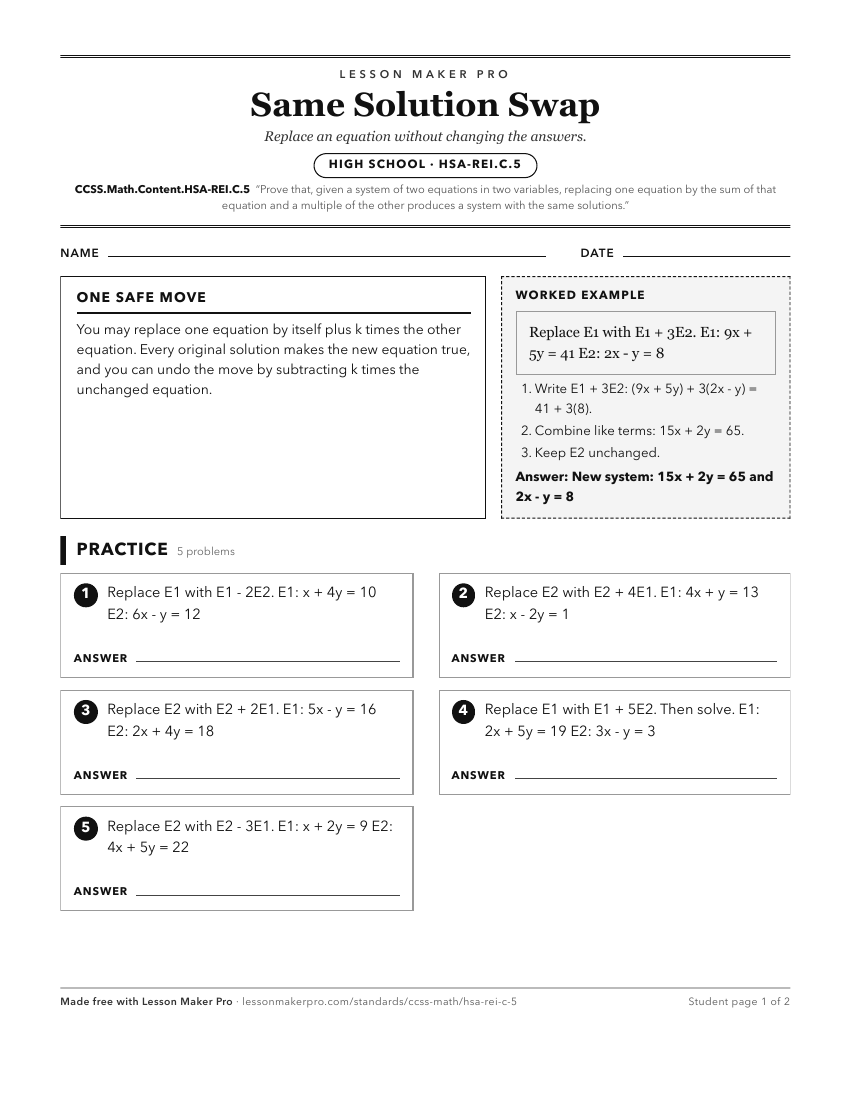
A ready-to-print activity worksheet aligned to CCSS.Math.Content.HSA-REI.C.5, with an answer key for the teacher on its own page. No account needed.
PDF, US Letter, prints cleanly in black and white.
Download the worksheetLearning progression
Where This Standard Sits
Before This Standard
If students are struggling here, check these first.
- CCSS.Math.Content.HSA-REI.A.1
Justifying equation steps supports proving that adding a multiple of one equation preserves exactly the same solution pairs.
- CCSS.Math.Content.8.EE.C.8
Understanding a system’s solution as an ordered pair satisfying both equations supports proving this equation-combination operation preserves solutions.
- CCSS.Math.Content.7.EE.A.1
Expanding, factoring, and combining linear expressions support understanding why adding a multiple of one equation preserves solutions.
Keep exploring
Related Standards
- CCSS.Math.Content.HSA-REI.C.7
Solve a simple system consisting of a linear equation and a quadratic equation in two variables algebraically and graphically.
- CCSS.Math.Content.HSA-REI.C
Solve systems of equations
- CCSS.Math.Content.8.EE.C.8a
Understand that solutions to a system of two linear equations in two variables correspond to points of intersection of their graphs, because points of intersect...
Turn this exact standard into a lesson
Grade, subject, topic, and the complete standard are prefilled. Create one free, no account needed.
Also for this standard:Make a WorksheetMake a QuizMake a Sub Lesson