CCSS.
Standard Cluster
Apply and extend previous understandings of operations with fractions to add, subtract, multiply, and divide rational numbers.
Common Core State Standards for Mathematics
Cluster contents
Standards in This Cluster
CCSS.Math.Content.7.NS.A is a cluster heading. These are the individual standards under it.
- CCSS.Math.Content.7.NS.A.1
Apply and extend previous understandings of addition and subtraction to add and subtract rational numbers; represent addition and subtraction on a horizontal or...
- CCSS.Math.Content.7.NS.A.1a
Describe situations in which opposite quantities combine to make 0.
- CCSS.Math.Content.7.NS.A.1b
Understand p + q as the number located a distance |q| from p, in the positive or negative direction depending on whether q is positive or negative. Show that a ...
- CCSS.Math.Content.7.NS.A.1c
Understand subtraction of rational numbers as adding the additive inverse, p - q = p + (-q). Show that the distance between two rational numbers on the number l...
- CCSS.Math.Content.7.NS.A.1d
Apply properties of operations as strategies to add and subtract rational numbers.
- CCSS.Math.Content.7.NS.A.2
Apply and extend previous understandings of multiplication and division and of fractions to multiply and divide rational numbers.
- CCSS.Math.Content.7.NS.A.2a
Understand that multiplication is extended from fractions to rational numbers by requiring that operations continue to satisfy the properties of operations, par...
- CCSS.Math.Content.7.NS.A.2b
Understand that integers can be divided, provided that the divisor is not zero, and every quotient of integers (with non-zero divisor) is a rational number. If ...
- CCSS.Math.Content.7.NS.A.2c
Apply properties of operations as strategies to multiply and divide rational numbers.
- CCSS.Math.Content.7.NS.A.2d
Convert a rational number to a decimal using long division; know that the decimal form of a rational number terminates in 0s or eventually repeats.
- CCSS.Math.Content.7.NS.A.3
Solve real-world and mathematical problems involving the four operations with rational numbers.
Teacher's field guide
What This Cluster Means
What Students Need to Do
- Students calculate with positive and negative fractions, decimals, and integers using all four operations. They use signs, models, and operation rules to explain and check results.
What Mastery Looks Like
- Students accurately calculate with positive and negative fractions, decimals, and integers. They choose efficient forms, simplify answers, and use estimation or inverse operations to check their work.
Common Misconceptions
- Students often ignore negative signs or apply whole-number rules to fractions. They may add denominators, invert the wrong fraction when dividing, or assume a negative product is always negative.
How to Assess It
- Use an exit ticket: solve −3/4 + 1/2, 2.5 − 4.1, −2/3 × 9/4, and 5/6 ÷ −10/3. Ask students to explain one answer using a number line or operation rule.
Lesson moves
Ways to Teach It
Place fraction cards on a floor number line, then have students model addition and subtraction by walking from each starting value.
Ask students to explain why dividing by −2/3 is the same as multiplying by −3/2, using numbers or a diagram.
Play Rational Number Four-in-a-Row, where students solve operation cards and cover matching answers on a shared grid.
Give students a bank account ledger with deposits, withdrawals, and shared expenses, then calculate each balance and explain negative results.
Free download
Printable 7.NS.A Worksheet
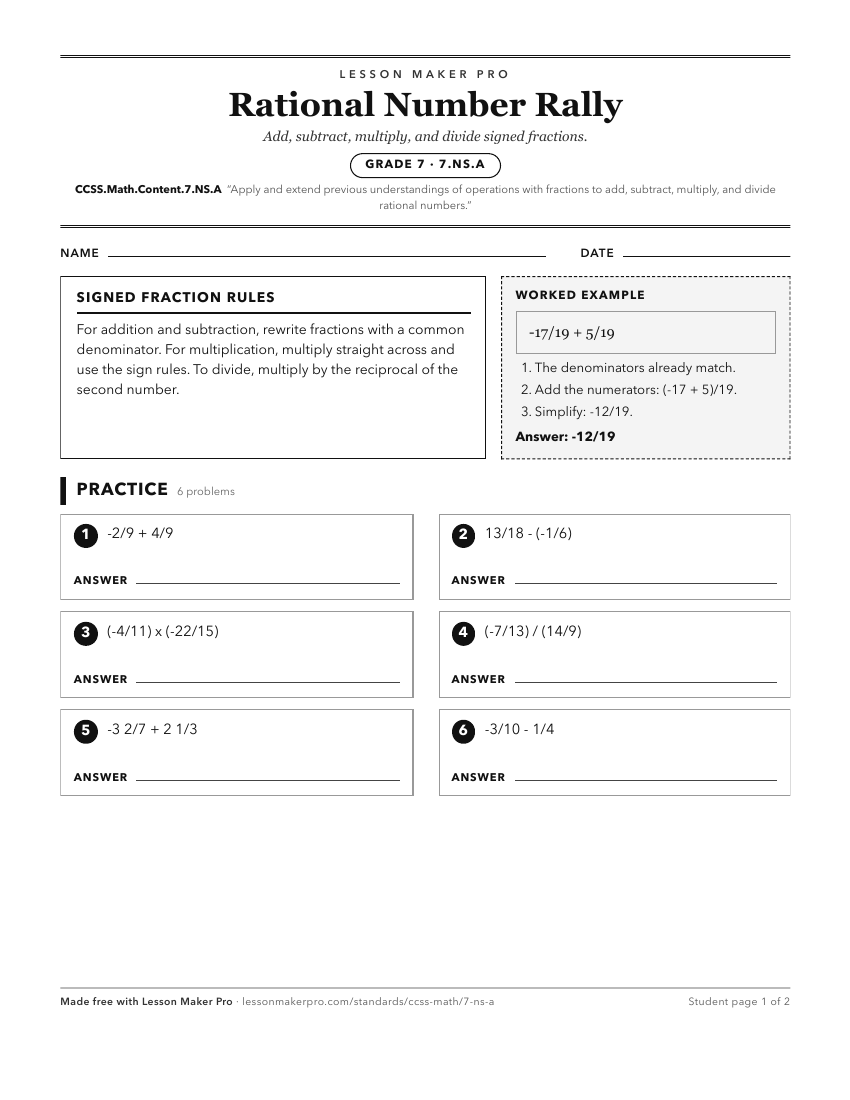
A ready-to-print activity worksheet aligned to CCSS.Math.Content.7.NS.A, with an answer key for the teacher on its own page. No account needed.
PDF, US Letter, prints cleanly in black and white.
Download the worksheetKeep exploring
Related Standards
- CCSS.Math.Content.6.NS.C
Apply and extend previous understandings of numbers to the system of rational numbers.
- CCSS.Math.Content.6.NS.A
Apply and extend previous understandings of multiplication and division to divide fractions by fractions.
- CCSS.Math.Content.5.NF.B
Apply and extend previous understandings of multiplication and division to multiply and divide fractions.
Turn this cluster into a lesson
Grade, subject, topic, and the complete cluster are prefilled. Create one free, no account needed.
Also for this cluster:Make a WorksheetMake a QuizMake a Sub Lesson