CCSS.
The Standard
Use variables to represent two quantities in a real-world problem that change in relationship to one another; write an equation to express one quantity, thought of as the dependent variable, in terms of the other quantity, thought of as the independent variable. Analyze the relationship between the dependent and independent variables using graphs and tables, and relate these to the equation.
Common Core State Standards for Mathematics · Expressions and Equations
Teacher's field guide
What This Standard Means
What Students Need to Do
- Students choose variables for two related quantities and identify the input and output. They write an equation, build a table, graph ordered pairs, and explain how all three representations match.
What Mastery Looks Like
- Given a real-world situation, students correctly identify which quantity is the input and which depends on it. They write an equation, generate matching ordered pairs, and graph them with labeled axes. They explain how a point connects to the situation and equation.
Common Misconceptions
- Students may switch the independent and dependent variables or place them on the wrong graph axes. They may create table values that do not satisfy the equation. Some assume every graph begins at zero, even when a situation includes a starting amount.
How to Assess It
- Exit ticket: A bike rental costs $4 per hour. Write an equation, make a table for 0 through 4 hours, graph the points, and explain what (3, 12) means.
Lesson moves
Ways to Teach It
Have pairs stack identical cups, measure each tower, record cup count and height, then write an equation and graph the data.
Ask students to explain which variable depends on the other in c = 3n and what each variable could represent.
Give groups equation, table, graph, and situation cards to match, then require one written reason for each completed set.
Compare two taxi fares with different starting fees and per-mile rates using equations, tables, and graphs.
Free download
Printable 6.EE.C.9 Worksheet
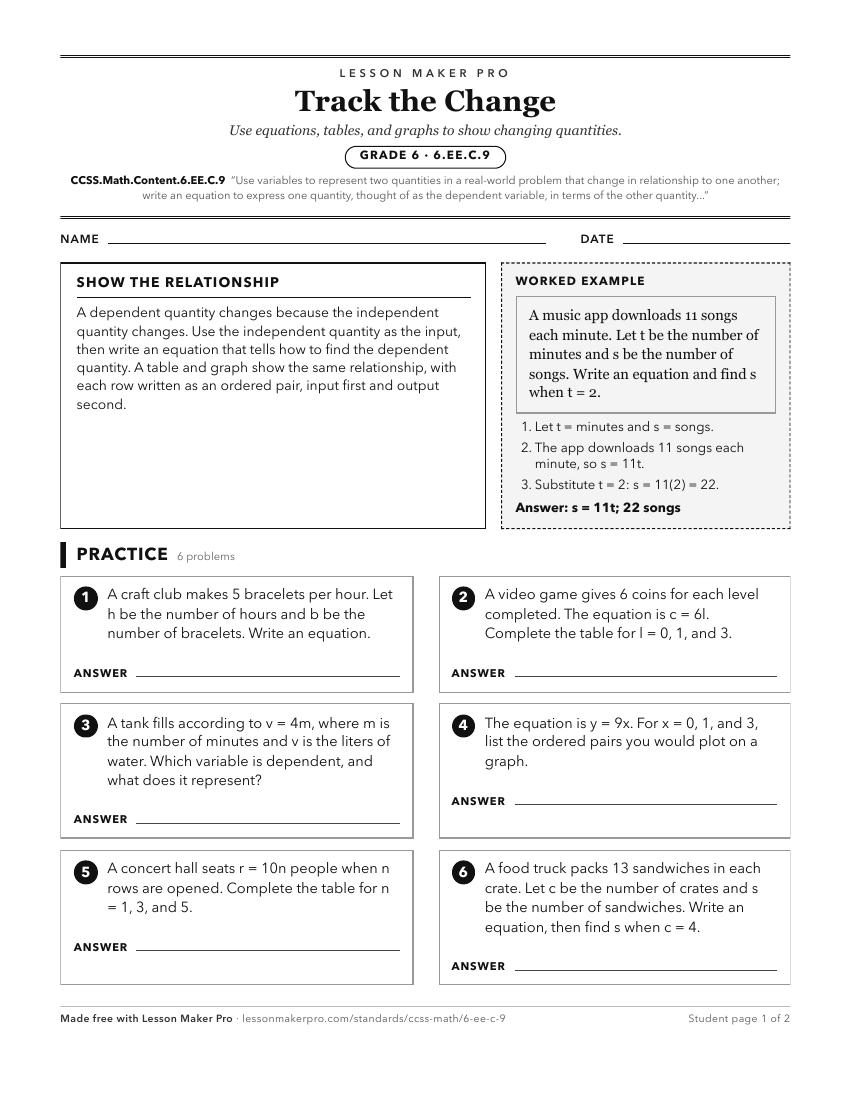
A ready-to-print activity worksheet aligned to CCSS.Math.Content.6.EE.C.9, with an answer key for the teacher on its own page. No account needed.
PDF, US Letter, prints cleanly in black and white.
Download the worksheetLearning progression
Where This Standard Sits
See the whole path on the Expressions & Equations progression map.
Before This Standard
If students are struggling here, check these first.
- CCSS.Math.Content.6.EE.B.6
Using variables for unknowns or varying values supports writing equations for related quantities and interpreting independent and dependent variables.
- CCSS.Math.Content.6.EE.A.2
Students must read, write, and evaluate variable expressions to create equations and connect their values to tables and graphs.
- CCSS.Math.Content.5.OA.B.3
Generating paired patterns and graphing ordered pairs prepares students to connect tables and graphs to equations for related changing quantities.
What This Unlocks
Mastery here sets students up for these next.
- CCSS.Math.Content.8.F.A.1
Using variables, tables, graphs, and dependent versus independent quantities prepares students to see functions as input-output rules.
- CCSS.Math.Content.7.RP.A.2c
Using variables for related quantities and linking tables or graphs to equations supports writing proportional equations like y = kx.
- CCSS.Math.Content.8.EE.C.8c
Writing and interpreting one variable relationship with tables and graphs supports modeling a problem as two linear equations.
Keep exploring
Related Standards
- CCSS.Math.Content.7.EE.B.4
Use variables to represent quantities in a real-world or mathematical problem, and construct simple equations and inequalities to solve problems by reasoning ab...
- CCSS.Math.Content.6.EE.C
Represent and analyze quantitative relationships between dependent and independent variables.
- CCSS.Math.Content.HSA-CED.A.2
Create equations in two or more variables to represent relationships between quantities; graph equations on coordinate axes with labels and scales.
Turn this exact standard into a lesson
Grade, subject, topic, and the complete standard are prefilled. Create one free, no account needed.
Also for this standard:Make a WorksheetMake a QuizMake a Sub Lesson