CCSS.
The Standard
Generate a number or shape pattern that follows a given rule. Identify apparent features of the pattern that were not explicit in the rule itself.
Common Core State Standards for Mathematics · Operations and Algebraic Thinking
Teacher's field guide
What This Standard Means
What Students Need to Do
- Students create number or shape patterns from a starting point and a rule. They spot features not directly stated and explain why those features will keep appearing.
What Mastery Looks Like
- Students correctly generate several terms from a starting value and rule. They identify features such as parity, repeated shapes, or changing gaps, then justify why those features continue.
Common Misconceptions
- Students may apply the rule inconsistently or leave out the starting value. They may confuse a term's position with its value, or notice a feature without explaining why it continues.
How to Assess It
- Give this exit ticket: Start at 2 and add 5 repeatedly. Write six terms, describe the odd-even pattern, and explain why it continues.
Lesson moves
Ways to Teach It
Give pairs tiles and a rule card, such as add two squares each step, then have them build and sketch five stages.
Ask students to explain why starting at 4 and adding 3 creates a repeating odd-even pattern.
Play Pattern Detective by showing five terms and having teams state the rule, predict three terms, and name a hidden feature.
Use a weekly savings plan that increases by $4 each week, then chart totals and describe patterns in the ones digits.
Free download
Printable 4.OA.C.5 Worksheet
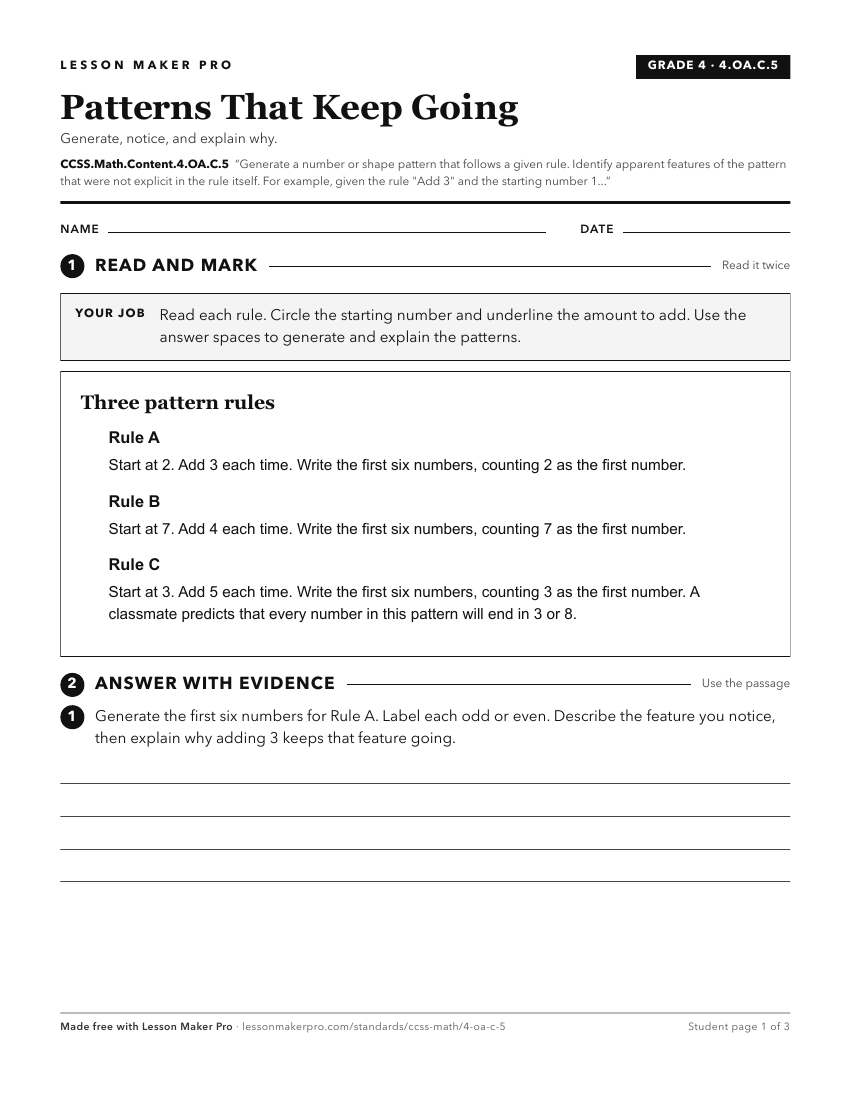
A ready-to-print activity worksheet aligned to CCSS.Math.Content.4.OA.C.5, with an answer key for the teacher on its own page. No account needed.
PDF, US Letter, prints cleanly in black and white.
Download the worksheetLearning progression
Where This Standard Sits
See the whole path on the Operations & Algebraic Thinking progression map.
Before This Standard
If students are struggling here, check these first.
- CCSS.Math.Content.3.OA.D.9
Identifying and explaining arithmetic patterns prepares students to generate rule-based patterns and notice features beyond the stated rule.
- CCSS.Math.Content.2.NBT.A.2
Skip-counting gives practice generating regular number sequences, which supports using rules and noticing features in later patterns.
What This Unlocks
Mastery here sets students up for these next.
Keep exploring
Related Standards
- CCSS.Math.Content.K.G.B.6
Compose simple shapes to form larger shapes.
- CCSS.Math.Content.2.G.A.1
Recognize and draw shapes having specified attributes, such as a given number of angles or a given number of equal faces. Identify triangles, quadrilaterals, pe...
- CCSS.Math.Content.4.OA.C
Generate and analyze patterns.
Turn this exact standard into a lesson
Grade, subject, topic, and the complete standard are prefilled. Create one free, no account needed.
Also for this standard:Make a WorksheetMake a QuizMake a Sub Lesson