CCSS.
The Standard
- CCSS.ELA-Literacy.RF.K.2
- Demonstrate understanding of spoken words, syllables, and sounds (phonemes).
Recognize and produce rhyming words.
Common Core State Standards for English Language Arts
Teacher's field guide
What This Standard Means
What Students Need to Do
- Students listen for words with the same ending sounds. They identify rhyming pairs and say words that rhyme with a word they hear.
What Mastery Looks Like
- Students can hear which two words rhyme in a short list. They can also say a real or made-up word that rhymes with a given word.
Common Misconceptions
- Students may match words by the first sound, such as cat and cup, instead of listening to the ending. They may also confuse words that sound alike with words that name related things.
How to Assess It
- Say, “Tell me a word that rhymes with log.” Then ask the student to choose the rhyming pair from sun and sock, cake and snake, or fish and fan.
Adopted as
This framework is adopted as written in Connecticut, Delaware, District of Columbia, Michigan, Nevada, New Hampshire, Vermont, Wyoming.
- California: RF_K_2a
- Connecticut: CCSS.ELA-Literacy.RF.K.2a
- Delaware: CCKRF2a
- District of Columbia: CCSS.ELA-Literacy.RF.K.2a
- Indiana: K_RF_4
- Kentucky: RF_K_2_a
- Maryland: RF_K_2_a
- Michigan: CCSS.ELA-Literacy.RF.K.2a
- Montana: CCSS.ELA-Literacy.RF.K.2a
- Nevada: CCSS.ELA-Literacy.RF.K.2a
- New Hampshire: CCSS.ELA-Literacy.RF.K.2a
- New Mexico: CCSS.ELA-Literacy.RF.K.2a
- New York: KRF2.a
State teaching guidance: Match word-reading practice to developing phonics and decoding skills. Also provide content-rich, complex texts through supported activities and interactive read-alouds, including texts children cannot yet read independently. Scaffold access to grade-level texts; comprehension experiences need not be limited to independently decodable material. (Grade guidance, p. 19.) Use this component with the complete New York KRF2 requirement and its other components. A matching component does not establish equivalence of the entire national family. (NY component, p. 22.) New York State Next Generation English Language Arts Learning Standards (2017), page 19. Check shared national resources against this guidance before use.
- Oklahoma: K_2_PA_2
- Vermont: CCSS.ELA-Literacy.RF.K.2a
- Washington: CCSS.ELA-Literacy.RF.K.2a
- Wyoming: CCSS.ELA-Literacy.RF.K.2a
Lesson moves
Ways to Teach It
Give students picture cards and have them pair rhyming pictures, such as cat and hat or fox and box.
Read a short rhyming poem, then ask, “Which words rhyme, and what sounds the same at the end?”
Play rhyme toss: say a word, toss a beanbag, and have the catcher say a rhyming word.
Use classroom objects to make rhyme pairs, such as chair and bear, then let students invent silly matching words.
Free download
Printable RF.K.2a Worksheet
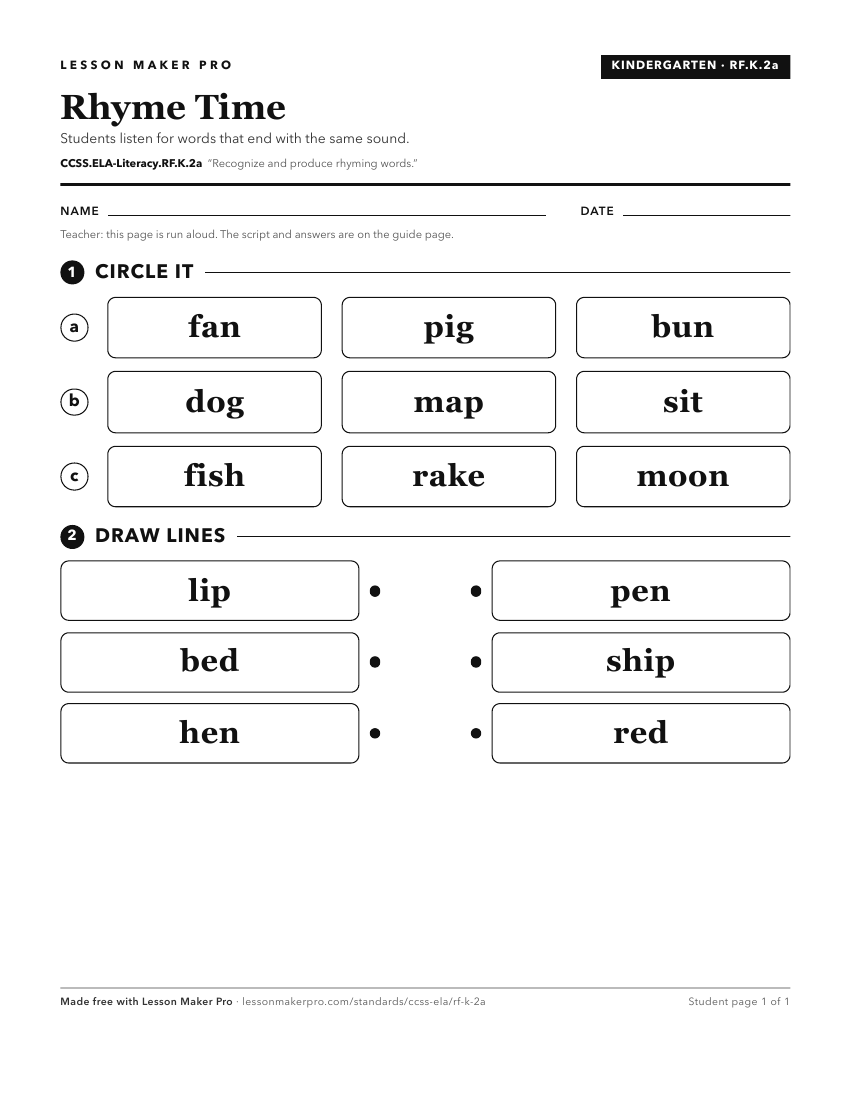
A ready-to-print activity worksheet aligned to CCSS.ELA-Literacy.RF.K.2a, with an answer key for the teacher on its own page. No account needed.
PDF, US Letter, prints cleanly in black and white.
Download the worksheetLearning progression
Where This Standard Sits
What This Unlocks
Mastery here sets students up for these next.
Keep exploring
Related Standards
- CCSS.ELA-Literacy.RF.1.3g
Recognize and read grade-appropriate irregularly spelled words.
- CCSS.ELA-Literacy.RF.2.3f
Recognize and read grade-appropriate irregularly spelled words.
- CCSS.ELA-Literacy.RF.1.2
Demonstrate understanding of spoken words, syllables, and sounds (phonemes).
- CCSS.ELA-Literacy.RF.K.2
Demonstrate understanding of spoken words, syllables, and sounds (phonemes).
Turn this exact standard into a lesson
Grade, subject, topic, and the complete standard are prefilled. Create one free, no account needed.
Also for this standard:Make a WorksheetMake a QuizMake a Sub Lesson