CCSS.
The Standard
Distinguish long from short vowel sounds in spoken single-syllable words.
Common Core State Standards for English Language Arts
Teacher's field guide
What This Standard Means
What Students Need to Do
- Students listen to a one-syllable word and decide whether its vowel sound is long or short. They make the choice from sound alone, without needing to see the word.
What Mastery Looks Like
- Students correctly label the vowel sound in spoken words as long or short. They can compare pairs such as cap and cape or kit and kite without seeing the words.
Common Misconceptions
- Students may think a long vowel is spoken louder or held longer. They may focus on the first sound or use spelling clues instead of listening to the vowel sound.
How to Assess It
- Say cap, cape, kit, kite, hop, and hope without showing print. For each pair, ask students which word has the long vowel sound.
Lesson moves
Ways to Teach It
Give students two sorting mats and counters, then say words aloud for them to sort by long or short vowel sound.
Ask, "How are the vowel sounds in ship and sheep different?" Have partners explain what they hear.
Play Vowel Corners by naming words and having students move to the long vowel or short vowel corner.
Students name classroom objects, such as clock, tape, pen, or cube, then classify each spoken vowel sound.
Free download
Printable RF.1.2a Worksheet
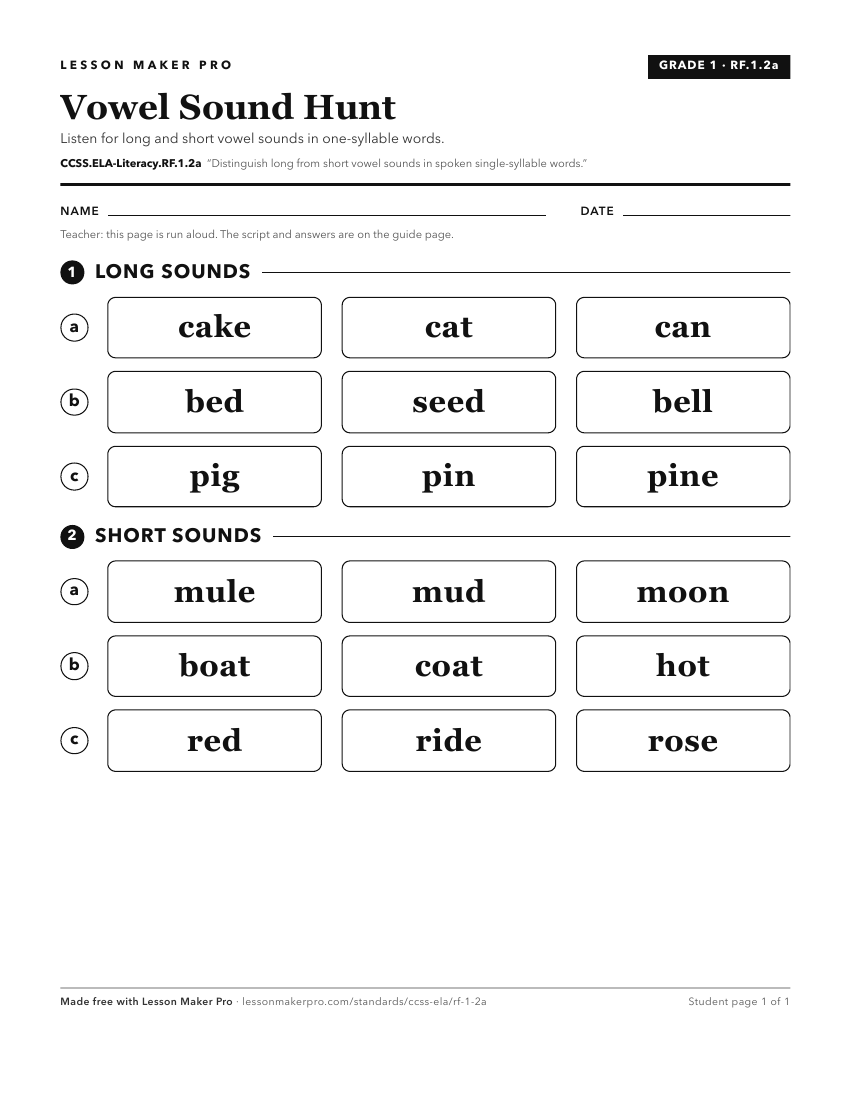
A ready-to-print activity worksheet aligned to CCSS.ELA-Literacy.RF.1.2a, with an answer key for the teacher on its own page. No account needed.
PDF, US Letter, prints cleanly in black and white.
Download the worksheetLearning progression
Where This Standard Sits
Before This Standard
If students are struggling here, check these first.
Keep exploring
Related Standards
- CCSS.ELA-Literacy.RF.1.2c
Isolate and pronounce initial, medial vowel, and final sounds (phonemes) in spoken single-syllable words.
- CCSS.ELA-Literacy.RF.K.3d
Distinguish between similarly spelled words by identifying the sounds of the letters that differ.
- CCSS.ELA-Literacy.RF.K.3b
Associate the long and short sounds with common spellings (graphemes) for the five major vowels.
- CCSS.ELA-Literacy.RF.2.3a
Distinguish long and short vowels when reading regularly spelled one-syllable words.
Turn this exact standard into a lesson
Grade, subject, topic, and the complete standard are prefilled. Create one free, no account needed.
Also for this standard:Make a WorksheetMake a QuizMake a Sub Lesson