CCSS.
The Standard
Associate the long and short sounds with common spellings (graphemes) for the five major vowels.
Common Core State Standards for English Language Arts
Teacher's field guide
What This Standard Means
What Students Need to Do
- Students hear a vowel sound in a spoken word and match it to a, e, i, o, or u. They tell whether the sound is long or short. They also produce both sounds when shown a vowel.
What Mastery Looks Like
- A student can hear the vowel in words such as cat, cake, pig, bike, hop, rope, sun, and cube. The student chooses the correct vowel letter, labels the sound as long or short, and gives another example.
Common Misconceptions
- Students may think each vowel has only one sound. Some use the vowel's name for every word, so they call the a in cat long. Others confuse short e and short i or identify the first sound instead of the middle vowel.
How to Assess It
- Show the letters a, e, i, o, and u. Say cat, cake, bed, he, pig, bike, hop, rope, sun, and cube. After each word, have students point to the vowel and say long or short.
Lesson moves
Ways to Teach It
Students sort picture cards onto vowel mats, then place each card under a long or short heading.
Ask, "How does the vowel sound change in cap and cape?" Students explain orally, then draw and label both words.
Play vowel bingo by saying a word while students cover its vowel and call out long or short.
Students find vowels on classroom labels, read each word with a partner, and decide whether the vowel sound is long or short.
Free download
Printable RF.K.3b Worksheet
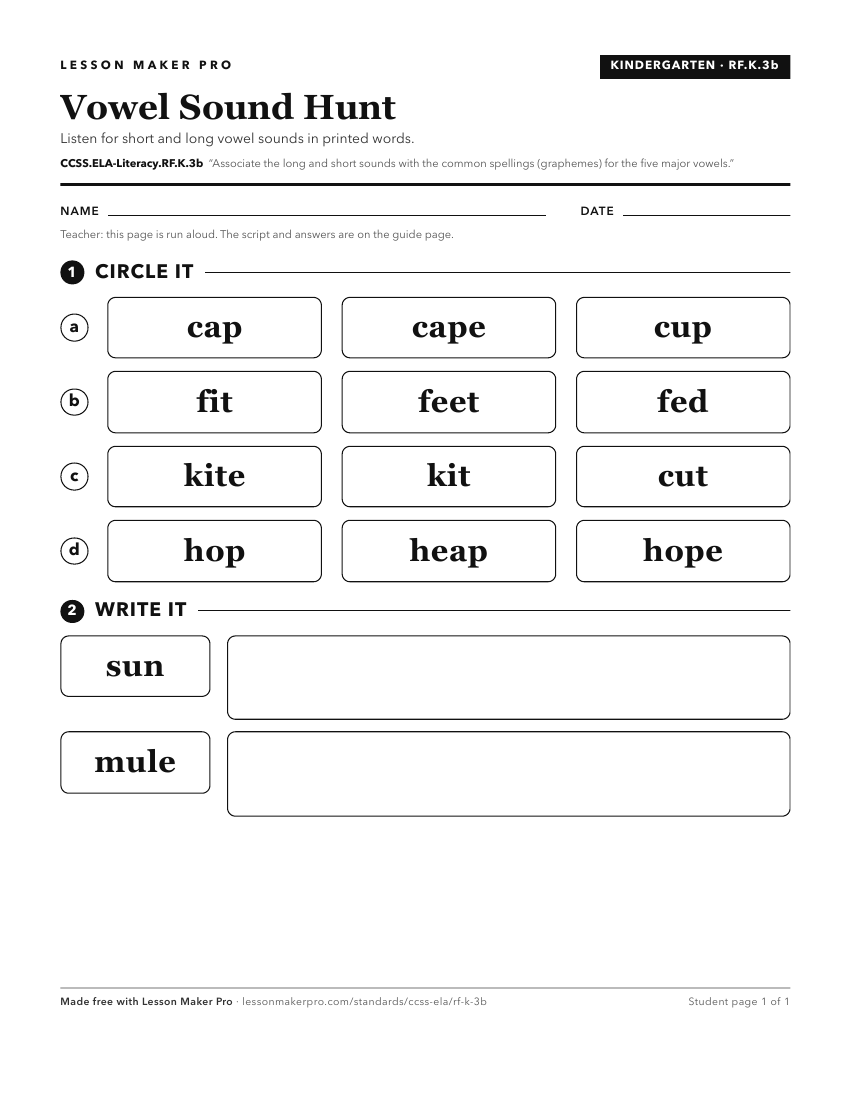
A ready-to-print activity worksheet aligned to CCSS.ELA-Literacy.RF.K.3b, with an answer key for the teacher on its own page. No account needed.
PDF, US Letter, prints cleanly in black and white.
Download the worksheetLearning progression
Where This Standard Sits
What This Unlocks
Mastery here sets students up for these next.
Keep exploring
Related Standards
- CCSS.ELA-Literacy.RF.K.3a
Demonstrate basic knowledge of one-to-one letter-sound correspondences by producing the primary or many of the most frequent sound for each consonant.
- CCSS.ELA-Literacy.RF.1.3c
Know final -e and common vowel team conventions for representing long vowel sounds.
- CCSS.ELA-Literacy.RF.1.3a
Know the spelling-sound correspondences for common consonant digraphs.
- CCSS.ELA-Literacy.RF.2.3b
Know spelling-sound correspondences for additional common vowel teams.
Turn this exact standard into a lesson
Grade, subject, topic, and the complete standard are prefilled. Create one free, no account needed.
Also for this standard:Make a WorksheetMake a QuizMake a Sub Lesson