CCSS.
The Standard
Demonstrate basic knowledge of one-to-one letter-sound correspondences by producing the primary or many of the most frequent sound for each consonant.
Common Core State Standards for English Language Arts
Teacher's field guide
What This Standard Means
What Students Need to Do
- Students look at a consonant letter and say its usual sound. They connect uppercase and lowercase consonants with words or pictures that begin with that sound.
What Mastery Looks Like
- Given consonant letters in random order, students say the usual sound quickly and accurately. They can give a word or choose a picture that begins with that sound.
Common Misconceptions
- Students may say the letter name instead of its sound, such as “bee” for b. They may add “uh” to sounds or confuse letters such as b and d, p and q, or c and k.
How to Assess It
- Show 10 mixed uppercase and lowercase consonant cards. Ask, “What sound does this letter usually make?” and record accurate responses without picture cues.
Lesson moves
Ways to Teach It
Have students match magnetic consonant letters to picture cards, then say each letter sound and picture name aloud.
Show one consonant and ask, “What sound does it make, and what word begins with that sound?”
Play consonant sound bingo by calling sounds while students cover the matching letters on their boards.
Hunt for consonants on classroom labels, food packages, and signs, then name each letter and say its usual sound.
Free download
Printable RF.K.3a Worksheet
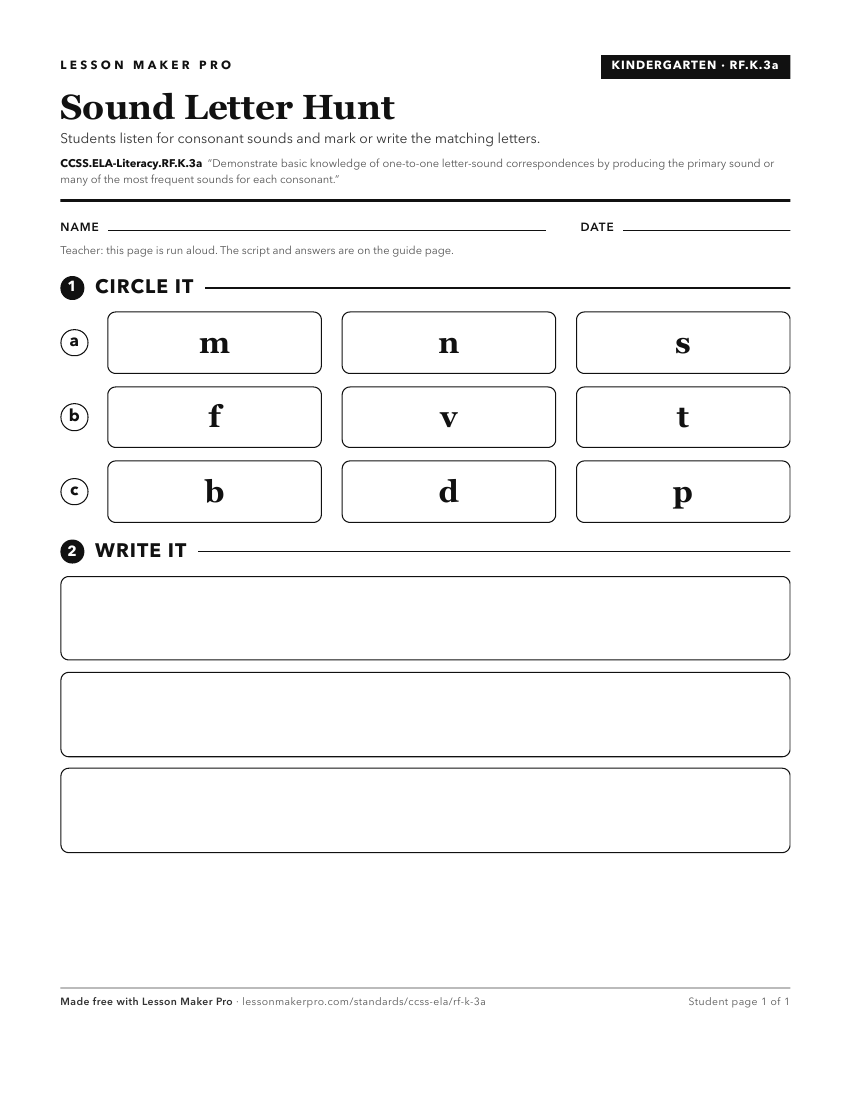
A ready-to-print activity worksheet aligned to CCSS.ELA-Literacy.RF.K.3a, with an answer key for the teacher on its own page. No account needed.
PDF, US Letter, prints cleanly in black and white.
Download the worksheetLearning progression
Where This Standard Sits
What This Unlocks
Mastery here sets students up for these next.
Keep exploring
Related Standards
- CCSS.ELA-Literacy.L.K.2c
Write a letter or letters for most consonant and short-vowel sounds (phonemes).
- CCSS.ELA-Literacy.RF.1.2
Demonstrate understanding of spoken words, syllables, and sounds (phonemes).
- CCSS.ELA-Literacy.RF.K.2
Demonstrate understanding of spoken words, syllables, and sounds (phonemes).
Turn this exact standard into a lesson
Grade, subject, topic, and the complete standard are prefilled. Create one free, no account needed.
Also for this standard:Make a WorksheetMake a QuizMake a Sub Lesson