CCSS.
The Standard
- CCSS.ELA-Literacy.RF.5.4
- Read with sufficient accuracy and fluency to support comprehension.
Use context to confirm or self-correct word recognition and understanding, rereading as necessary.
Common Core State Standards for English Language Arts
Teacher's field guide
What This Standard Means
What Students Need to Do
- Students notice when a word they read does not fit the sentence or passage. They use nearby clues to choose the correct word, then reread to check meaning and flow.
What Mastery Looks Like
- A student reads a grade-level passage aloud and notices when an error disrupts meaning. The student corrects the word, rereads smoothly, and explains which context clue confirmed the correction.
Common Misconceptions
- Students may accept a similar-looking word even when it makes no sense in the sentence. They may guess from the first letter or continue reading without fixing a confusing word.
How to Assess It
- Ask the student to read aloud, “The family deserted the beach when lightning flashed.” If a word sounds wrong, have the student fix it, reread, and name the clue that helped.
Adopted as
This framework is adopted as written in Connecticut, Delaware, District of Columbia, Michigan, Nevada, New Hampshire, Vermont, Wyoming.
- California: RF_5_4c
- Connecticut: CCSS.ELA-Literacy.RF.5.4c
- Delaware: CC5RF4c
- District of Columbia: CCSS.ELA-Literacy.RF.5.4c
- Kentucky: RF_5_4_c
- Michigan: CCSS.ELA-Literacy.RF.5.4c
- Montana: CCSS.ELA-Literacy.RF.5.4c
- Nevada: CCSS.ELA-Literacy.RF.5.4c
- New Hampshire: CCSS.ELA-Literacy.RF.5.4c
- New Mexico: CCSS.ELA-Literacy.RF.5.4c
- New York: 5RF4.b
State teaching guidance: By the end of grade 5, students should read and comprehend literary and informational texts at or above grade level. Distinguish independent-comprehension practice from teacher-led texts that build language and knowledge, and provide scaffolding for access to complex texts. (Grade guidance, p. 64.) Use this component with the complete New York 5RF4 requirement and its other components. A matching component does not establish equivalence of the entire national family. (NY component, p. 66.) New York State Next Generation English Language Arts Learning Standards (2017), page 64. Check shared national resources against this guidance before use.
- Vermont: CCSS.ELA-Literacy.RF.5.4c
- Washington: CCSS.ELA-Literacy.RF.5.4c
- Wyoming: CCSS.ELA-Literacy.RF.5.4c
Lesson moves
Ways to Teach It
Students read a short passage in pairs, placing a counter beside each word they correct before rereading the sentence aloud.
Ask, “Which words showed that your first reading did not make sense?” Students name the clue and explain their correction.
Play Misread Detective: one partner reads a sentence with a planned substitution, while the other stops, corrects, and rereads it.
Use a lunch menu or school announcement for oral reading, asking students to stop and correct any word that conflicts with nearby details.
Free download
Printable RF.5.4c Worksheet
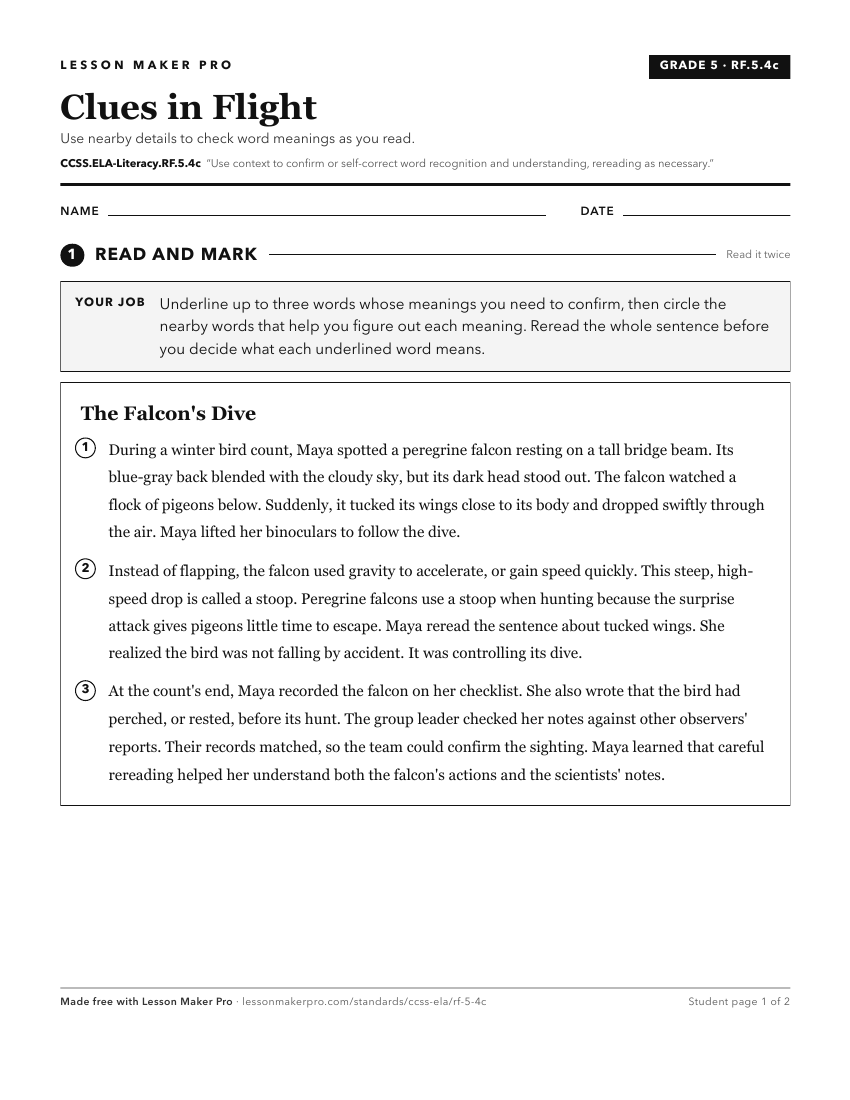
A ready-to-print activity worksheet aligned to CCSS.ELA-Literacy.RF.5.4c, with an answer key for the teacher on its own page. No account needed.
PDF, US Letter, prints cleanly in black and white.
Download the worksheetLearning progression
Where This Standard Sits
Before This Standard
If students are struggling here, check these first.
Keep exploring
Related Standards
Turn this exact standard into a lesson
Grade, subject, topic, and the complete standard are prefilled. Create one free, no account needed.
Also for this standard:Make a WorksheetMake a QuizMake a Sub Lesson