CCSS.
The Standard
Recognize variations from standard English in their own and others' writing and speaking, and identify and use strategies to improve expression in conventional language.
Common Core State Standards for English Language Arts
Teacher's field guide
What This Standard Means
What Students Need to Do
- Students notice words, phrases, and sentence patterns that do not fit a formal school context. They revise them by rereading aloud, checking references, or using peer feedback while preserving the speaker’s meaning.
What Mastery Looks Like
- Given a paragraph, students can mark language that does not fit the audience and explain why. They can revise it for a formal context while keeping the original meaning and voice.
Common Misconceptions
- Students may treat dialects and informal speech as careless or incorrect in every setting. They may revise only spelling and punctuation, missing agreement, pronoun case, or unclear wording. They may also erase a writer’s voice instead of adjusting language for the audience.
How to Assess It
- Exit ticket: Rewrite “Luis and me was gonna explain the results” for a formal lab report. Circle each change and name one revision strategy you used.
Lesson moves
Ways to Teach It
Give pairs sentence strips from texts, chats, and school reports; have them sort by context, then revise two for a formal audience.
Ask, “When should a writer keep a dialect or informal phrase, and when should they revise it?” Students defend one example.
Play Revision Relay: teams correct one marked sentence, name the strategy used, and pass the paper to the next student.
Compare a job application email with a text to a friend, then rewrite one message for the other audience.
Free download
Printable L.6.1e Worksheet
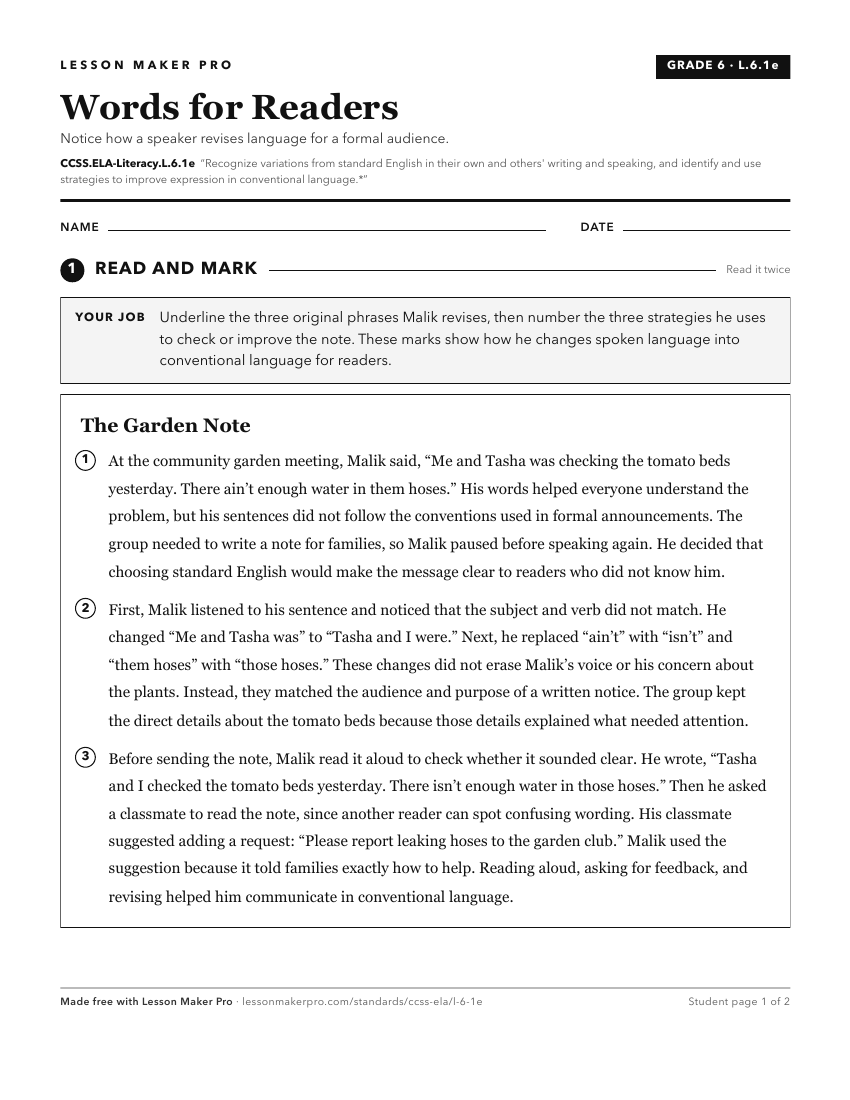
A ready-to-print activity worksheet aligned to CCSS.ELA-Literacy.L.6.1e, with an answer key for the teacher on its own page. No account needed.
PDF, US Letter, prints cleanly in black and white.
Download the worksheetLearning progression
Where This Standard Sits
Before This Standard
If students are struggling here, check these first.
Keep exploring
Related Standards
- CCSS.ELA-Literacy.L.4.3
Use knowledge of language and its conventions when writing, speaking, reading, or listening.
- CCSS.ELA-Literacy.L.7.3
Use knowledge of language and its conventions when writing, speaking, reading, or listening.
- CCSS.ELA-Literacy.L.3.3b
Recognize and observe differences between the conventions of spoken and written standard English.
- CCSS.ELA-Literacy.L.6.3
Use knowledge of language and its conventions when writing, speaking, reading, or listening.
Turn this exact standard into a lesson
Grade, subject, topic, and the complete standard are prefilled. Create one free, no account needed.
Also for this standard:Make a WorksheetMake a QuizMake a Sub Lesson