CCSS.
The Standard
- CCSS.ELA-Literacy.L.3.5
- Demonstrate understanding of figurative language, word relationships and nuances in word meanings.
Distinguish shades of meaning among related words that describe states of mind or degrees of certainty (e.g., knew, believed, suspected, heard, wondered).
Common Core State Standards for English Language Arts
Teacher's field guide
What This Standard Means
What Students Need to Do
- Students compare related words that show what someone thinks, knows, or feels sure about. They choose the word that best fits the person’s level of certainty.
What Mastery Looks Like
- Students choose a word that matches a character’s exact level of knowledge or certainty. They can compare two related words and explain how their meanings differ in context.
Common Misconceptions
- Students may treat related words as exact synonyms or rank them only by how strong they sound. They may also confuse having information, as in heard, with being certain it is true.
How to Assess It
- Give students the words knew, believed, suspected, heard, and wondered. Ask them to complete one sentence with each word, then explain which character is most certain.
Adopted as
This framework is adopted as written in Connecticut, Delaware, District of Columbia, Michigan, Nevada, New Hampshire, Vermont, Wyoming.
- California: L_3_5c
- Connecticut: CCSS.ELA-Literacy.L.3.5c
- Delaware: CC3L5c
- District of Columbia: CCSS.ELA-Literacy.L.3.5c
- Maryland: L_3_5_c
- Michigan: CCSS.ELA-Literacy.L.3.5c
- Montana: CCSS.ELA-Literacy.L.3.5c
- Nevada: CCSS.ELA-Literacy.L.3.5c
- New Hampshire: CCSS.ELA-Literacy.L.3.5c
- New Mexico: CCSS.ELA-Literacy.L.3.5c
- New York: 3L5.c
State teaching guidance: Use this component with the complete New York 3L5 requirement and its other components. A matching component does not establish equivalence of the entire national family. (NY component, p. 53.) New York State Next Generation English Language Arts Learning Standards (2017), page 53. Check shared national resources against this guidance before use.
- South Dakota: 3_L_5_c
- Vermont: CCSS.ELA-Literacy.L.3.5c
- Washington: CCSS.ELA-Literacy.L.3.5c
- Wyoming: CCSS.ELA-Literacy.L.3.5c
Lesson moves
Ways to Teach It
Give pairs word cards such as knew, believed, suspected, heard, and wondered to arrange on a certainty line, then defend each placement.
Ask students to write what a detective knew, believed, suspected, heard, and wondered after finding one muddy footprint.
Play Certainty Charades, where students act out a word and classmates identify it and explain the level of certainty.
Read three weather statements from a forecast and label each as knew, believed, suspected, heard, or wondered, using clues from the wording.
Free download
Printable L.3.5c Worksheet
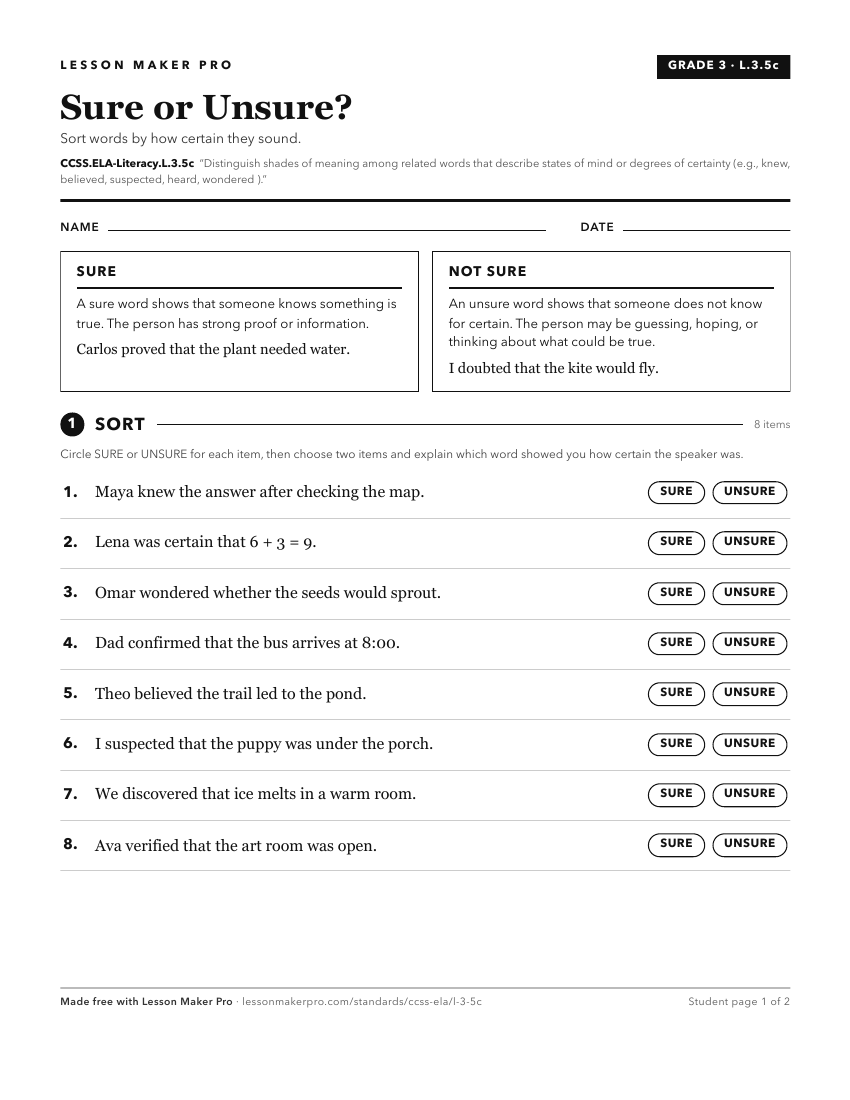
A ready-to-print activity worksheet aligned to CCSS.ELA-Literacy.L.3.5c, with an answer key for the teacher on its own page. No account needed.
PDF, US Letter, prints cleanly in black and white.
Download the worksheetLearning progression
Where This Standard Sits
What This Unlocks
Mastery here sets students up for these next.
Keep exploring
Related Standards
- CCSS.ELA-Literacy.L.1.5d
Distinguish shades of meaning among verbs differing in manner (e.g., look, peek, glance, stare, glare, scowl) and adjectives differing in intensity (e.g., large...
- CCSS.ELA-Literacy.L.11-12.4b
Identify and correctly use patterns of word changes that indicate different meanings or parts of speech (e.g., conceive, conception, conceivable).
- CCSS.ELA-Literacy.L.11-12.5b
Analyze nuances in the meaning of words with similar denotations.
- CCSS.ELA-Literacy.L.9-10.5b
Analyze nuances in the meaning of words with similar denotations.
Turn this exact standard into a lesson
Grade, subject, topic, and the complete standard are prefilled. Create one free, no account needed.
Also for this standard:Make a WorksheetMake a QuizMake a Sub Lesson